Ladies and gentlemen, I’d like to present Echoes and Imaginings, issue one.
Quite pleased with the title, actually. My aim is to produce at least four issues, although whether I do or not depends largely on how quickly I can put each issue together. I want them to roughly reflect the seasons of the year, without being too dogmatic about it. There is a slant towards folklore, psychogeography and a bit of speculation, as well as photography and poetry. Future issues may well have some of my artwork included.
I’m already writing articles for issue 2…
In this issue you can find Hoodening, Wassailing, a meditation on time, photographs, poetry, and more. There are lots of trees. Some of the articles have appeared here as posts, although there is some re-writing, but most of the poetry and the pictures are new. It is available through my Etsy shop, or just message me directly (I use PayPal).
Personally, I reckon it’s a thing of beauty.
And as well as these four issues, I have ideas for some others, which I expect to bring out at random times.
At the moment, I feel this is the way for me to go. I don’t see myself finishing a novel any time soon, although I do have an almost finished one sitting there. I don’t currently feel inclined to get it published, though. And equally, I don’t feel inclined to go through all the hassle of submitting poems or short stories to different publications or into competitions.
And on another note, you have probably seen on other blogs the ongoing issues of pirated e-books (especially on Amazon, I hear). I think we have AI to thank for a lot of this, and it seems so many authors are having their books ripped or plagiarised it’s becoming ridiculous. For that reason, I have simply decided my books will no longer be available as e-books, and have deleted them.
In February 1600 Will Kemp Morris-danced his way from London to Norwich, a distance of approximately a hundred miles.
Kemp (or Kempe), born around 1560 and died, probably of the plague. in 1603, was an actor, dancer and all-round clown. A member of Shakespeare’s company, Chamberlain’s Men, he regularly played the role of the clown in Shakespeare’s plays. He undertook his famous dance after some sort of disagreement within Shakespeare’s company as a result of which Kemp took his shares and left. Although we don’t know what form this disagreement took, it is widely assumed Kemp was very much a scene-stealer who was apt to improvise during a performance – possibly Shakespeare was alluding to Kemp when he has Hamlet declare ‘let those that play your clowns speak no more than is set down for them’. Kemp also had a tendency to dance jigs at the end of a performance that critics declared ruined the mood of a tragic performance.
Afterwards he described his dance as a ‘nine daies wonder’ in a booklet he published, although it actually took him twenty eight days to accomplish as he rested up for a while between each day dancing,
By the time he had joined Chamberlain’s Men, he was already famous for his acting and dancing. He had toured the Low Countries (now referred to as Benelux) and Denmark 1585-86 as a performer with the Earl of Leicester’s Men, performed frequently as a solo dancer and actor – usually performing clownish parts – and his improvised jigs were renowned for being frequently both ridiculous and lewd, which might go some way to explaining the rift with Shakespeare’s company, who by then were attempting to attract a more refined audience.
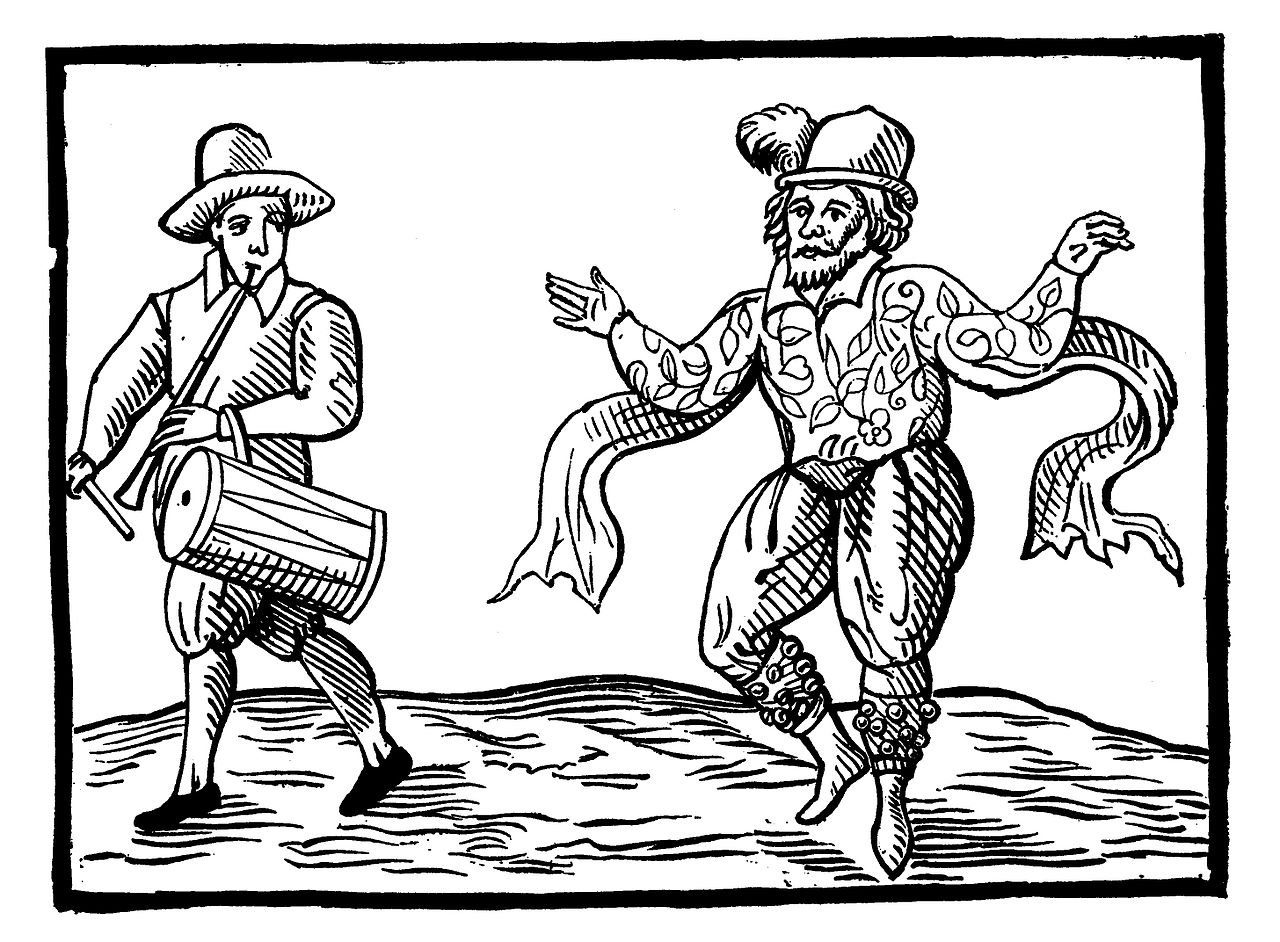
The dance from London to Norwich was performed as a publicity stunt and also as a way for Kemp to raise money by betting on himself to complete the journey. He was accompanied by a Thomas Slye, who played both the tabor (a small drum) and a fife to accompany the dance steps, and George Spratt who acted as overseer to the spectacle. Kemp wore a feathered cap, a slashed doublet with streamers attached to the shoulders, slashed breeches, and with clusters of jingle bells around his ankles and calves. A large crowd assembled to watch him set off from London at seven in the morning on February 10th 1600, and he continued to attract great crowds the length of his journey, which he completed on March 9th. He wrote the booklet later, as a riposte to those who doubted he had completed the journey.
This isn’t the origin of the phrase nine days wonder, incidentally, that goes back to at least the early thirteen hundreds.
The tune Kemp’s Jig appears in John Playford’s The English Dancing Master of 1651 and is attributed to John Dowland, but it is known that Kemp himself composed some jigs – four examples survive today. Whether Dowland (if it were he) wrote the jig to honour this journey, however, or whether it was a more generic tribute, we don’t know.
The journey, though, was quite an achievement.
I know this is all a bit niche, but having bought myself a sweatshirt featuring the image, I decided to learn a bit more about Mr Kemp and this is the result of that. I already knew about his dancing from London to Norwich, but I knew little about him beyond that.
The May Day festival, Beltane, is a survival, or revival, from the Iron Age, celebrated in Celtic communities – Scotland and Ireland particularly – and revived as a full festival in Scotland in the 1980’s by the Beltane Fire Society. Beltane was a fire festival, although nothing of that remains in the festivities carried out in England. Beltane was first mentioned by name in Irish writings from the late 800’s / early 900’s.
The English version of this festival involves cutting flowers and greenery and dancing around a maypole, which things are also carried out during Beltane, celebrating the beginning of Summer which begins on May 1st. When I was a child, dancing around the maypole was the chief, possibly only, activity carried out on May Day. I have a photograph of my brother, my cousin, and myself, dressed up for the May Day Fair at which there was maypole dancing, but no obvious indication of surplus greenery. Past generations in England celebrated May Day with a day of celebrations which while including maypole dancing as an important manifestation of encouraging the fertility of the soil (and the festival-goers!) would also have included plenty of food and drink and general gaiety.
Mayhem, if you like.
This year, I managed two May Day days out.
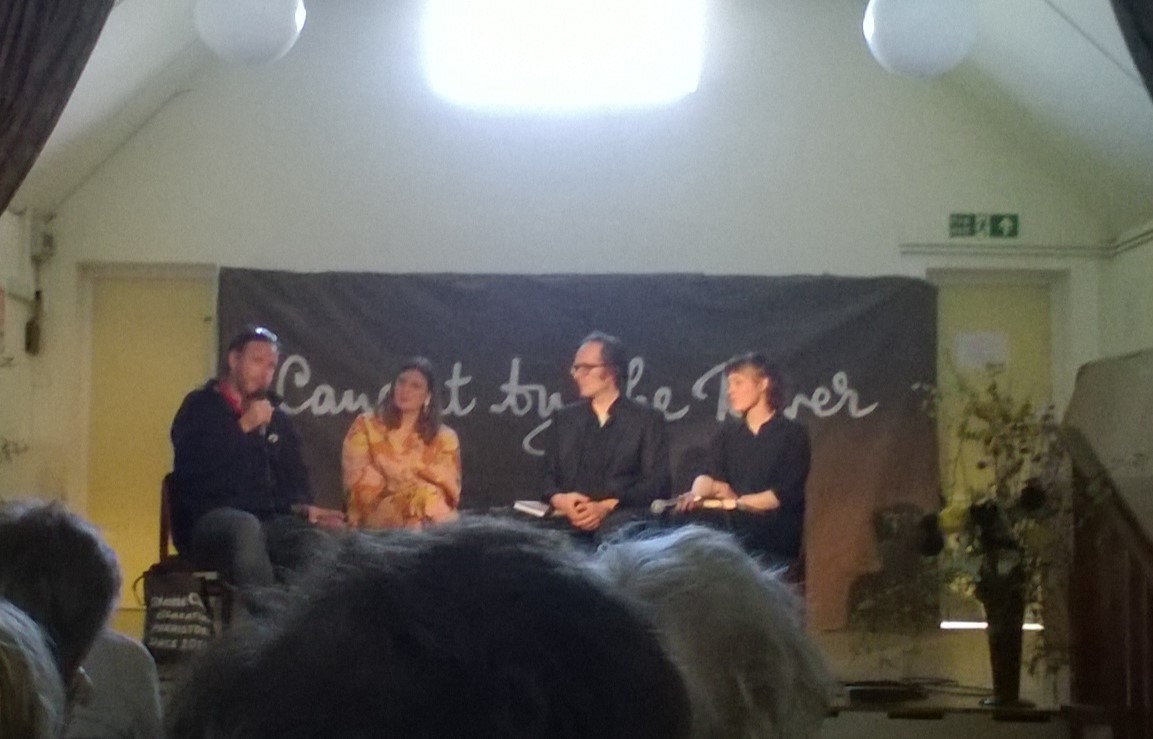
On Saturday, two days before May Day, I visited Kingston near Lewes, in Sussex, for the Caught by the River Mayday event. Caught by the River describe themselves as an arts/nature/culture clash and you can read all about them here. I have followed them now for several years, and this seems as good a time as any to mention that their coverage of arts, nature, and culture are second to none and if you’re not yet following them, well, you should be.
There was mask-making to begin with, especially to involve the children, the makers encouraged to incorporate flowers and greenery into their masks, and almost inevitably a certain amount of folk-horror found its way into some of these.
Nice, Richard.
This was followed by a promenade around the maypole, after which the activity moved indoors.
There were films, talks, and discussions, subjects including rivers, village life in the early eighteenth century, art, standing stones and the like, and the environment. After which, in the late afternoon, we all promenaded up the hillside to the Gurdy Stone.
This is the Gurdy Stone, a modern standing stone on a hillside overlooking Kingston. Here, Local Psycho (Jem Finer and Jimmy Cauty), held a gathering to encode the music of their Hurdy Gurdy song into the stone “To mark the 50,000 year return of the Green Comet and release of The Hurdy-Gurdy song on Heavenly Recordings.”
Throughout the day, naturally, we all had access to the pub.
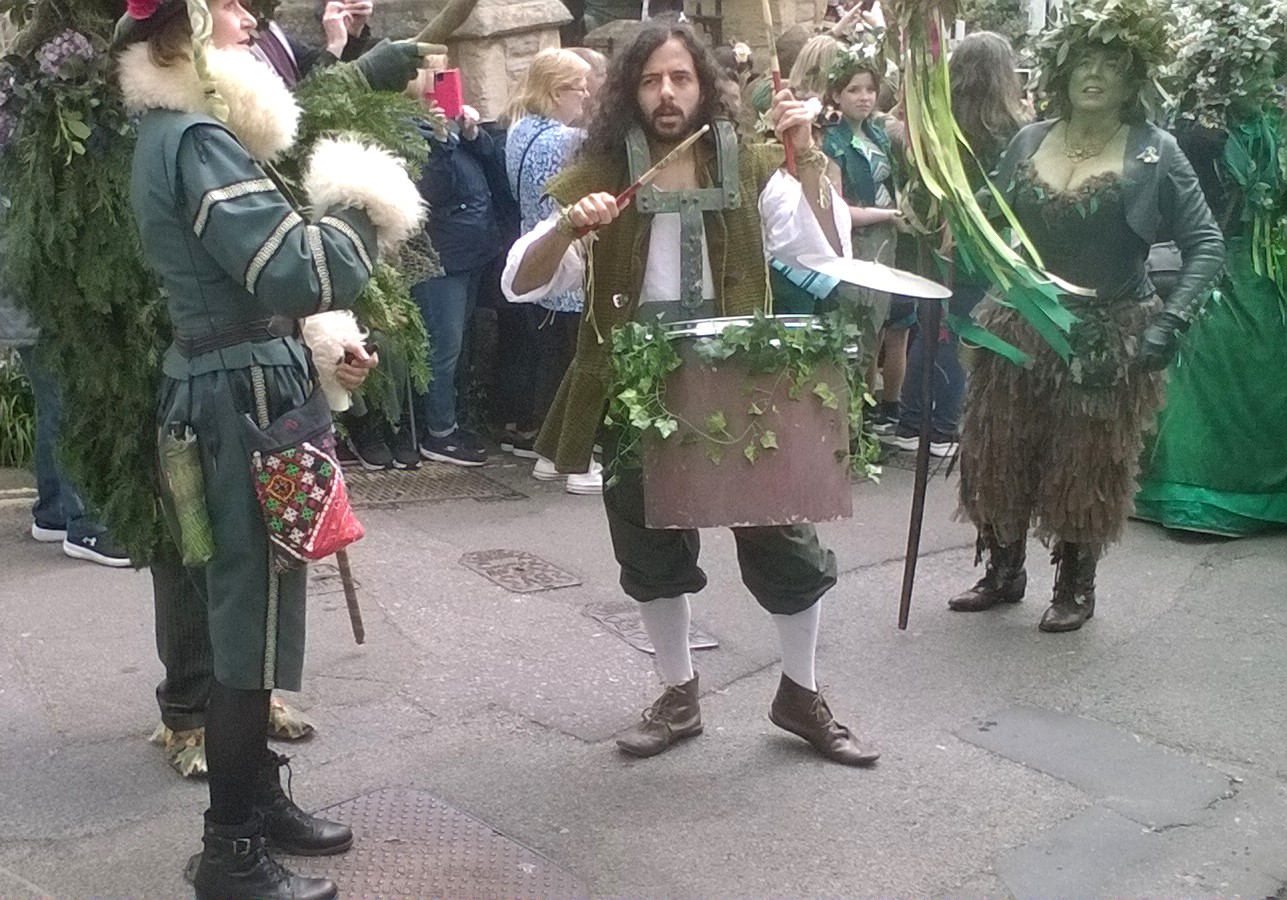
And then on Monday, which was May Day, we went down to Hastings. It rather felt as though everyone in South East England must be in the town, either at the Jack in the Green festivities or watching blokes on motorbikes roaring up and down the seafront for no discernible reason. I don’t much like crowds, and some of this was very difficult. But away from the huge horsepower and testosterone nonsense, amongst the Jack in the Green celebrations the atmosphere was brilliant and the large numbers of people perfectly acceptable. Jack in the Green is a manifestation of the spirit of spring, related to the Green Man, a dancing figure covered in greenery.
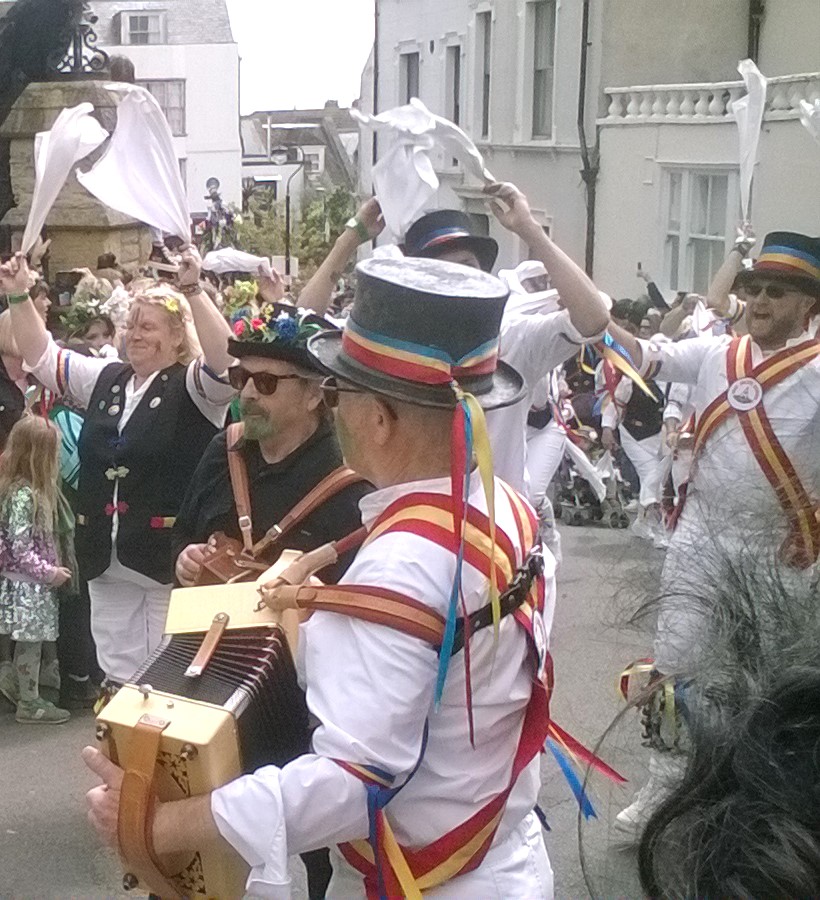
The festival in Hastings has grown over the years into a large event involving musicians, dancers, Morris sides, huge figures in addition to Jack in the Green such as the Queen of the May, a witch, and others, plus any number of people joining in the procession around the town, all decorated with as much, or as little, greenery and/or flowers as they feel suitable.
There you go, a Morris side.
Followed by a large witch with a cat. Why the witch? I’ve no idea. Why not? I suppose.
And there you have it. Music. Drumming. Greenery. Crowd involvement. Summer is icumen in and winter’s gone away-o.
In the town I used to live in, there was once a pub called the Hooden Horse, sadly now renamed to something much less interesting. I was reminded of this at an exhibition at Maidstone museum on Hooden Horses. Hooden Horses? Well, briefly…
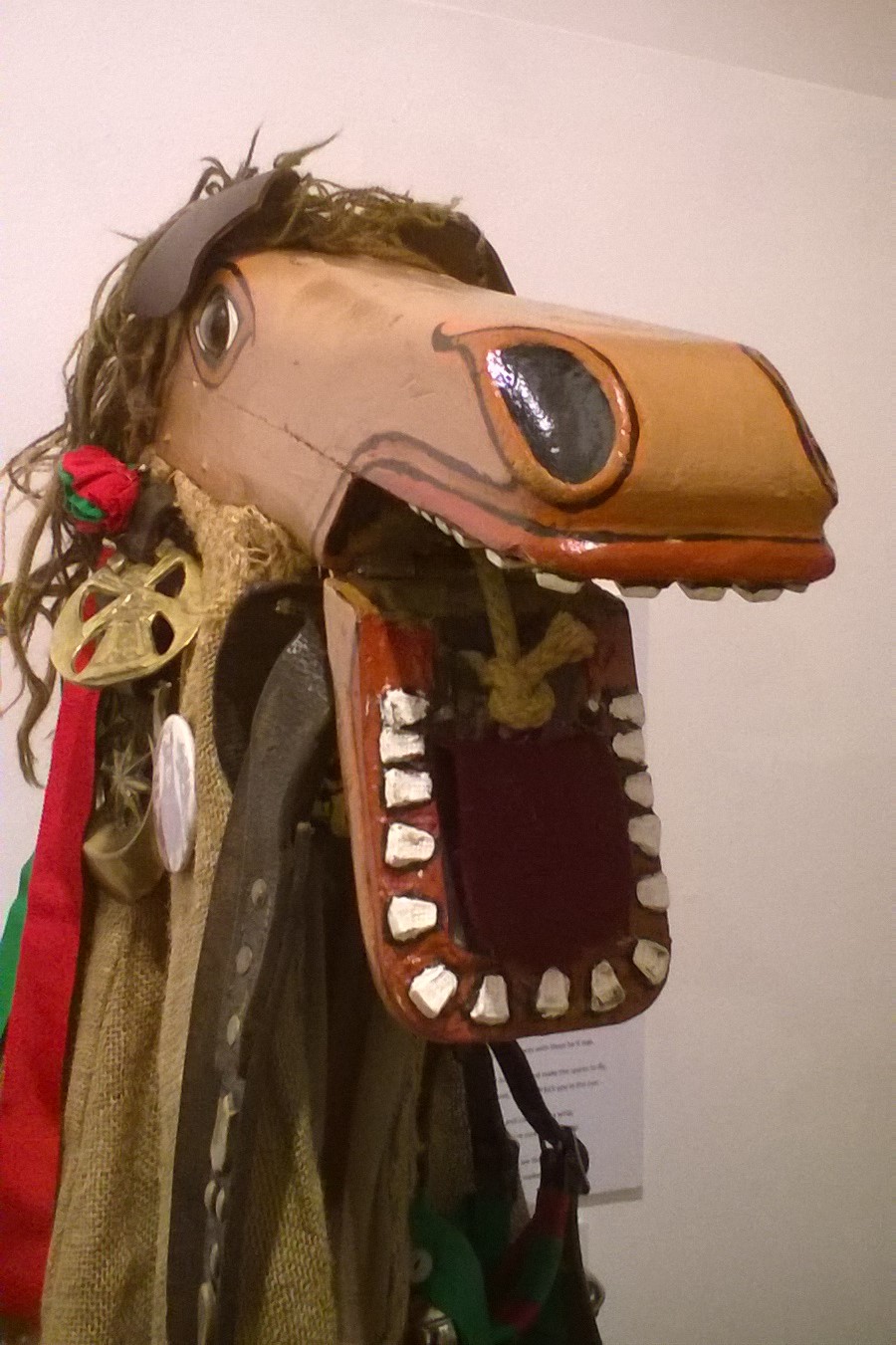
Hoodening is a rural folk tradition unique to East Kent, England. Going back a few hundred years, in the week or so running up to Christmas, groups of farm labourers would dress up as various characters and go from door to door requesting money, cake and beer. One of the characters would be the Hooden Horse, which was an artificial horse’s head made of wood, with a jaw operated by string, on a wooden pole, held by one of the performers with his body covered in cloth – usually sacking. A sort of play was then performed in rhyme, a mixture of plot and satire, usually featuring a few local characters who would be well known to the watchers and might be the butt of jokes and scorn, as well as stock characters such as Molly, a waggoner, and the Mayor. And of course the horse (him)self, invariably called Dobbin. There would also be music performed on whatever might be available – accordions, fiddles, drums or whistles.
The relationship to Morris dancing and Mummers is hard to avoid and, like these traditions, has been revived in modern times by enthusiastic traditionalists.
A photo from the early twentieth century
A modern Hooden Horse
Another early twentieth century photo.
There are many other traditions in Britain involving what is known as ‘animal guising’, where men or women take the guise of an animal, the Padstow ‘obby ‘oss being perhaps the best known of these. The performance on May Day in Padstow, Cornwall, invariably draws large crowds.
On the left, a Hooden horse, and on the right a Mari Lwyd, the ‘skull horse’ of Welsh tradition. Although unconnected (as far as I know) the Welsh had a similar tradition, also taking place around Christmas and New Year. Skull horses are to be found in other parts of England, however, including Yorkshire.
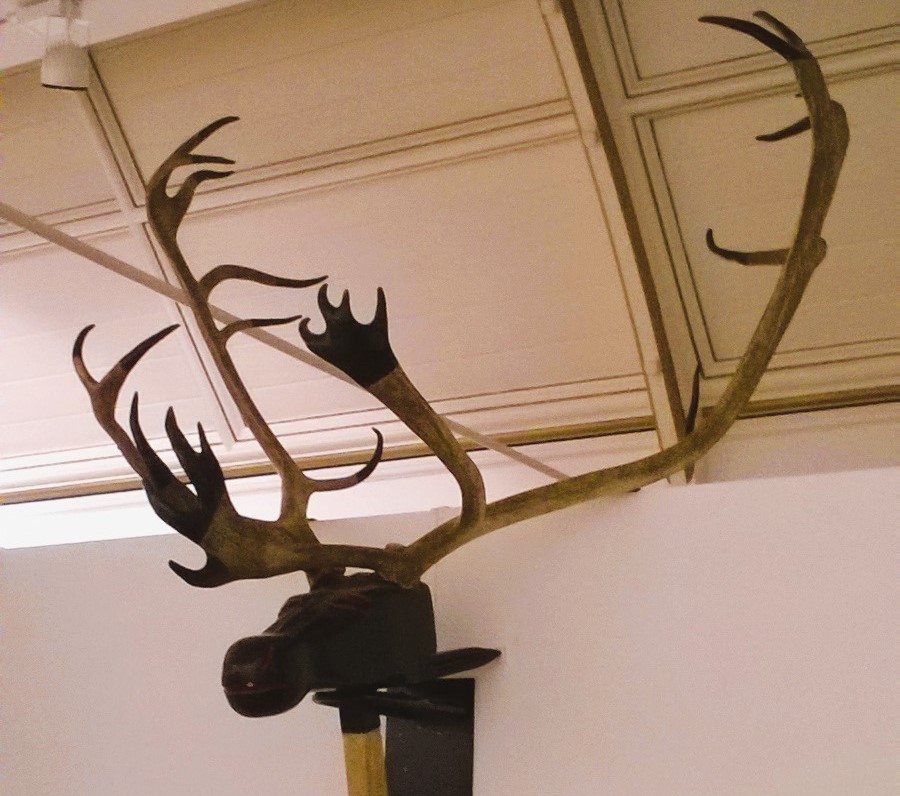
Stag guising is another old tradition – possibly older than horse guising. It was certainly in existence during medieval times and survives today in the form of the Abbots Bromley Horn dancers, Staffordshire, who perform carrying reindeer antlers on poles on the Monday following ‘Wakes Sunday’ in September. Wakes Week became a tradition in industrial Northern England when factories and mills closed down for a week for maintenance giving the workers a holiday. This began in the early nineteenth century, but before this the ritual presumably took place at a different time of year.
The exhibition is on until 17th July 2023 and there is a link to their site here.
In this book Matthew Green charts the decline and eventual abandonment of eight British settlements; a diverse selection ranging from the Stone Age settlement of Skara Brae in the Orkneys, through several Medieval villages and cities and up to the twentieth century, to an area emptied of its inhabitants during the Second World War and a village that was abandoned when the valley it inhabited was flooded to create a reservoir – although in that case ‘abandoned’ is the wrong word, since that particular story is a harrowing tale of folk driven from their homes at the diktat of decision makers far away, not even of their own country.
In each chapter he tells the story of the decline of the settlement drawing upon written records for all but the oldest, Skara Brae, for which he relies upon archaeological evidence, and some of the more recent, for which he uses a mixture of eye-witness accounts and the testimonies of those who had heard their stories at first hand. Of all the stories here, that of Dunwich is probably the most famous, with its myths of bells from long-drowned churches being heard far out under the waves, although the popular description of Dunwich as a ‘drowned city’ is inaccurate, as it fell away into the sea as the cliffs beneath it were eroded away. But much is known of Dunwich, with many extant records and maps of the city, enabling Matthew to chart its decline and eventual end in some detail.
Hirta is the biggest island of the St Kilda archipelago and was occupied for at least two thousand years until 1930, when the final thirty six islanders voted to leave. By then, most of the families and younger residents had left for the mainland, and their traditional way of life had become unsustainable. Until a couple of hundred years ago the islanders were virtually cut off from the rest of Scotland, due to the distance and the difficulty of making a landing at the island. Existing almost exclusively on a diet of seabirds (remarkably, they were apparently lousy fishermen!), the islanders lived a remarkably difficult life and it is no surprise that as they were exposed more and more to the outside world, more and more of the islanders opted to leave for a better life.
I found I was drawn deep into these stories not just because I found them so fascinating, but also because of Matthew’s skilful and easy style. A very well researched and beautifully presented book, I’d definitely give it five stars out of five.
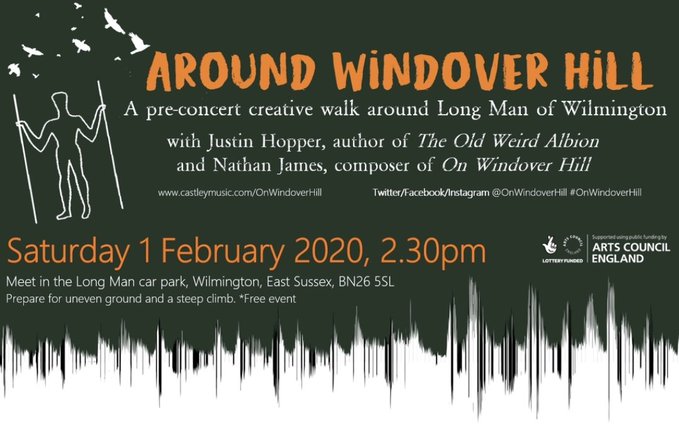
Yesterday, we joined a walk to the Long Man of Wilmington, on the South Downs in Sussex. The walk was led by composer Nathan James, and Justin Hopper, the author of The Old Weird Albion.
The Long Man is a chalk figure etched through the grass into the hillside, below the summit of Windover Hill, revealing the chalk that lies beneath. When and why it was first cut is the subject of myth and speculation – and that brings us neatly to Nathan’s new composition.
On 7th March, Nathan will premier his fantastic new choral work On Windover Hill at Boxgrove Priory, Chichester, Sussex. This has been inspired by the Long Man, its mythology, and the art that has arisen around it, as well as the written history and the geography of the surrounding land. It has a very English feel to it, in the tradition of Vaughan Williams or Holst.
Full details of the work and the performance can be found here. Tickets can also be bought by clicking ‘The Premier’ link in the sidebar there. We have ours, and it would be great to see it sold out!
This walk was by way of a taster for the concert, with a mixture of history and mythology imparted along the way, a poem from Peter Martin, read by himself, and extracts from stories read out by Justin, all of which referenced the Long Man. Also Anna Tabbush sang two folk songs, one of which was the only song known about the Long Man, appropriately enough called The Long Man and written by the late Maria Cunningham.
I’m not sure How many people I expected to see, but we were around forty, with a surprisingly large number being artists of one sort or another.
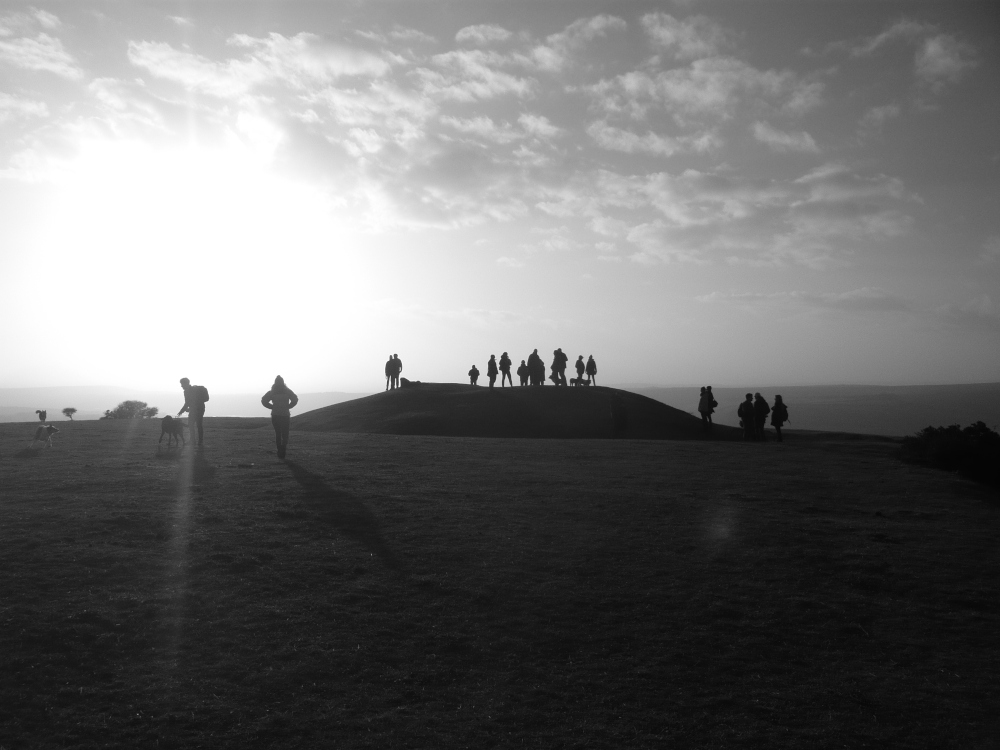
The weather was so much better than we had a right to expect – the forecast had been for clouds and rain, but the clouds cleared during the morning, and we had plenty of sunshine as we ascended, although it rather lived up to its name at the top, with more than enough wind for everyone.
Here, the remains of prehistoric burial mounds sit overlooking the Long Man, and the rest of the surrounding countryside.
Some landscapes seem to muck around with your perception of time, and Downland seems especially prone to this. I’m not entirely sure why this should be, but suspect it is a combination of factors.
It is a very open landscape, and other than the contours of the land and a few trees, frequently the only features that stand out are prehistoric ones, such as barrows and chalk figures. Due to the uncertainty around their origins, these have a timelessness about them, a fluidity when it comes to grasping their history. We see the long view, which perhaps works on our sense of time as well as space. The more recent additions to the landscape are usually in the form of fences, which can easily seem invisible as we look around for something less ephemeral than the open sky to fix our eyes on.
The Downs are an ancient landscape, in any case. When human beings recolonised what is now Britain after the last Ice Age, at first they kept to the higher ground which gave less impediment to travel and settlement than the marshy and thickly wooded lowlands. Most standing stones and burial mounds from the Neolithic or earlier are found on these higher areas.
I do not get these feelings in more recent landscapes. At a medieval castle or manor house, it is easy to imagine the inhabitants baking bread or sweeping corridors; activities as natural to us today as they were then. I feel a comfortable mixture of the old and the new, a recognisable timeline connecting the past with me.
But barrows, standing stones and hillside figures have a purpose alien and unknown to us. Step on the ground near these remains and you can feel the presence of the unknown. No wonder the belief in the past in faeries and elves who inhabited the underground, and who lived essentially out of time.
They offend our carefully erected sense of order and belonging and, perhaps, still pose a barely acknowledged threat to us today.
I might be imagining it, of course, but listening to the extracts from On Windover Hill on the website, I think I recognise that feeling in places, an unexpected musical response to my own feelings. And then Nathan’s description of his creative process on the website echoes some of this too.
I wrote this just over a month ago, and never got around to posting it, for some reason.
I have just finished reading Wilding, and I am almost overwhelmed with several feelings. The first is that I need to come back to this book after a month or two and re-read it, since there is just so much to take in. The second is that this book presents so much information that appears new to us in the twenty first century, yet was common knowledge some fifty to a hundred years ago and was hiding all the while in plain sight, as well as some new conclusions that were also, really, hiding in plain sight. And third, a feeling this might just be one of the most important books I have ever read.
This means I am attempting what appears to be ridiculous, and that is to review a book I don’t think I am yet ready to fully appreciate. But first impressions count for a lot, so here goes, although to keep this brief enough for one blog post, I can hardly even skim the surface.
Knepp is an estate in Sussex, England, which the author and her husband farmed for many years the way most farming is done nowadays – intensively. But as returns gradually diminished and the soil became more and more degraded despite the application of the usual chemical cocktails, they decided in desperation to take a leap of faith and re-wild part of the farm. The reasoning was they were going broke farming traditionally, so something new was needed – perhaps something revolutionary. What had they got to lose?
It was a huge learning curve for them, and many of the steps they took had unforeseen consequences. By allowing the land to revert to the condition it would have been in thousands of years ago, they discovered that many of our birds and insects, for example, actually favour environments and foods different to those we have assumed they do. Interestingly, on reading books written a hundred years or so ago about, for example, birds, they were simply rediscovering what was known then, but overlooked since. Just one example – pigeons do not actually prefer the seeds of cereal crops, but wild grass seed. The fact that they eat so much cereal seed today is due to the destruction of the areas of wild grass they would gave grazed before.
Probably the most important conclusion to take from this book is that a return to a more traditional, environmentally-friendly form of farming is not only better for the environment, but in the long term is even better for farmers who might be initially worried about losing out financially. It’s a win-win situation in that it would enable much wildlife to recover from its precarious, endangered, situation, it would reduce the risk of flooding during periods of heavy rainfall, restore soil fertility without pumping massive loads of chemicals onto the land and, consequently, into the water systems, and reward farmers with not only a better environment but healthier crops and stock which, in turn, would be healthier and more nutritious for the consumer.
Along with most others, I have always understood that back in the Neolithic period, when man was first making his mark upon the landscape in what would become Britain, most of the land was covered in thick, dense, woodland. I also understood that the large wildlife here – the megafauna – consisted of the likes of elk, cattle (aurochs), wild horse, mammoth and the such-like. Basically the kind of large animals that graze and browse the open, lightly wooded, grasslands of the African savanna today. Could we really not see the contradiction in this? This strongly suggests that the natural post-glacial vegetation of the British Isles was an open woodland, rich in undergrowth and grass, maintained by the regular grazing and browsing of this megafauna.
And from that, we understand that much of the habitat association we make today with our native wildlife is just plain wrong – we see birds and animals favouring a particular habitat and assume that is their preference, rather than understanding we have forced them into this by removing their real preferred ones.
There is so much to take in and think about in the this book, as I said at the beginning of this post, that a single review can only begin to hint at the mass of information to take in.
If you have any interest at all in our environment and what we have done to it, this book is an essential read.
The self publishing boom has given rise to the publication of millions of new books, the majority of which would never have been published traditionally because they would be either deemed to be of insufficient interest to return a profit to the publishers or because they were, frankly, just too terrible to see the light of day.
How good a book is can be very subjective in many ways, but certain rules must apply.
If you buy a traditionally published book, you may be reasonably certain that it has been edited and proof-read to a high standard, the printing and layout of the book is of good quality, and the actual contents – plot, dialogue, character development et al – are sufficiently well written as to repay your reading time.
There are no such guarantees with a self published book.
As a member of several Goodreads groups, I receive regular emails which consist largely of other members promoting their books. These promotions frequently consist of a synopsis of the book, extracts, and links. All well and good, but the number of extracts that are poorly written, unedited (it would seem), with poor print layout, and the number of synopses that are equally poor, is very high indeed. Probably the majority, unfortunately. And should I follow the link to the ebook sales site and read a longer extract, frequently this, too, is filled with more of the same errors.
As far as the plot and dialogue and all that goes with that is concerned, I admit that may be partly down to taste. I have no doubt that some poorly written and poorly plotted books still give great pleasure to many readers, and good luck to them. There are certainly examples of the same amongst traditionally published books. And styles go in and out of fashion, anyway.
What I do take issue with, though, is poor, sloppy editing.
Most people cannot afford to pay for professional editing – I certainly can’t. I understand that. It means doing the job yourself, but taking infinite time and care over it. Check it over and over again until it is the best you can do. The odd mistake will slip through, but that happens even in a professionally edited work. Persuade others to act as beta readers for you. They may not be professionals, but they will spot things you don’t. You are too close to the work, anyway.
If you can’t do that, don’t publish the book.
Let’s take layout first. It only takes a careful look at half a dozen professionally published books to get a good idea of what that layout should look like. And you can buy books that supply more detail. If you are serious about your book, you should do that.
Spellcheck is a useful tool, but only if it is used properly. It recognises a correctly spelled word in its database, but has nothing to say about the suitability of its use. I do find it particularly irritating to come across passages where the completely wrong word has been used, no doubt because Spellcheck flagged it up as the correct spelling. Common examples are groyne / groin, sheer / shear, alter / altar etc. etc. etc.
Grammar is the biggest minefield, though. We all get that wrong at times, even the best of us. But at least avoid the biggest howlers – the so-called grocer’s apostrophe, for example. Put the manuscript through a program such as Grammarly, which is free to download, to pick up the majority of the errors.
Another phenomenon I have seen recently is a 4,000 word story published on Amazon as a ‘Novella’. I suppose there’s nothing wrong with selling a story that length, but anything that comes in at 4,000 words is a short story. And quite a short one at that. To describe it as a novella, no matter what price it is being sold at is, quite frankly, a bit of a bloody cheek.
Please don’t do that.
And I’m sure many other readers have their own pet peeves.
Long ago in the misty depths of time – that’s last year, actually, I posted a piece about Ladakh (you can find it here if you’d like to read it.)
This, then, is another mixture of photographs and entries from my journal of my 2005 trip to India, which included a couple of weeks spent in Ladakh. I went comparatively early in the year, when the nights are still extremely cold and very few visitors have made their way up from the plains.
Just the way I like it!
Ladakh is high. If you fly in from Delhi (the only way to enter Ladakh for 8 months of the year), you travel from around sea level to 3500m in no time at all. Ladakh means ‘The Land of High Passes’, and is aptly named. Leh, the capital, at 3500m, is one of the lower areas of Ladakh. It’s all uphill from there. Winters are incredibly harsh and the summer growing season brief, yet the Ladakhis traditionally are self-sufficient in everything they need – food, clothing and shelter – and have only recently collided with the western consumer society. In contrast with most of the rest of India, the religion and culture of the majority of the people there is Tibetan Buddhism.
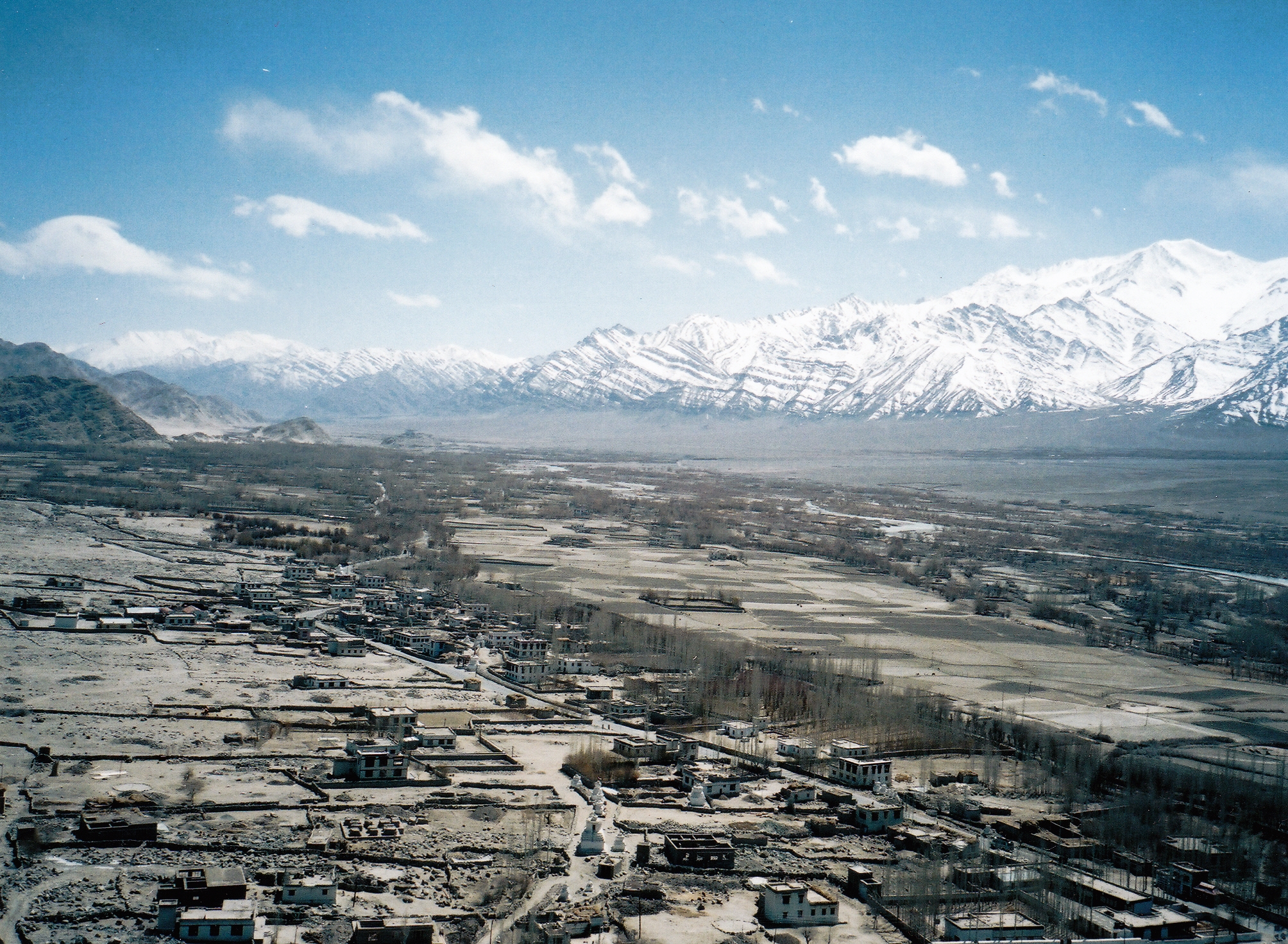
The Roof of the World – View across the Indus valley at 3500m, Thikse, Ladakh.
Friday 8th April 2005
I’m in Ladakh and, hey, wow!
At the airport for 4.30am, to find the flight postponed until 8am, due to weather conditions. It all looked ominous, but just after 7am we were told to check in and after numerous baggage checks, body checks, baggage identifications, etc, we were away at 8.30.
I’ve heard the flight described as one of the most spectacular in the world. I’ve also heard it described as jaw-dropping. I can imagine that it could be bowel-dropping. As we approached the Himalaya, clouds steadily built up and we flew through with tantalising glimpses of great snow-covered ranges below, through the occasional gaps in the cloud. After a while the turbulence built up and we were buffeted quite considerably. Then as we began to near Leh, we slowly lost height, the turbulence increased and we got more views of peaks at under-carriage height. Once we had dropped out of the clouds and the whole valley lay spread into the distance surrounded by snow-swept mountains, it was indeed jaw-dropping.
Then into land after three slow circles around the airstrip. The outside temperature was 2C, we were told, but it certainly didn’t seem that cold.
Once we’d gone through the formalities of registration and baggage reclaim with the refreshingly friendly ground staff, I walked out into the front of the airport and found a taxi. Yousef charged me RS 100/- to go to my choice of guesthouse (The Ti-Sei) and left me his mobile number. He also gave me all the usual (sensible) advice about taking it easy for a day or so.
I’m now sitting in a splendid light and airy room, looking out across the vegetable garden (covered in this morning’s snowstorm) to lines of bare poplars, traditional houses and some splendid mountains, also covered in snow.
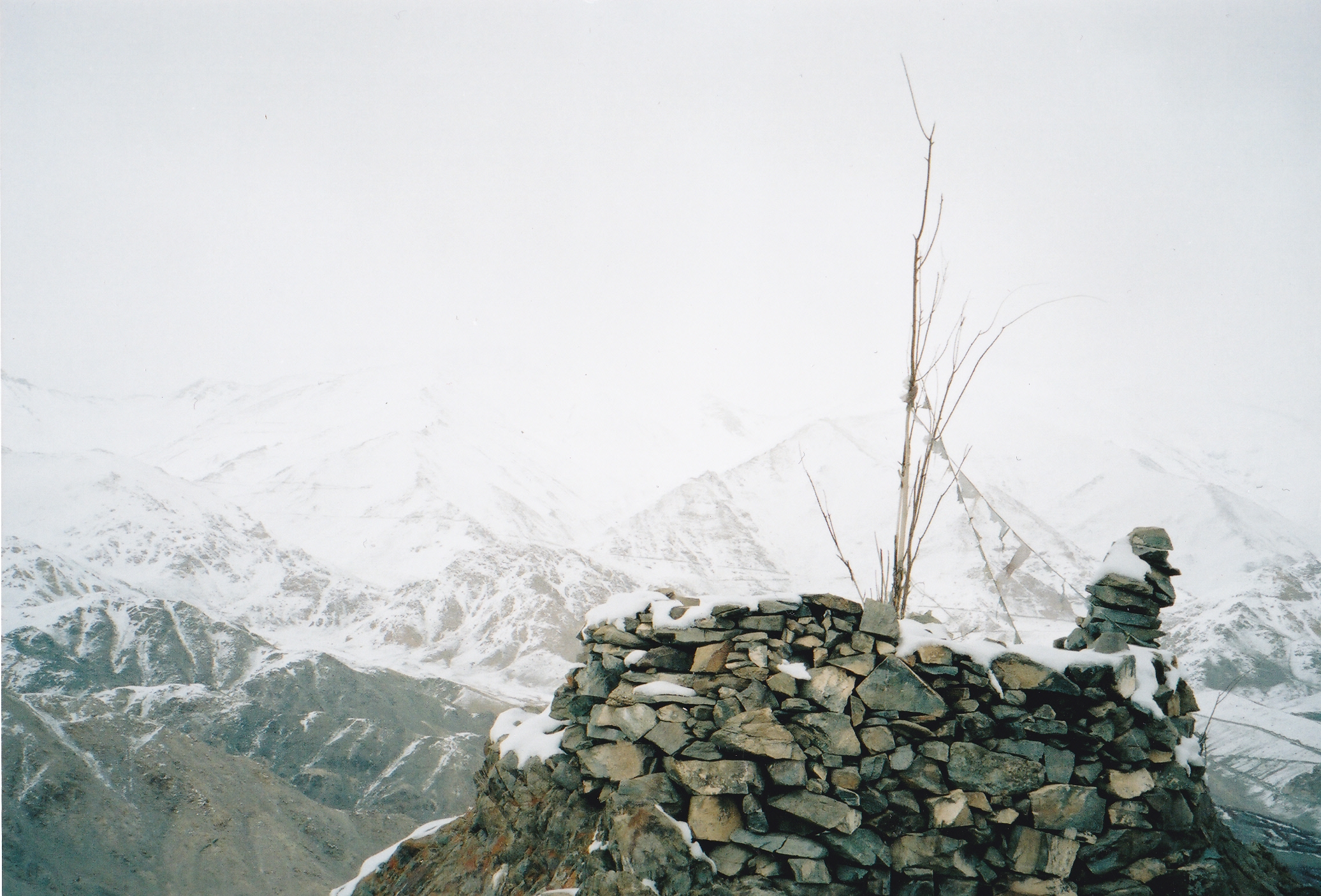
Cairn at top of mountain north of Leh.
After a Ladakhi lunch of apricots, apple juice and water, headed north past the Shanti Stupa towards the first line of hills. Reached there at 1.15pm and stopped there for a breather. Silence. Apart from the pounding of the blood in my head. Absolute silence. After a few minutes the call of the muezzin drifts up from Leh, from the Jama Masjid. Then a few bird calls from the crags. Perfect peace. A perfect desert landscape, with pockets of snow. I’m sitting on a boulder, warmed by the sun, my feet in patches of fresh snow.
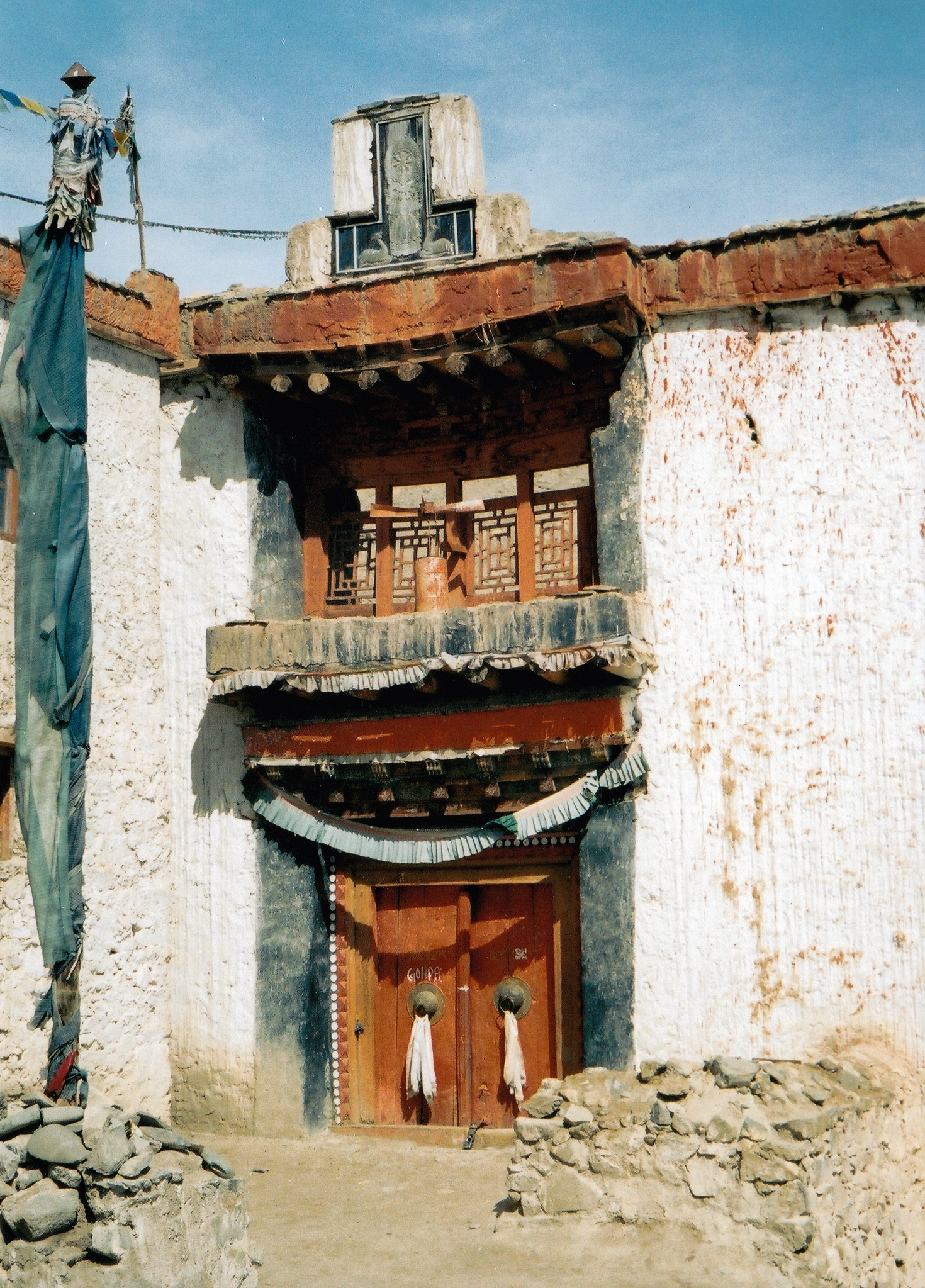
Gompa just below Leh Palace, Leh, ladakh.
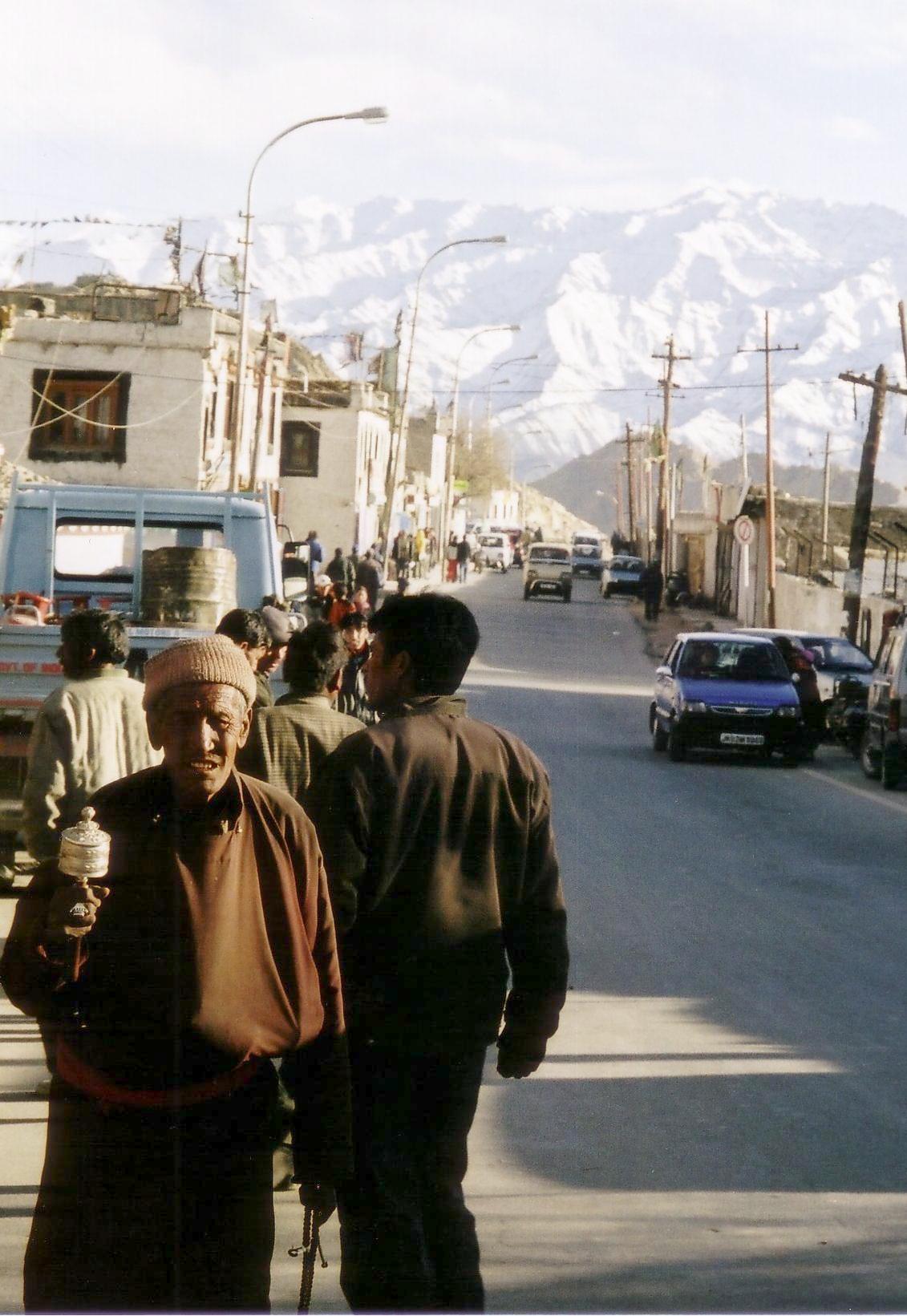
Man spinning prayer wheel, Leh. To Ladakhis, their religion is not somehow separate from their daily life, but an essential part of it.
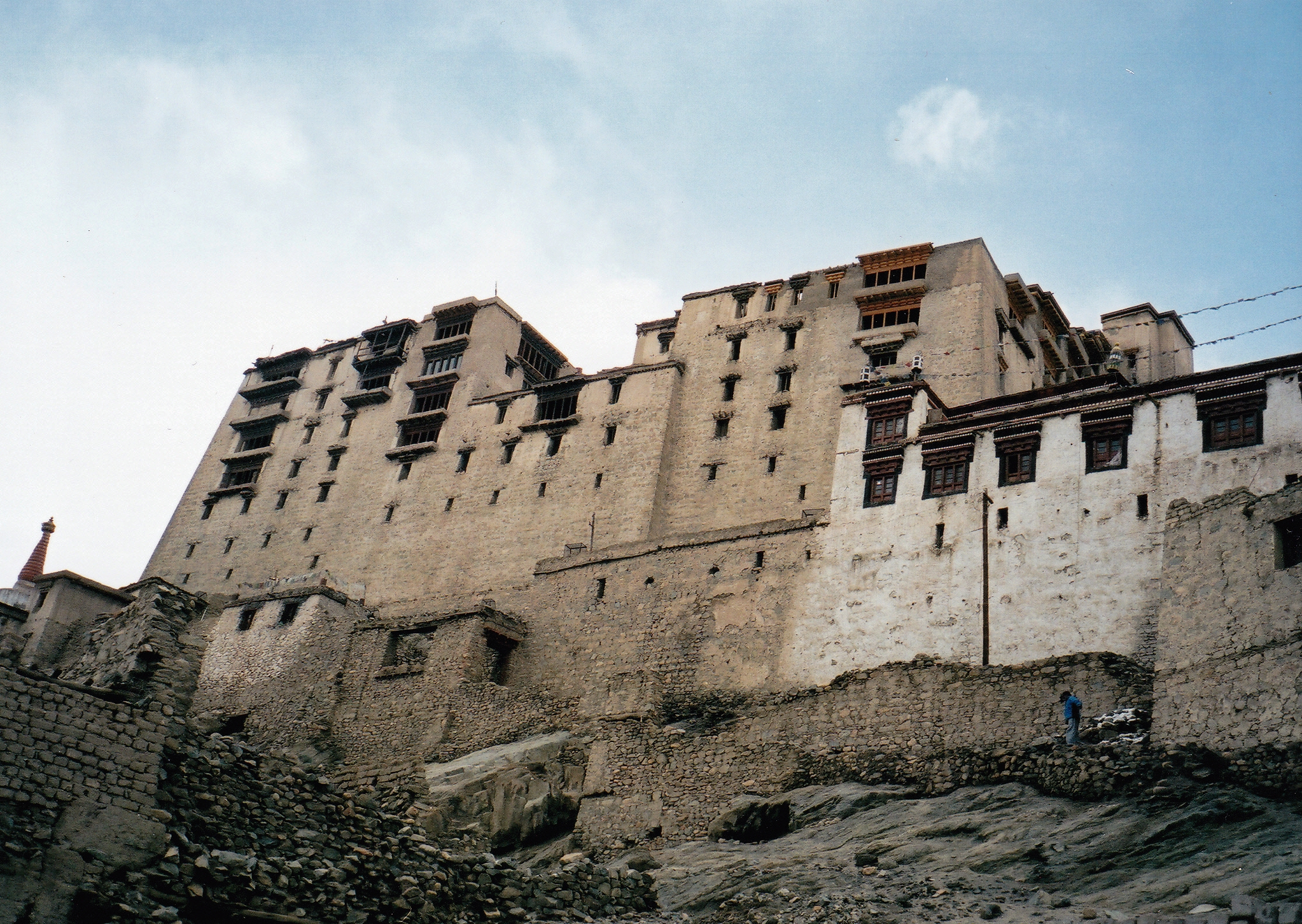
Leh Palace. Very similar to the Potala in Lhasa, although smaller, this was the home of Ladakh’s royal family from the 17th century, when it was built, until the mid 19th century when they moved to the palace at Stok, on the other side of the Indus Valley, as a result of an invasion by Kashmiri forces.
Gateway to Gompa at Leh Palace.
Old buildings on the outskirts of Leh, ladakh. Traditional Ladakhi buildings closely resemble those of Tibet. In fact, there are so many similarities between the two areas, that Ladakh is often referred to as ‘Little Tibet’.
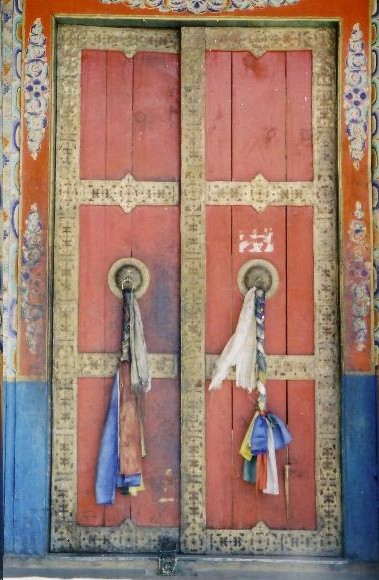
Temple Door at the Monastery at Thikse, Ladakh.
Statue of Maitreya, the Future Buddha, at Thikse Gompa. This statue, 2 stories high (15 metres) in it’s own temple was completed in 1981.
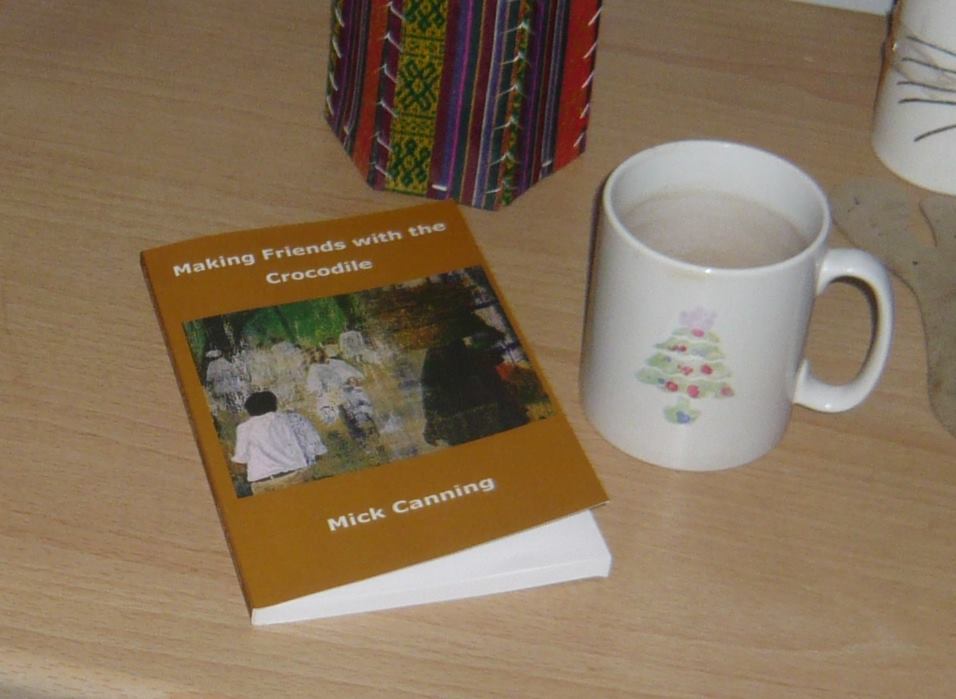
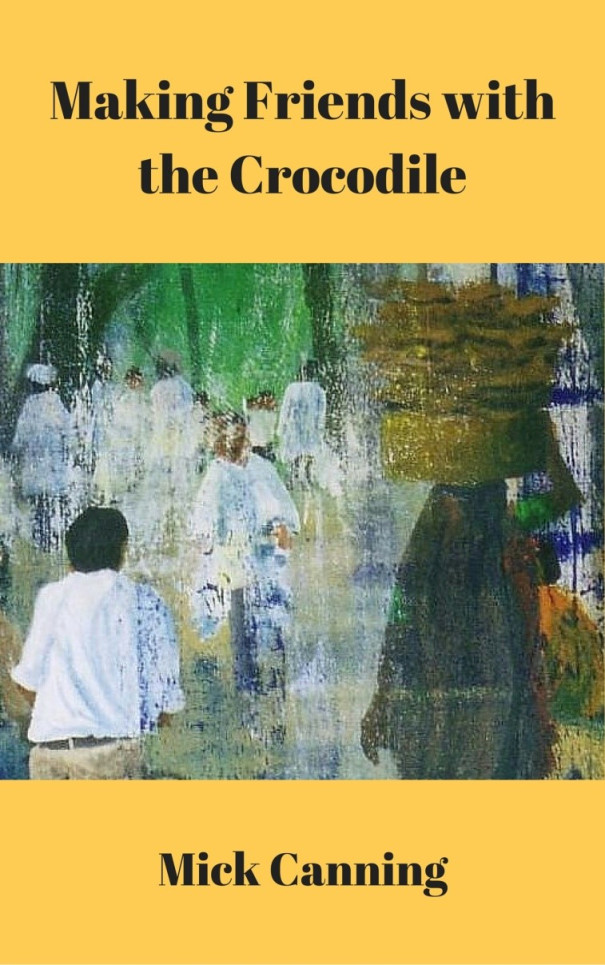
‘Making Friends with the Crocodile‘ is now released!
Kindle edition Paperback edition
Anyone who has already pre-ordered it on Kindle / Amazon should have received it by now, and in countries where there is no pre-order facility, such as India, the Kindle edition is also now available to buy.
The paperback is available from the Amazon.com, Amazon.ca, Amazon.co.uk and Amazon.eu sites only – this is a quirk of Amazon – but can also be ordered from the estore at CreateSpace, at the following link:
And now, I wait to see what people think of the book, with a considerable amount of nervousness.
If you do buy a copy, please consider leaving a review either at Amazon, or on Goodreads, if you are a member (better still, at both!). Reviews are genuinely the lifeblood of a writer, and do help to sell books.
Finally, the blurb again…
‘Siddiqa was only just into her teens when she was forced to leave her home to live with her new husband and his family in another village. The years have passed, and now Siddiqa has three children of her own. Her grown up son has brought his new wife, Naira, to live with them, so Siddiqa is no longer the lowliest in the household, for she has a daughter-in-law.
Life in rural India is particularly harsh for women. This novel explores themes of female oppression and tradition and asks whether the next generation will find life any easier.’

















 Mick Canning