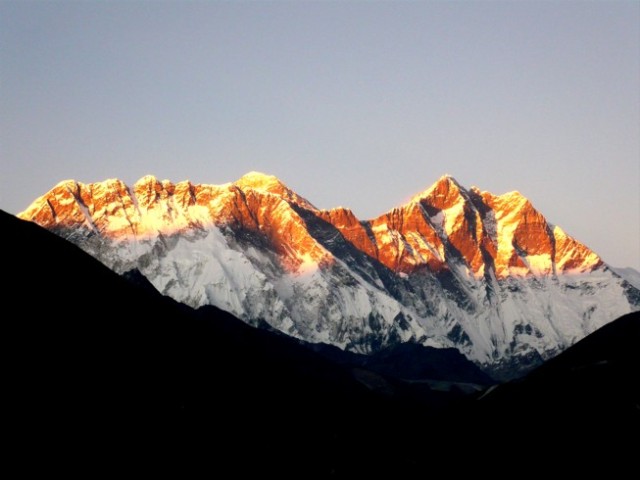
This view must have been photographed so many times, but how fantastic is it?
Sunset on Everest (left) and Nuptse (right), photographed from Tengboche.
This view must have been photographed so many times, but how fantastic is it?
Sunset on Everest (left) and Nuptse (right), photographed from Tengboche.
Tengboche is a monastery complex and a couple of trekking lodges on the route up to Everest Base Camp from Lukla, in Nepal. It sits high above the waters of the Dudh Khosi.

Inside Tengboche monastery following a puja (ceremony).
Rightly or wrongly, I don’t like taking photographs of pujas in monasteries. It feels intrusive and bad mannered. I would feel the same in a church, mosque or temple. This has nothing to do with any beliefs of my own, but is born of simple respect.
I noted in my diary: We have just sat in on a chanting puja, but my meditation failed dismally. I was completely unable to concentrate on my breath as all that I could think of were my freezing feet!
It was blooming cold!
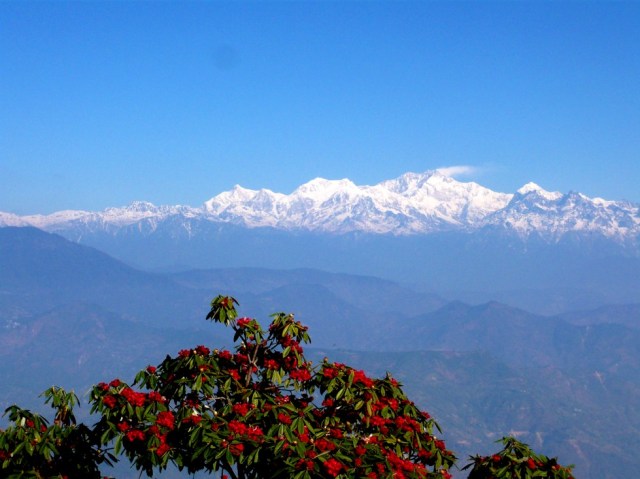
Kanchenjunga, the third highest peak in the Himalaya (and the world) taken from Observatory Hill, Darjeeling. It is the peak right of centre, with the spindrift blowing from the summit.
Have a great Thursday.
Ouch! Probably my worst title yet!
I can’t help it…I’ve not been well…
…well, only a cold, but you know what we men are like.
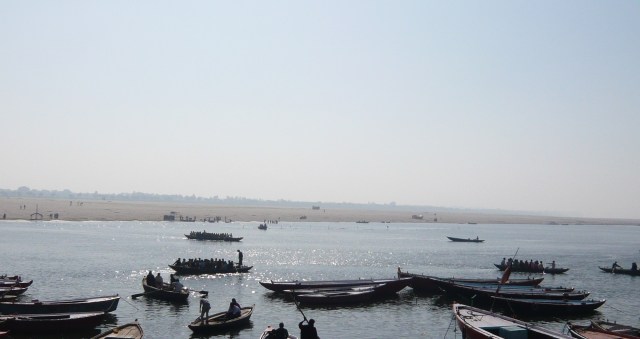
In another attempt to feel instantly better, I’ve nipped across to North India (only in my imagination, unfortunately), to picture Kedar Ghat, on the banks of the Ganges, in Varanasi.

Ghats, a Hindi word, are sets of steps leading down to a river (and also mountain ranges or passes – The eastern and Western Ghats in Central India). It has also come to mean a level place at the edge of a river where Hindus cremate their dead.
In Varanasi, there are between 84 and 87 ghats, depending upon who you get this information from,. The Manikarnika Ghat, or Ghats (possibly this is the origin of the confusion over the number) is the ‘burning ghat’, where cremations are carried out 24 hours a day, all through the year. The source fire there has supposedly been burning for thousands of years, but photography is actively discouraged, hence my only shot is one taken from a distance.

Of course, the ghats are also used for bathing. Hindus bathe en masse there, as a dip in the Ganges is meant to wash away sins. Important pujas (ceremonies) take place at sunrise and sunset. Boat trips to view the ghats are very popular, and finally much of the city’s laundry gets done at the dhobi ghats (dhobi meaning laundry).
Namaste!
It’s been a busy week again. I don’t seem to have managed to write anything, take any photographs, or even think about drawing or painting.
The news? I try to avoid it.
And to top it all, I have a cold and I feel bleurgh.
It’s at times like this I usually travel somewhere exotic in my head.
So, a few more photographs from Southern India, then.

Ganesh Temple, Kodaikanal. Ganesh, the elephant-headed god of prosperity, is one of the most popular gods in the Hindu pantheon and worshipped widely throughout India. This shrine is by the lake in Kodaikanal, a hill-station in the Palani Hills northwest of Madurai.
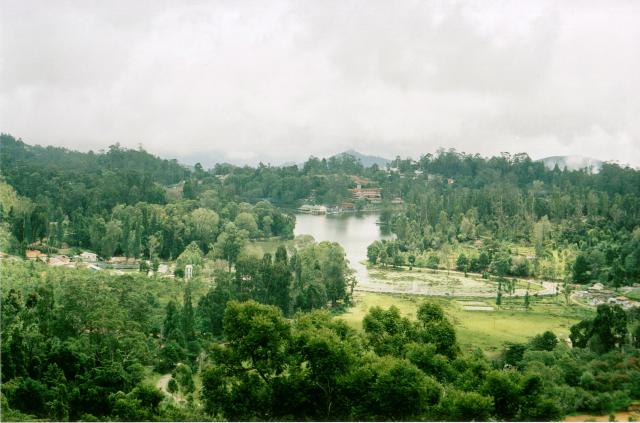
View of the lake at Kodaikanal. Besides the better known hill stations of Northern India, there are quite a number further south, of which Kodaikanal is just one example, although unique in having been originally started by American missionaries in the 1840’s.

Raj-era bungalows in Kodaikanal. These are on a ‘prime-site’ location overlooking the lake.

Madurai skyline. The Sri Meenakshi Temple complex, dedicated to Shiva and his wife, Sati, dominates the skyline of the old city. Often called ‘The Heart of Tamil Country’, Madurai attracts up to 10,000 pildrims and tourists on any one day. This picture was taken from the Rooftop Restaurant Terrace at the Hotel Supreme, where we sat with a beer and watched a long procession of tourists wander across the roof to take the same shot.

Entrance to the Sri Meenakshi Temple complex, Madurai. 12 huge gopuram towers, each between 45 and 50 metres in height, are carved in highly elaborate designs featuring gods, people, animals and mythical creatures which are then brightly painted. The whole effect is more like an enormous and eccentricly iced cake, or at least plaster-work. The whole of the temple seethes with pilgrims, tourists, trinket sellers and guides. And touts, who basically cover the last two categories.

Carved statue of Nataraja, Madurai Temple complex. I am unfamiliar with this particular god, but I like the carving!
I have been posting a bit about walking, recently, what with my frustration at being unable to do a great deal of it after my foot operation.
Foolishly, I made reference to the following episode in a reply to someone on one of the ‘walking’ posts, and admitted I might write about it sometime. Well, take this as a Warning From Someone Who Learned The Hard Way.
Thirty years ago I lived and worked in Oman. I was a seismologist, working on seismic data for an oil exploration company – but before you all shout at me, my conscience is clear. I don’t think I was particularly good at it, and I don’t think my efforts contributed to anyone finding any oil.
*phew!*
I do worry that as a result of this post, though, someone will now contact me and say ‘Hello, Mick. I was a geophysicist in Muscat when you were there, and I remember that one of the projects you worked on found absolutely stonking amounts of oil!’ But I doubt it.
Anyway, let me set the scene.
I lived near Muscat, the capital, which lies on the north coast of Oman. Behind me, towards the interior, ran a line of high hills
It is a massive simplification, but just at this point the hills run east to west, parallel with the coast, and consist of a series of ridges (jebels) and valleys (wadis). So to cross them from north to south (or in the opposite direction) the traveller has to continually climb up and down for the entire journey.

I bet you can already see where this is going.
When I had a few free hours, I would often walk out of my house, and up into the hills to just wander around and explore. As a result of this, I knew the first couple of wadis and jebels pretty well. There was a high, prominent jebel to the south, though, which was the final ridge before the land fell away to a wide stony plain, and I had never gone that far on foot up till then. This ridge was easy to spot, however, as there was a large microwave (radio) transmitter on top, and I knew it was the final ridge as we would often drive past it on the south side.
I had a day off.
I don’t know exactly what time of year it was, but it must have been in the ‘cooler’ season, because even I wouldn’t have been stupid enough to try when it was really hot.
Surely?
I didn’t even have a proper rucksack, I had a small roll-bag, which I slung uncomfortably over my shoulder. Inside, I had a single bottle of water, and a dozen small packaged juice drinks. I had a compass, but no map. I had a hat, I had a camera.
So, well-equipped and well-prepared, I set off.
The first couple of hours went well. I crossed two or three ridges and felt fine. I guess I should say at this point, that I was pretty fit. The project probably wasn’t an unreasonable one, by any means.
Certainly not for someone with the right equipment and supplies.

I was probably just beginning to feel a bit hot and tired when I crested what I thought would be the penultimate ridge, only to find I was looking down on another two smaller ridges that I still had to cross before reaching the final large one.
And the large one was looking very large indeed!
I can be ridiculously, unreasonably, stubborn, at times. I remember that on the final ascent I had to force my legs to bend and stretch, to take each step, but the top was getting nearer and nearer and I wasn’t going to give in.
I made it.
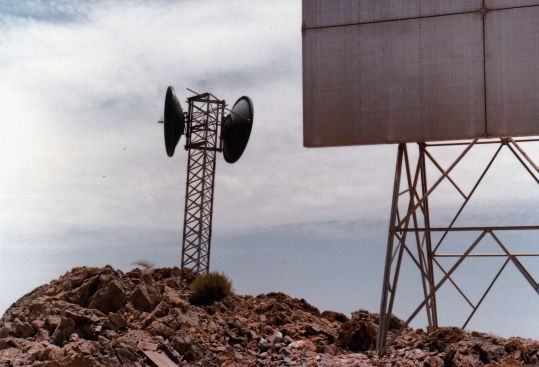
I enjoyed the view and the moment. It was, admittedly, very impressive and I knew I’d done pretty well to get there.
And really, all I needed to do then was to carry on down the south side of the ridge, walk another kilometre or two to the road I mentioned earlier, and hitch a lift back to Muscat.

Have I mentioned I can be unreasonably stubborn?
I turned around and started heading down the north side towards home.
I could draw this out into a long dramatic story of my walk, but I’ll give you the abbreviated version.
I found I was in difficulty as soon as I had to go up the next hill. especially as I had finished all my drinks by then.
It took me several hours and more energy than I realised I had at one point, just to get to the final ridge. But at that point, I knew I no longer had the energy or strength for that last climb. I could not do it. Fortunately for me, I knew I could follow the valley for a mile or two east, where it would come out to the coast plain. So I turned and stumbled that way. By now, I was desperate to find some sort of shade, just for a moment, but there was nothing.
But I staggered along, and as the hills either side dropped down, I came to a cluster of buildings. I don’t know what exactly they were, but I staggered in through a doorway and an Indian working there took one look at me, sat me down and brought me water.
‘Slowly!’ I remember him saying, as I poured it down my throat. ‘Not good to drink too quick!’
I didn’t care. I drank it like a camel on steroids given twenty seconds to fill up. I got through an awful lot of water, but he made me sit and rest for a while before I went off again. I think he offered me food, which I refused, and I think he offered to find someone to drive me, but I don’t really remember too much from that point on. I did walk home eventually, though. I just hope I thanked him sufficiently.
It was not one of my more intelligent adventures.
Last week, I posted that it was important to take journeys.

For the last nine weeks, I have been unable to get around a great deal, having had an operation on my foot to correct a few bits that were, sort of, pointing in the wrong direction, and painful when I put my foot down, and, er, lumpy where they shouldn’t be lumpy…
I’m sure you get the picture.

What it means is that I have been desperate to get out of the house and do a decent walk. I have managed to walk an average of a mile or so a day, just to try and keep reasonably fit and, I guess, supple, but it’s been quite hard work with the plaster and bandage on my foot and a stick to help me get around. Going uphill especially.

But the plaster comes off in a couple of days, and then I am going to do some walking. Boy, am I going to do some walking! Because I’ve been so frustrated at being unable to just get out there and walk the way that I’m used to doing.

I’m gonna walk!

And I’m so grateful that I’m still able to. God knows what I’ll do if I ever lose that. It really doesn’t bear thinking about.
Everyone should go on a journey; a journey of discovery.
Even if they only do it once.
The journey will be different for everyone. No two journeys will be the same. But what they will have in common is that they will all be journeys where the traveller discovers something about themselves, as well as the environment where they have chosen to journey. The essence of the journey is that it gives the traveller both time and space to think; that on the journey they allow themselves to be open to new sights and thoughts and people.
For some, it will be a carefully curated tour to a country with a different culture to their own. Perhaps a Westerner travelling to Nepal or Cambodia, or an Indian visiting Spain or Iceland, with a carefully prepared itinerary designed to help them get the most out of their journey.
For some, it could be much the same, but as an independent traveller. They would have the flexibility to either keep to a strict itinerary, or to go off somewhere new as the whim takes them. Because everyone’s sense of adventure is different.
For some, it will be a long, long trek through difficult terrain, pushing themselves physically and mentally every step of the way.

For some, it might also be a long journey, but under easier conditions, where the aim is more one of contemplation, perhaps a pilgrimage of sorts.
For others, the difficult terrain might be that of their prejudices and fears – the terrain of the mind.
What starts as a pilgrimage might end up in your discovering that you do not believe in God; well, that is fine. Remember, it is perfectly possible to be a spiritual person without believing in any god.
Although what ‘spiritual’ actually means is not so easy to nail down. I think of it as pertaining to the spirit, rather than to material things. In that sense, I would associate altruism with the spiritual, and greed with the material. A sense of calm and peace with the spiritual, a rowdy hedonism with the material.
For some, the journey might be from their house to a town or village a few miles away, and the journey might take no longer than a day.

It is essential, though, that the journey is undertaken for the sake of the journey. The destination is, in some ways, unimportant. It is what happens on that journey that matters.
Many, perhaps, will journey without realising that they have done so, or arrive at their destination not realising that is what it is. They might only realise later.
Some will arrive at a totally unexpected destination, and perhaps that is the best destination of all.
Go on, then, off you go!
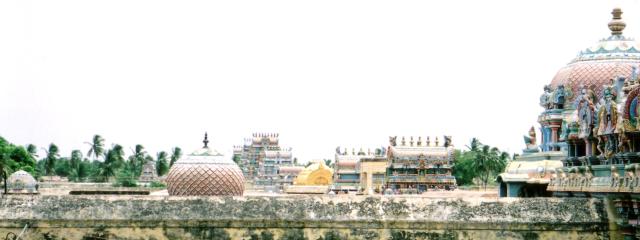
Another shot of the skyline of Sri Ranganathaswamy Temple in Trichy.

Decorated door in the Sri Ranganathaswamy Temple.The scorch marks at the foot of the door are from candles and incense sticks, which have been lit and offered to the god in pujas.
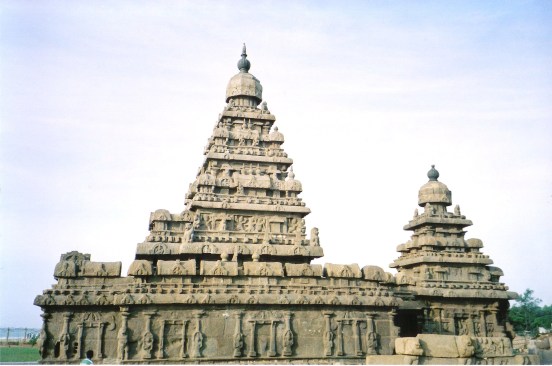
Shore Temple, Mamallapuram. Mamallapuram is a short way South of Chennai (Madras) and is a large village which is home to hundreds of stone sculptors. The village itself has a wealth of old temples and sculptures in the form of friezes and ‘Rathas’ – literally chariots, carved out of solid rock. The Shore Temple shown here has been extensively weathered by wind and sea, but has a remarkable amount of detail still preserved.

Carved Elephant at the 5 Rathas, Mamallapuram. An incredible complex of rock-cut temples from the Pallavan Period, 300m from the shore. They were buried under the sand until rediscovered and excavated by the British some 200 years ago.
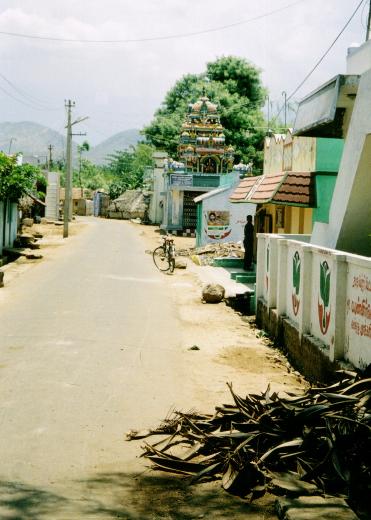
Sometimes it seems that there is a temple down every side-street. This one is in a village near the town of Dindigul, Tamil Nadu.

This roof shrine is nearby.
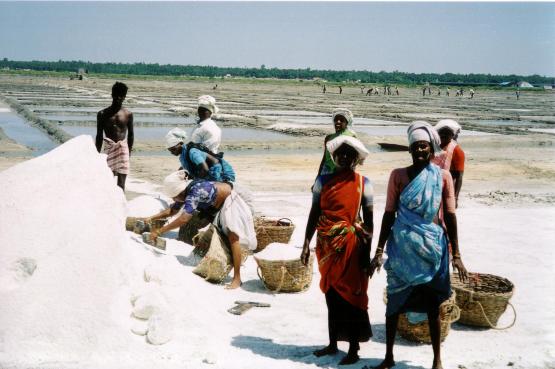
Salt workers pose for a photograph at the salt pans near Marakkanam, just north of Pondicherry (now renamed Puducherry, its original name before the French arrived). The sea is allowed to flow into ‘pans’ (not unlike paddy fields!) and then evaporates over several days under the hot sun, leaving behind a layer of salt which is gathered by hand. Salt has been gathered this way in India from time immemorial, but when the British in India imposed a salt tax, this eventually led to the ‘Salt March’ led by Gandhi, where he symbolically gathered salt at the coast after a 200km march, an action that contributed to the loosening of the hold that the British Raj held on India.
Southern India differs from the north in several respects. The first difference that the visitor tends to notice, once they have got away from the typical Indian maelstrom of airport, traffic, city centre, etc, is that with the less densely concentrated population comes a somewhat more laid-back atmosphere and attitude than in the north. The hassles and pressures, the touts, are still there, but seem somehow less intense.
The second real difference is in the culture. Southern India was never really assimilated into the Mogul empire, and only ever partly conquered, so there is a huge wealth of Hindu architecture and a proportional lack of Islamic, with next to no Buddhist remains and no continuing tradition of Buddhism at all. At times, it seems as though the visitor has entered a different country, but India has a way of reasserting itself on the senses…

Stall outside Sri Ranganathaswamy Temple, Tiruchirappalli (Trichy), Tamil Nadu State. All over India, amongst the heat, dust and drabness that pervades the majority of the population’s day to day life, one finds colour.

Garland seller outside Rock Fort Temple complex, Trichy. The garlands will be used to decorate statues of gods during pujas (ceremonies) conducted in the Temples.

Rock Fort temple, Trichy. A view of the main temple from the pathway that leads to the tiny temple at the top of the rock. Non Hindus are not allowed into the main temple, dedicated to Shiva, or the temple at the top dedicated to Ganesh…although for a small donation, the priest is willing to waive this rule…
From my journal:
‘The trip is not particularly uncomfortable. It is a typical five hour trip through India – dust, buffaloes, half a dozen schoolchildren stuffed into an autorickshaw, wait-till-the-other-guy-blinks over-taking, temples large, medium and small, huge dry river beds, The Cauvery full of water, trees, strange crops, broken down trucks, train lines stretching arrow-straight into the distance, rows and rows of stalls with neat piles of fruit and vegetables, rows of hanging water bottles from the roof, biscuits, samozas, cigarettes and crisps, a child squatting in the dirt, mum feeding the family beneath the tree, ‘Tiffin Ready’ signs, smart petrol stations, mud huts, cement buildings, palm shacks, huge residences surrounded by high walls – all concrete, police traffic blocks (ignored), it all blurs into one.’
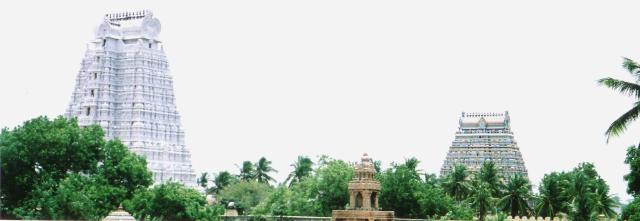
Part of Sri Ranganathaswamy Temple complex. This is the largest of all temple complexes in India, covering a staggering 60 hectares, and is dedicated to Vishnu. The Gopuram (tower) on the left is painted white, as a symbol of purity, and is one of the buildings that non-hindus are not permitted to enter.
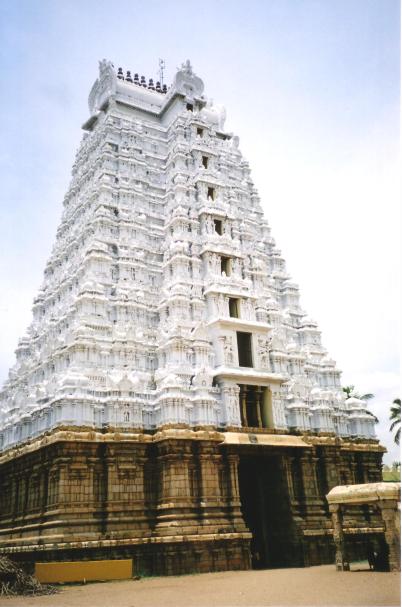
The White gopuram, in all its glory.

Pillar in Sri Ranganathaswamy Temple, liberally decorated with coloured powders and with offerings of incense, rice and flowers. Devotees of the god concerned will conduct their own personal pujas to ensure health and prosperity, or perhaps for some more specific purpose, such as to request the birth of a son or success in a particular undertaking. Although this temple is dedicated to Vishnu, other gods are represented there and prayed to.
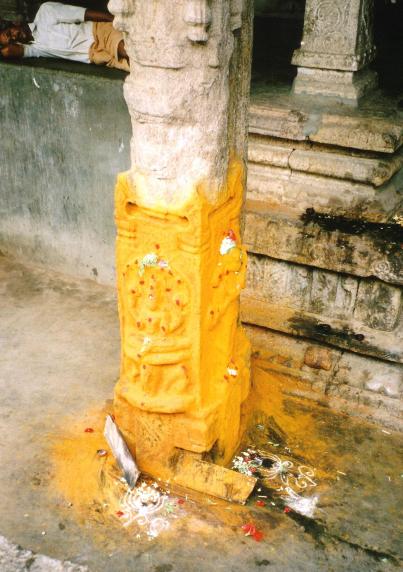
Another, nearby, pillar in the same temple. Although in the same temple and close to the pillar in the previous picture, this shrine will be to another, different, god. Its use, however, will be the same.
 Mick Canning