Despair – a poem.

She counts the tomato flowers:

One, two, three, four,

On the stunted plant.


Forever waiting.

Hoping….still hoping.


Old plastic sheeting and palm fronds.

Dry ground and hot sun.

IMG_0021

Stunted children,

One, two, three, four.

With spindle legs,

And hard, round stomachs,

Lie beneath the palm fronds.


Silently.


Flies,

Around dry mouths,

And dull eyes.


A few onions,

Some spinach.

Dry soil.


He was a farmer.

Drought.

Poor harvests.

And debt.


All he grew was hunger.

***

This year, he takes another loan to buy seeds

But this year will be different.

He will keep one tenth of the crop

For the seeds


Next year,

There will be no more debt.


No more hunger.


There is a harvest.

Jubilation.


Next year,

Sterile seeds.


Although he has paid back some money,

The debt has trebled.

***

That land was his,

Over there,

On the other side of the village.


That land covered in waste,

Hope buried under rubbish.

The future smothered with despair.


The land that belongs to someone who lives

In the nearby town.

Someone who has never seen it.


The next day,

She pulls up one onion.

Picks some spinach.

Boils some water for her children.

One, two three…


Her fatherless children.

***

In India every year, large numbers of farmers take their own lives when they become trapped in a cycle of poverty, high-interest debt, and bad harvests. And to compound their problems, certain huge multi-national companies are developing seeds that produce only sterile plants, meaning that the farmer cannot use harvested seed to grow new crops, and has no choice but to buy seed again the following year, sinking further into that hopeless spiral.

The government seems unwilling or unable to do anything to break this cycle.

Advice to New Bloggers (from Bob)

Bob has decided to go into journalism. Did I have any hints, he asked me? How should he go about it? In the end, I suggested he write a guest post for me.

‘What on?’ he asked.

Oh, I don’t know, I replied, possibly a little too casually. How about blogging?

‘Okay,’ he said. ‘I’ll do that.’

Over to you, Bob:

‘Right, so…why do we follow blogs? Obviously, it is so we can read the pearls of wisdom they scatter before us mere mortals. And if every post is a literary delight, then how much better would it be if we could get twice as many? Or three times? Or more? Everyone wants to read 20 new posts a day from their favourite blogger, all the more so if they receive email notifications of each one, as they get the added frisson of a ‘ping’ every few minutes as another notification arrives; an anticipation of the huge pleasure they will get when they read the new post!

‘Black print on a white background is so yesterday! Experiment with colours – green on blue, perhaps, or if you must use black, try it against a dark grey background. This ensures the reader gives your post the attention it deserves, rather than perhaps just scanning it quickly and moving on to something else.

‘But don’t stop there! Times New Roman and all that ilk are boring, boring, boring! Fonts such as Blackadder or Edwardian Script make it so much more fun! Again, your reader must work hard to prove how much they adore your posts if they are going to get to the point of posting any sort of relevant reply.

‘Size is everything. there is nothing better than a 4,000 word post to read because, let’s face it, your readers have nothing better to do with their time than read your post. After all, it’s probably the highlight of their day, so why skimp on their reading pleasure? Especially so if you have employed fonts and background colours similar to those mentioned above!

‘Is that okay, Mick?’

‘It’s a bit short, Bob. I thought you were in favour of long posts?’

‘Um…I ran out of stuff.’

Thanks, Bob. I’ll let you know.

Ladakh 3


IMG_0027

The Wheel of Life, Tibetan Buddhist wall painting, Thikse Gompa. The Wheel represents the cycle of being, the various realms of existence, and the three poisons (desire, ignorance and hatred).

IMG_0026

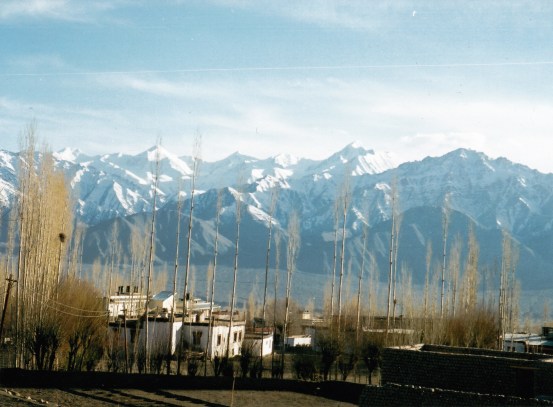
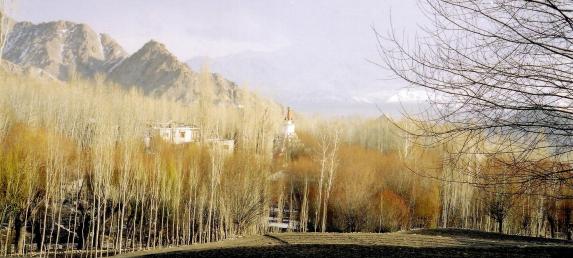
View of the Stok Mountains, Part of the Himalaya Range, above farms and poplars on the edge of Leh, Ladakh.

From my diary, Friday 15th April 2005:

Outside, my hosts are planting their potatoes, today. It’s been fascinating watching over the last week, as they’ve dug over the whole vegetable garden (about an acre), then divided it up into a total of about fifty smallish and four large plots, all neatly divided with earth walls, between which are carefully dug channels to the stream that runs along the side.

Then, over the last couple of days, half of the plots have had compost dug in and the channels opened one by one to flood each plot for a set time, then closed and the water allowed to soak into the earth.

The first of the large plots is now being planted with potatoes, presumably saved from last year’s crop, and some more digging is commencing at the far end of the garden, where so far there are no small plots.

I’ve just noticed what’s happening at the far end of the garden. It’s going to be one huge potato patch. Dad is digging, Mum is planting, whilst Granny is sorting the potatoes ready for planting. The little girl is happily employed in making mud-pies, like small children anywhere in the world under these circumstances!


The monastery at Thikse, Ladakh. Virtually the whole of the hill is covered in buildings belonging to the monastery, whilst the Gompa or temple crowns the top. Founded in the fifteenth century by monks of the Gelugpa, or ‘yellow hat’ school of Tibetan Buddhism, to which the Dalai Lamas belong.

Wednesday 13th April 2005:

12.45 and I’m sitting on a rock in hot sunshine at the foot of Thikse Gompa. The bus ride here was remarkable. Where else in India would you find that they don’t bother charging anyone for just going a couple of stops, or that they’d wait a few minutes whilst a passenger nipped off the bus to buy some bread? All along here, passed all this desert scenery, so similar to Oman. And so many fairy-tale castles and palaces and the like hanging precariously to the tops of cliffs. 

IMG_0028

Building at Thikse Gompa.

If it is so beautiful now, in winter, then what must it be like in the other seasons? I’d dearly love to come back to see! And after all the heat, dust and pollution in Delhi, well, need I say more? I’ve not even been asked once for baksheesh, either. 

Mandala painted onto roof of entrance to Shanti Stupa, Leh. The Shanti Stupa, or Japanese Peace Pagoda, is one of more than 70 built around the world by the Japanese Buddhist Nipponzan Myohoji Organisation, which was run by Fujii Guruji. They were built to promote world peace.

indus at chog

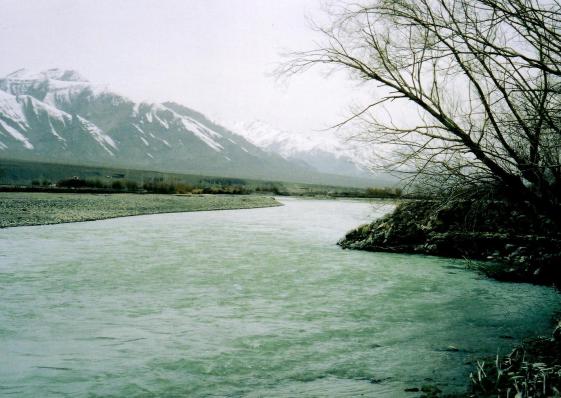
The River Indus at Choglamsar . The Indus originates in Tibet, near Lake Mansarovar – a lake sacred to both Hindus and Buddhists – and after flowing through Northern Kashmir, including Ladakh, passes into, and flows the length of, Pakistan, to the Arabian Sea. So, ironically, the river that gave its name to the state of India, flows mainly through Pakistan.

trees

Trees on the edge of Leh. Trees are highly important to Ladakhis – they provide timber for building, fuel, food in the form of walnuts and apricots, and fodder for animals. In all of Ladakh, the only trees that grow are willow, poplar, walnut and apricot.

A Poem – ‘Glamour’

Every time I post a poem I insist I don’t write many; that’s it’s not really my forte. And yet, I still write them, despite my doubts.

Although I consider myself a fiction writer, and a writer of short and long stories to be a little more precise, I love poetry. I love its conciseness, its ability to paint pictures and tell stories without telling stories. I feel it is closer to painting than other forms of creative writing.

So here is another offering, called ‘Glamour’.

Untitled-Grayscale-02

Sun-bed ravaged skin dry flaking and decaying,

Masked by layers of painted make-up.

She sets the wig straight with faltering hands,

Since the bloody thing has slid over her eyes again

For the umpteenth time!

Now takes a deep breath,

Then

Checks herself in the mirror across the room,

Turning her head painfully this way a little,

And then that…

‘Shit, I guess that’ll have to do.’

Both hands shaking, she lights a last, final, cigarette,

And,

Her lips pursed and cracking,

She expels the smoke with a wheezing sigh,

And coughs,

One eye still on her reflection.

Then leans back awkwardly against the pillows,

And turns slowly towards the nurse.

‘Do I look good?’ She rasps.

‘Yeah.’

The nurse nods.

‘You look good.’

The Best of Humanity

It is frequently said that when disaster strikes, that is when you will see the best of human nature. Generosity, bravery, selflessness – this was all on display yesterday at the dreadful fire in West London. The bravery and selflessness of the rescue services, and of many individuals caught up in the horror as it unfolded. The generosity of the entire community and beyond as they rallied around to donate food and clothing, money and shelter to the victims. All this and much more.

IMGP2282

But it is important to remember also that every single day countless individuals all over the world carry out countless acts of kindness, bravery and generosity that few others, if any, ever know of.

It is often tempting to look at the news and think that the human race is a barbaric, selfish, and bloodthirsty entity, and I know I am guilty of that at times, but we must never lose sight of the bigger picture. Because if there are many occasions when as a race we fall much lower than any other creature on earth, equally, there are many where we rise far higher.

Visit to Kashmir

I fell in love with Kashmir.

It was 1989, and I had come to India to have a closer look. A year before, I had flown to Delhi and the same day taken the bus to Kathmandu to go trekking in Nepal.

This meant that I had a lot of hours sitting and watching Northern India go past the windows of the bus, and this had piqued my interest and convinced me I should go and have a proper look.

So I arrived and, a couple of days later, took the bus up to Srinagar, a journey of 24 hours. In those days, I never kept a travel journal, which is something I regret now. It makes it difficult to piece together the details and leaves me, at best, with impressions and, of course, a number of photographs.

The photos, though, were taken on a cheap camera, and I did not take many.

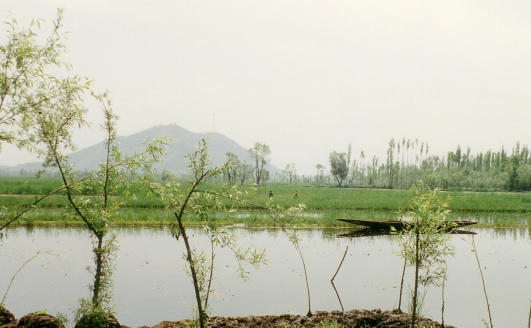
But I had a week in Srinagar and although I did not venture far afield from there, I loved what I saw of the valley with its gardens, Lake Dal with its confusion of meandering paths through fields and grass, naturally, the houseboats on the lake and also the shakiras, the sampan-like boats used by the fishermen and the traders on the lake.

shakirab

Shakira on Lake Dal

I found a houseboat when I arrived, managing to resist ending up in a hotel in town that was being pressed on me by a fellow on the bus. I seem to remember I found my houseboat by going to the lake, hiring a shakira and asking the boatman to take me to the first of a long line of moored houseboats, where I asked if there was a room. I think at the second or third I struck lucky.

I keep trying to remember the name of my houseboat.

Occasionally, during their waking day, a dreamer will catch a glimpse, a snapshot – no, not even that; perhaps no more than a hint, a flavour of a previous night’s dream. Something akin to catching a scent on the breeze that is gone before it is even realised that it was there. That is the best way I can describe the teasing hint I may get of the name of that boat. I think ‘Ah, yes, it began with ‘S’…no, wait, it didn’t, but there was definitely an ‘S’ in it somewhere. Perhaps…’ then it has gone.

But it was my own floating palace for a week. A marvel of beautifully carved wood, a magnificent bedroom and living room all to myself, and a fellow who lived on board (not the owner, I gathered) who cooked my meals. When I wasn’t ashore exploring, I sat on the deck and read.

I remember the Shalimar Gardens, and that there were at least one or two more; masses of flowers, large lawns, trees…I wandered around there with the high mountains towering above us.

And, there was the beginning of the agitation. At that point, I knew next to nothing of India’s history or politics, and although I could detect the tensions, I was unaware of what they comprised. Once or twice, there were isolated gunshots in the distance, especially at night. ‘Bandits’, said my fellow on board, rather too casually. I came across a mass demonstration outside a mosque in town, with either the police or the army, I’ve no idea which, a very heavy presence. There was a lot of shouting, and the atmosphere was hostile enough for me to make myself scarce fairly quickly.

But I personally encountered nothing but politeness and good humour, and other than the underlying tensions, despite getting ripped off now and again in shops (it was Kashmir, and I was a tourist!), I felt comfortable and happy there. When I left the valley to return to Delhi and thence further afield, it was with the thought I would return again one day.

Regrettably, though, each time I have returned, it has not been considered a safe destination.

Perhaps, though…perhaps…one day…

The Kashmir Issue

I posted a little while back that I had prepared a rather contentious post.

This is it.

Of course, I realise I risk being shot down in flames over this post. An Englishman blogging on what he thinks might be the solution to an incredibly difficult problem in the Sub-continent. So I will put on my tin hat, duck behind the sandbags, and press ‘Publish’.

As always, I welcome your comments. In fact, it is probably pointless my posting this unless there is a conversation. But, please, keep it polite.

Obviously, I am not the only person to have thought of this idea. Indeed, I read about it a long time ago, when these various options were being discussed to the backdrop of bombs and bullets.

Plus ca change.

twenty eight

I fear there is only one solution that is practical in the long term, but I strongly doubt that the governments of India or Pakistan would have the courage to implement it. For the whole of Kashmir to remain in Indian hands will mean a continuation of the devastating armed conflict in progress at present, with no prospect of it ever ending, plus the ever-present prospect of it escalating into something much more serious. But for it to pass entirely into Pakistani hands would be considered out of the question by the huge majority of the Indian population, and certainly by the whole of the political class.

No, the only prospect of peace that I see is for the state of Kashmir to be partitioned in much the same way as India herself was in 1947. The areas of Muslim majority such as the Vale of Kashmir would need to be ceded to Pakistan, and the remaining ones would remain part of India. Pakistan and the insurgents would need to agree to give up all claims to these areas. This would need to be achieved by negotiation in good faith with goodwill on both sides, both conscious of the risks and the monumental steps they are taking to finally establish permanent peace, and to restore prosperity to a troubled part of the sub-continent. And upon resolution, all parties would need to declare very publicly that this was a solution agreeable to all, and give it their blessing.

It is not as though there is no precedent to that arrangement. After all, both the Punjab and Bengal were divided this way at independence, and although it was strongly resented by some, it was also generally viewed as the only practical solution. And it is what should have happened to Kashmir, then.

If the difficulties in the way of this solution are huge, then so too are the incentives for success. It goes without saying that the loss of life and the devastation caused by the troubles are highly undesirable in the first place, and then there is the massive drain in resources to both sides by keeping huge forces established on either side of the border. With the prospect of peace, then agriculture, industry and tourism could return to normal with major benefits for everyone involved. Lastly, with the removal of the ‘Kashmir Issue’ as a friction between them, it is possible that both sides might finally come to the sort of mutual respect, collaboration, and friendship envisioned back in 1947. Even if the attempt were to end in failure, then the goodwill generated by the attempt could be a positive that might spill over into other areas of India / Pakistan relations.

The alternative solution, sometimes mooted, of an independent Kashmir under UN jurisdiction, appears an unworkable ideal. The state itself is too divided for this to work, and both Indian and Pakistani players would still covert the whole country. It is unlikely that conflict would cease under these conditions; it would be more likely to simply escalate. The small state would forever be reliant on the UN for security, leading to a constant financial drain on the organisation. The peacekeepers, too, would inevitably become military targets raising the risk of  new frictions arising.

I believe that the option of doing nothing is one that must be finally put aside. At present the situation is one where a resented and hated military presence governs within its own borders through fear and the threat of violence, That is not a situation that is likely to ever change to trust. The population are never going to learn to love their rulers that way. The only option in that situation is the eternal continuation of the status quo.

But it lies within the power of the regional players to solve this crisis once and for all, and it is essential that the attempt is made.

The Great Sandwich Schism

Once upon a time, a long, long time ago, God created the world. And he looked upon the world and said ‘Well, so far so good’.

And the world was full of beautiful things and good things and a great bounty of useful things that humans would later ransack and destroy in the name of greed, although that is a story for another day.

But when the people whom God had created looked upon his great works, they said unto Him ‘How might we thank you, oh God? How might we show our gratitude for your benevolence?’

And God replied ‘Oh, I don’t know. I really wish you wouldn’t bother. But if you must, just make me a sandwich, or something. I’m feeling a bit peckish after all that creating.’

013

And so the people made haste to slice bread and find Good Things to become a tasty and delicious filling for the sandwich they had made for their God. And there arose minor disputes such as whether ham and cheese really went together in a sandwich, or whether mayonnaise actually counted as food, but the people settled their quarrel in an amicable fashion and so the sandwich was created and placed upon a golden plate that was decorated with the names of angels and archangels, and set about with small mountains of salad and just a little dash of mustard in case God should fancy some.

And then one among them rose up and said ‘Wait, for we must cut this sandwich before we present it to our God, unless it be a bit too large for him to handle and he drop pieces of cheese from the sides or drip mayonnaise in his holy lap.’

And all at once there arose discord, for some were found who would cut the sandwich in a diagonal fashion, and yet others who declared that would be an affront to His holiness and that the only Right Way would be to cut the sandwich into equal rectangles.

And lo, the factions took up weapons and fought, yea, even in the Holy Kitchen, and they did massacre one another and each declared that the other faction was a worshipper of Satan, who was completely bemused by all this, since he had no followers (not even on Facebook), and they did create rival churches and rival nations and declared undying enmity against each other, spending the next few thousand years thinking up new and more imaginative ways to hate and kill and destroy each other.

And God groaned and held his head in his hands and said ‘Oh verily, what a cock-up this has become. I think I shall destroy the lot of them.’

Bob’s New Hobby

Bob’s wife has been urging him to do more work around the house.

I don’t mean things like the washing up or vacuuming the carpets – God knows, she tried that before, and it ended with her drinking an entire bottle of gin in one sitting – no, I mean the ‘little’ tasks such as putting up shelves or fitting new internal doors or hanging pictures.
066a

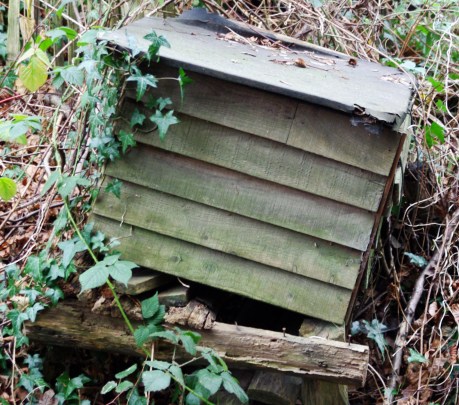
Just why anyone would encourage someone like Bob to engage in activities that involve sharp edges, high speed motors, cutting blades, heavy blunt instruments or pointy pieces of metal is totally beyond my comprehension, but who am I to judge these things?

I had occasion to go round to their house recently, and was startled when Bob proudly showed me the shelves he had recently put up in the alcove in the living room. Now, I am certainly not someone who regards himself as a handyman in that respect, and my opinion of DIY is that it is something to be avoided at all costs, but even I could have made a far better fist of it than Bob did.

The shelves contained a few books and two or three very large ornaments which, I suppose, had been chosen due to their shape and mass being such that they were unlikely to slide off of the shelves, despite the unusual slope of those shelves.

‘What do you think?’ he asked, proudly. ‘Gina is very pleased with them.’ He indicated his wife who was standing in the doorway. As I glanced at her, she gave me a look that was nothing if not inscrutable.

‘I’m quite impressed, Bob,’ I said, which was true, since I was unaware of him even changing a fuse before. ‘Is this the first time you’ve put up a shelf?’

‘Oh, no,’ he said, looking slightly hurt. ‘I put a shelf up in the garage, last week.’ I raised my eyebrows.

‘You’ve found a new hobby, then.’

‘I can’t think why I haven’t done this before.’ His enthusiasm was obviously sincere. ‘There is so much to do around here. We’re getting a new kitchen cabinet next week, which will need putting up, and it would cost a fortune to pay some bloke to come and do it, so if I do it we’ll save that money.’ I stared at him, quite unsure what to reply. ‘And Gina wants me to cut the hedge this afternoon,’ he continued. ‘I’ve never really been into gardening, but I’m rather looking forward to it.’

From the living room there came a crash! and the sound of heavy objects hitting a carpeted floor fairly hard. ‘What was that?’

‘Nothing,’ said Gina, mildly. I looked at her sharply, aware that she was usually Bob’s fiercest critic, but she merely smiled at me and sipped her tea. A little later I went out to the garage with Bob.

‘This is the shelf I put up,’ he said, proudly, indicating a plank of wood somehow clinging to the wall just below the ceiling. To get anything down, Bob would clearly have to use a step-ladder.

‘Why so high up?’

‘Gina suggested that it would be a good place to put some of the bigger tools, so they weren’t in the way. I stared up at the shelf from the opposite side of the garage. I could make out a heavy hammer, an electric drill, and…

‘Is that a chainsaw, Bob?’

‘Yes. Gina wants me to take down that old tree at the bottom of the garden. It was a real bargain.’ I stood silently for a moment, as a thought struck me.

‘A bargain? Where did you get it?’

‘At the Saturday market in Umbridge.’ The market was notorious for selling cheap imported electrical goods from the far east, most of which had faulty wiring with no earth, and dubious import licenses, and other, heavier, tools that had been chucked out because they were no longer reliable.

‘Right. Your idea?’

‘No, Gina’s. A friend told her about them.

‘Right. Um. And the hedge this afternoon?’ He indicated a hedge-trimmer that lay on the workbench. It was big. Very big. I don’t really know about such things, but it looked as though it was designed for seriously heavy work. ‘Is that electrical?’

‘No, petrol driven. Same as the chainsaw.’ I scratched my chin thoughtfully, and as I did so I gradually became aware of a muffled sound that was not unlike that of an electric drill, coming through the wall from the house. Bob seemed not to notice it, and I decided not to mention it.

‘Bob, were there any instructions with that?’

‘No, but it’ll be easy enough to operate. These things are all quite similar to each other,’ he said, confidently.

‘Do me a favour,’ I pleaded. ‘At least get a book out of the library on this, and learn how to use it before you start.’ He shrugged.

‘If you think it important.’

‘I do, yes.’

We strolled around the garden, and Bob pointed out the jobs and ‘improvements’ that he had been asked to do. Eventually, and much against my better judgement, I have to say, I offered to come and help him, or to at least keep an eye on him. He smiled broadly at this.

‘Great! I’ll get a few beers!’

‘We can have them afterwards,’ I said, hastily.

We went back indoors. In the living room, the shelves were still up, and still filled with books and ornaments. In fact, Gina was in the process of adding more books as we came in. I stared at the shelves, and I stared at Gina, who returned my stare coolly.

The shelves were now perfectly level.