A mere ten days after mentioning I thought I was close to finishing the final draft of A Good Place, it is, in fact, finished. This is the second novel I have written that’s set in India, this time in a fictitious hill station in the Himalaya, amongst the English diaspora remaining behind after Independence.
Having discarded two previous drafts, the skeleton of the story is now essentially the plot I visualised way back when I started.
There is a lesson in there, somewhere.
It will shortly go off to a couple of beta readers for their comments, and then hopefully after that it will just be a case of one final edit, then the hard part. I intend to at least have a go at finding a publisher and / or an agent.
I’m still here, although you might be forgiven for not realising that.
One or two of you might have noticed, though, that I have been an occasional visitor to your blogs over the last few months, but mostly I’ve kept away from WordPress in that time.
Of course.
Life quite often has a tendency to get in the way of my writing. It gets in the way of most of the things I do, actually.
That’s my excuse.
But I’m still plugging away at A Good Place, my novel set in Northern India about the English left behind after Independence, and am now very close to finishing it. I’m also working sporadically on Echoes and Imaginings Issue 2, now I’ve decided what I want it to be about. It’s gonna take a while to finish, though.
Cos life, you know.
Life getting in the way. What a drag.
But as for posts on here, I just seem to have just run out of ideas for now. It has been rather tempting to post the odd political rant during the last few months, but I don’t do politics on here. It would just make me cross and I’d get into arguments and I don’t want to do that. The point is I haven’t felt I’ve had anything worth writing. And I’m a great believer in that if you haven’t got anything to say, then don’t say it.
Those of us who call ourselves creatives, why do we create? Why do we have this need to make things? I know the usual answer is we write / paint / carve / whatever it is we do, because we have to, because there is something inside of us that needs to find an outlet. But what is that something? In my case, as well as a storyline it is frequently a place where I have spent some enjoyable time. It provides me with a comfortable setting in which to tell a story.
Most of what I do, certainly the work I feel is my best, my most successful (in the sense of expressing what I want to express), falls into that category. My long poem The Night Bus, for example, was the result of a thirty year (admittedly intermittent) search for a way to record my experience of a long bus ride across Northern India into Nepal. I attempted prose and paintings without success, although through this I did develop a style of painting I went on to successfully use on many Indian paintings, and had long given up on the project when chance showed me a way into the poem. The poem I completed succeeds in conjuring up (for me) the impressions and feelings I had on that journey; I can relive the journey again by re-reading the poem. Whether it conveys anything of that to other readers, I naturally cannot know.
And my stories, too. I look through Making Friends With The Crocodile, and I am in rural Northern India again. I re-read The Last Viking and can easily feel myself on an island off the west coast of Scotland. This is not to imply any intrinsic merit to my writing, other than its ability to transport myself, at least, into the setting I am attempting to describe.
These stories are a composite of three basics: a setting, as mentioned already, a storyline – and again this needs to be something important to me, or I find it pretty well impossible to put my heart into it, and strong, convincing, characters.
It is useful, then, to know where lots of my writing comes from, and what shapes it, what drives it. I have long suspected that this is frequently nostalgia and, recognising that, have wondered whether this might be a bad thing. Nostalgia, after all, has a rather bad press…does it just mean I am living in the past because I am viewing it through rose-tinted spectacles? As a way of not addressing issues of today I should be tackling?
This yearning for nostalgia, though, is a desire for something we see as better than what we have now. To write passionately about something it needs to be something I feel strongly about. Obviously this can also be something we find frightening or abhorrent – dystopian warnings about the future or anger about injustices, for example – but even in those cases the familiar provides a cornerstone of safety, even if only by way of comparison.
This is also true when I paint. I am not someone who can paint to order – if I’m not inspired, it does not work. A number of difficult commissions have proved that point to me. I paint what I like, what moves me. After all, whatever I am creating, it should be foremost for myself.
That book, then…
I began writing it about five years ago for all the wrong reasons. I had self-published Making Friends With The Crocodile and decided my next story should also be set in India, and as a contrast decided to write about British ex-pats living in a hill station in the foothills of the Himalaya. I wanted to write about India again. The trouble was, I had no idea what story I was going to tell. I had no stories that might slot into that setting I felt in any way driven to write; it just seemed to feel appropriate at the time. I was pleased by the reception the first book had and felt I ‘should’ write this one.
What could possibly go wrong?
I spent time putting together a plot, with which I was never wholly satisfied, and began writing. Really, I should have seen the obvious at that point and bailed out. But I carried on, and twice reached a point where I thought I had the final draft.
My beta reader then proceeded to point out all the very glaring faults.
So twice I ripped out a third of it and chucked it away, then re-plotted the second half of the book and got stuck into the re-write. I’m sure you can see part of the problem at this point – I wanted to hang onto as much of the story as I could, instead of just starting completely afresh. And now here I am trying to finish the final draft for the third time, as my February project for this year. And it’s just not working for me. But at this point, after well over a hundred and fifty thousand words (half of which I’ve discarded) I just feel I’ve invested too much time and effort in it to abandon it now. Somehow, it has to get finished. I do have an idea for a couple of quite drastic changes which I’ll try this week, but unless I feel I’m making some real progress I’ll then happily put it aside for a while and concentrate on next month’s project: painting and drawing.
And, to be honest, if it eventually ended up as a story of less than ten thousand words, and if I felt satisfied with it, then I’d take that as a result, now.
And the moral of all this? I’m sure there was a point after a couple of months when I knew I shouldn’t have been writing this book. I should have binned it there and then and saved myself a lot of fruitless trouble, but stubbornly ignored the warning signs.
Well, here we are again. A New Year. At least we’ve had a few sunny days, recently:
On Rye Harbour Nature Reserve, Sussex.
Heading up on to the South Downs from Clayton, Sussex.
‘Jill’ windmill, near Clayton, South Downs.
‘Jack’ windmill – no longer working, and now a private dwelling.
And another shot of ‘Jill’ – restored and now working
I don’t miss 2021 at all, although I’m sure I’m not alone in that. But I got off much easier than many people, of course. I’m still here, for a start. But I had a few health issues that I’m now stuck with, and these have slowed me down a bit and have forced me to alter my lifestyle in small (but annoying) ways. And I feel old. I am old. If you’re under twenty one, then I’m incredibly old!
And for various reasons I had a very unproductive year in that I found writing really difficult and just couldn’t get my head around any art. Although I don’t make New Year Resolutions as such, I’m tackling the uninspired non-productivity by setting myself, well, not exactly goals, but projects for each month of the year.
I have been researching my family tree, and instead of nice neat charts and tables, I have reams of scrap paper with partly legible duplicated notes (and a few charts and tables). For January, then, I am sorting all of those out and making those nice neat charts and tables, and trying to fill in some of the many gaps I’m discovering as I do so. It’s only halfway through the month and it’s going well, so that’s a success so far. But the rest of the year will comprise creative projects. For the next one – February – I intend to fill all the gaps left in my work in progress, A Good Place (the novel I’ve been working on for four or five years). I won’t get around to editing it, but I intend to complete what I am determined will be the final draft.
And then for March, I shall…well, I’ll tell you that in February.
I’ve been playing this album for much of the last week. the first I had heard of Sharron Kraus was on Chanctonbury Ring, the album she worked on with Justin Hopper, based on Justin’s book The Old Weird Albion. Joy’s Reflection is Sorrow is filled with beautiful haunting songs in the folk tradition, with more than a touch of otherworldliness about them.
My world is full of paths that are too well trodden at the moment. I suppose everyone’s is, really. All the paths nearby on the common and through the woods are overflowing with dog walkers and families out for exercise and relaxation, and without going further afield it is difficult to find anywhere to walk in solitude. So a longer walk is demanded this week, out to fields and woods and rivers where I know I shall meet hardly a soul.
I think I shall resist posting progress reports on my writing in future, since I jump from project to project and no sooner do I say I’m doing a final edit of x, than I am working on y and have shelved x for the foreseeable future. I have, for example, found great difficulty in finishing A Good Place, revising the plot and the ending for the third time now…
It’s downright embarrassing, really.
I’m finding writing very difficult at present, though, which is one reason I’m not posting on here very often. Like everyone else, I just need to hang in there.
And I’m reading An Indifference of Birds by Robert Smyth.
This is another book about birds, but in this case it looks at how birds see us and how we affect them. And by extension, it looks at how we affect the whole of the natural world, and the enormous damage we are doing to it. But if that sounds horribly gloomy, the book is a delight to read – beautifully written, and filled with observation and information. Do buy it.
For the last couple of months, during Lockdown and its easing, I have spent an awful lot of time up in the Himalayan foothills of West Bengal.
Okay, that’s not strictly true, but for most of that time I have spent my working day revising, re-writing, and editing A Good Place, my novel set in a fictitious hill station there. I have some new characters to weave in, some old ones to remove, and the story line to alter in several major ways, including a different ending.
I finished the first draft some nine months ago, but there were parts I didn’t feel entirely satisfied with then, and my beta reader unerringly picked those out for major revision. I then spent a while thinking about the story line and took out nearly all the final third of the book and chucked it.
That left me with a lot to rewrite.
Much of the problem stemmed from the fact that after I published Making Friends With the Crocodile, which is set in an Indian village with peopled with all Indian characters, I wanted to write a novel dealing with the British who remained behind in India after partition. A kind of balance to my writing. That was all well and good, but I began writing the novel before I was completely satisfied with the story line, and the more I wrote of it the less I liked it. So I kept changing the story line as I wrote rather than doing what I really should have done, which was delete the whole thing and go away and write something completely different, waiting until I knew what I really wanted to write. But I’m now content that I have the story I want to tell, rather than Just A Story.
Consequently, I have been virtually living in West Bengal during these days, inevitably leading to yearnings to be there in person. Which does nothing to ease the feelings of frustration at enduring the travel restrictions of Lockdown.
However, one of the advantages of having several projects on the go at once, which I always have, is that I can switch to another for a while when I need to. Last week, then, I spent one day giving a final edit to a short story which gave me the opportunity to spend the day (in my head!) in rural Sussex, which was very welcome. Especially as that is somewhere we can get to now, with a minimum of hassle.
And A Good Place? I’m glad you asked. I think I’m close to finishing the second draft, which will be a blessed relief.
Just so long as my beta reader doesn’t throw her hands up in horror when she reads it…
It was after posting my series of poems ‘The Old Way‘, last week, and also mentioning that I’d almost completed a very long poem on a very long bus journey, that made me think of travel again. Not that that is unusual, of course. I’d nip off on another journey at the drop of a hat if I had the chance, but for the time being we can’t afford to do that.
But, I am planning to publish those poems and a whole lot more, plus a few short stories, in a book some time later this year, as well as the Indian novel I’m currently editing – A Good Place. Two book in one year! We’ll see how that pans out…
But…Spain. Mallorca, this time, to be precise. Mallorca is the largest of the Balearic islands and lies in the Mediterranean Sea about a hundred miles east of the Spanish city of Valencia.
If you were to do a Google search for Mallorca (Go on, now I’ve mentioned it you can’t resist, can you?), you would be forgiven, looking at the results, for thinking there was nothing on the island other than the city of Palma, beaches, swimming pools, hotels and night clubs.
And you would be very wrong.
Certainly, there’s plenty of that if you want it, but there is also the rest of the island, which measures approximately fifty miles by forty miles, and contains some surprisingly big hills and mountains, small villages and towns, orchards, fields and woodlands, hiking trails and Roman and Moorish remains.
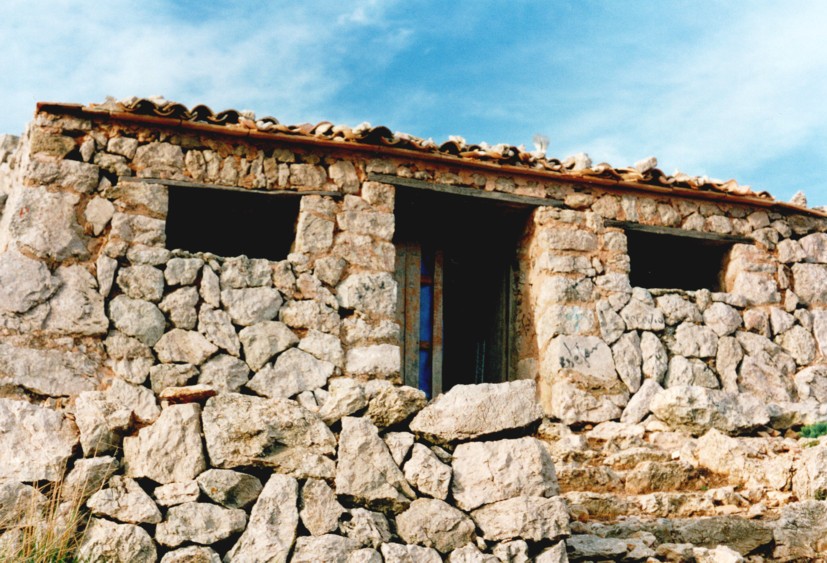
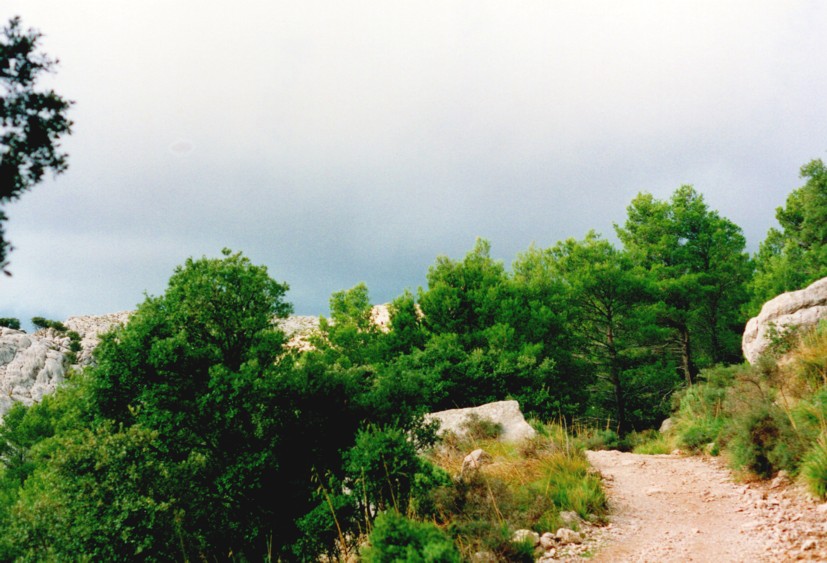
I’ve only had one visit there, and after flying into Palma I took the train up into the Tramuntana, the range of mountains on the north west of the island, to the little town of Soller. From there I walked up into the mountains themselves and spent the next couple of days just wandering around and exploring, sleeping overnight in a stone refuge.
Luxury holiday accommodation at about 2000ft.
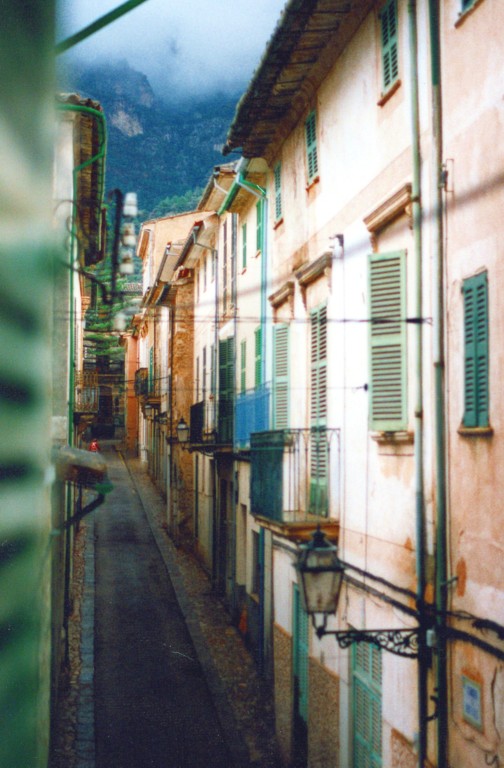
But there was a lot of rain arriving, and I retreated back to Soller for the remainder of my week, finding a room in a cheap backstreet hotel and spending the days exploring the lower hills and villages, and some of the coast nearby.
Lots of rain arriving.
View from the window of my other luxury holiday accommodation in Soller. Lots of rain still arriving.
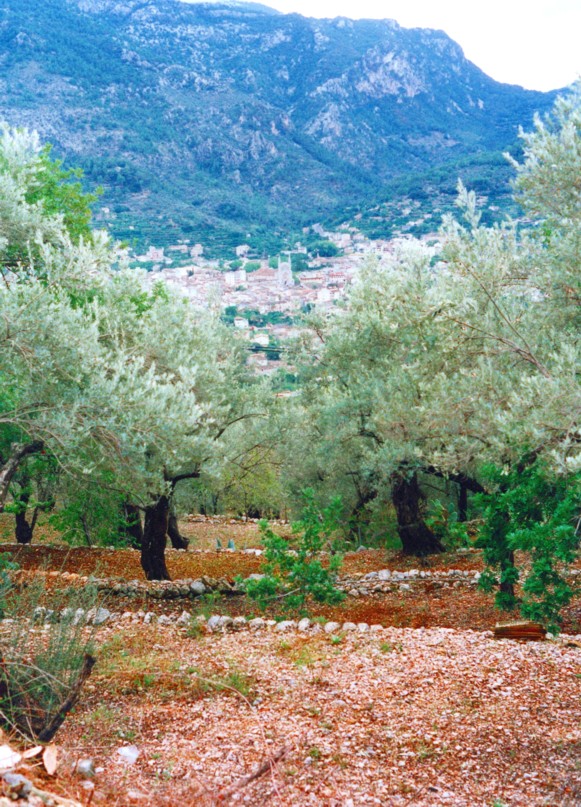
But it wasn’t all rain. There were lots of little villages to explore…
Farms, and hills to wander around in…
Village church
…and lots of bread and cheese and fruit and wine to enjoy. Not that you need to see a picture of that.
Many bloggers post photographs on Wednesday under the heading ‘Wordless Wednesday’. Me? I’m going to write a few posts about words – specifically words in English borrowed from languages of the Indian Subcontinent.
I’m just plain awkward, but you knew that, didn’t you?
I am currently editing the first draft of my novel A Good Place, which is set in a hill station in Northern India. And in that hill station live a number of English who remained behind after Partition.
‘I’m sitting on the veranda of the bungalow in my pyjamas.’ Well, no, no one says that in my book. But if they had, what is the significance of that sentence?
The significance is the number of words borrowed from Indian languages.
Veranda is an Indian word, but coming originally, perhaps, from Persian. The Oxford Dictionary suggests two derivatives, either from the Hindi (varanda) or from the Portuguese (varanda). Digging a little deeper, if I refer to Hobson-Jobson, the Anglo-Indian Dictionary that was published in 1886 and traces pretty well every word or phrase borrowed from the Sub-Continent, I discover a very long entry on this word. It begins by dismissing the possibility of it being derived from the Persian beramada, and goes on to state that it appears to exist independently in both Hindi, and in Portuguese (and Spanish). It then traces the possible routes the word might have taken to reach the English language, before then saying, surprisingly, that it could have its roots in the Persian after all. This seems quite likely to me, since many Persian words made their way to India especially with the Mughals, and it suggests a possible route to the Spanish peninsular when the Islamic armies arrived in the early eighth century.
I tried typing it into Ngram Viewer. This is an online tool that searches through the entire database of books that Google can access online (including ones still under copyright) published since 1800. Looking at the results for all books in English, it tells me it was barely used in 1800, although it does exist, rises steadily to a peak about 1910, and then falls away slowly, although it is still in common usage. Unfortunately Ngram has not been set up to search books in Indian languages, or even Portuguese. I tried Spanish and the pattern was similar, except that after peaking just before 1910 , it dropped sharply, but since then the trend has been upwards. I then noticed something. I had actually looked at the trend in American English. So I then tried British English, and this gave me a rather different pattern; The curve rose gradually until it peaked in the 1950’s and then fell away sharply. Why? I think it must be due to a surge of historical / biographical / nostalgic writing, both fiction and non-fiction, after the British left India.
Don’t worry, I’m not going to try to go into that sort of detail with other words.
Next, bungalow actually refers to a ‘Bengal style’ house (often with a veranda!) that the British frequently chose to live in.
And pyjamas are loose cotton trousers worn in India which were ‘adapted’ for night wear by Europeans.
Okay, class, lesson over. Be sure to wash your hands before eating your snacks (samosas and pakoras today, of course).
We’ve had cold, bright, sunny days. We’ve had cold snowy sleety days. And today we have lashing rain and wind. It’s milder than it was, but as miserable as sin and the wind still cuts through you!
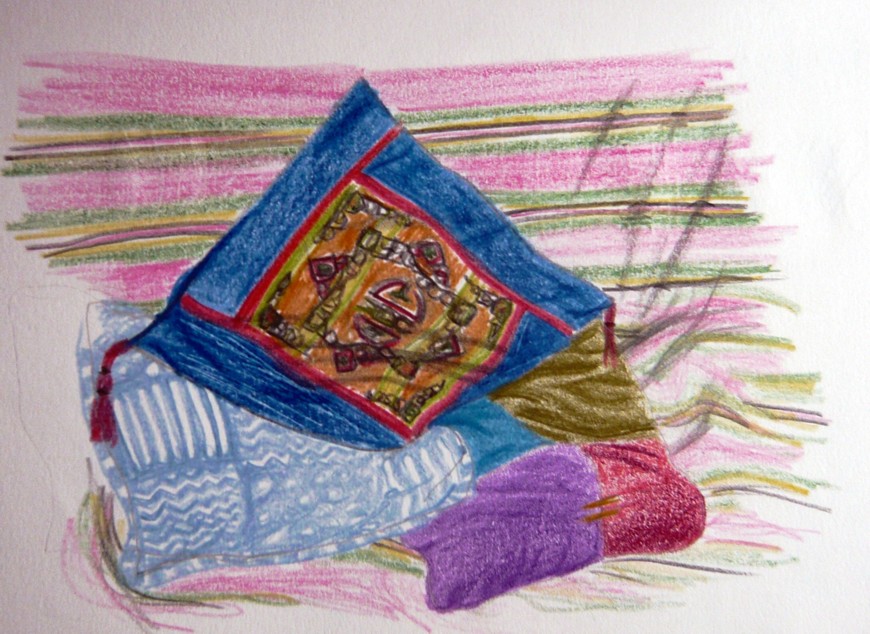
So here is a sketch for the day – cushions on the sofa to remind me of Nepal, since the top one came from there:
And here is a haiku for the day, to remind me of summer:
Amidst the traffic,
In the still airs above me,
A lark dripping down.
And a thought for the day? Another haiku, to remind me to slow down sometimes:
Obsession with time
Is climbing trees in autumn
To get down the leaves.
And today I begin the first edit for A Good Place – initially reading it through and thinking about the voice, the narration, to see if it works for me. Next, another read to look for flaws in the plot, redundancies, things to add and take out. Finally, try to knock the grammar into shape. If I’m happy with that, then it’s on to the beta readers.









 Mick Canning