The Footpath Book

Once, I thought I’d write a footpath book, a guidebook for an area I walked frequently and knew well. As well as the practicalities of walking the paths – pointing out turnings that were easy to miss, alternative routes, the geography of the paths – I would also discuss the history and geology of the area, the wildlife and architecture, the folklore…

I’m sure you’ve seen plenty of examples of these books.

But that, naturally, would require me to walk each path carefully noting every point at which I would need to remark on these details. But I know me. I would be coming up to a point where I knew I needed to take note of the vagaries of the route, or points of special interest, and then a mile or two later I’d realise I’d been working on a poem in my head and had forgotten all about the task in hand….I would just find it impossible to keep my focus on the technicalities while walking. And I don’t really do technicalities very well, anyway.

And to have to do this for every step of every part of these routes, well, it’s not what I do. While walking, I’m inclined to drift along, my mind wandering, my focus flitting from one thing to another – whatever catches my eye at the time.

It will just have to go down as another of my discarded projects. The footpath book is for someone else to write.

What’s In A Name?

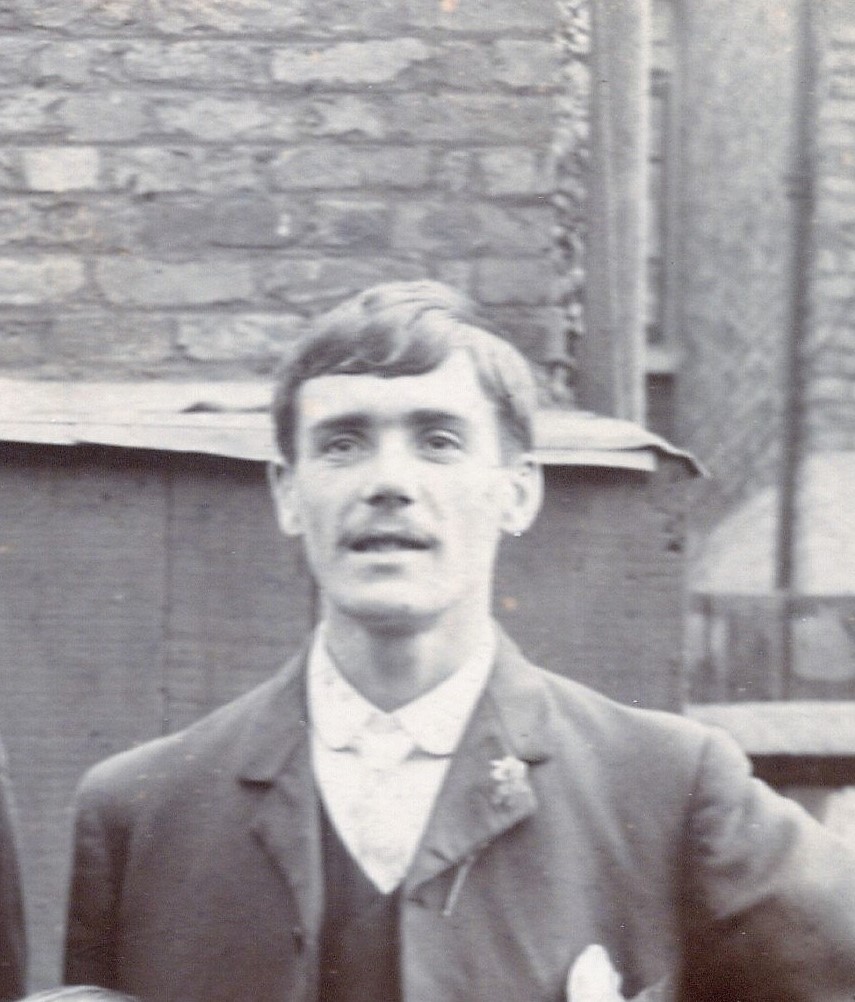
My Great Grandfather moved from rural Hampshire to London sometime in the late 1870’s, during the course of which he changed his surname first from Prater to Cannon, and then to Canning. We don’t know the reason why, but I suspect a family rift of some sort. Whatever the reason, from that point onwards our family were Cannings, rather than Praters.

Great Grandad pictured in 1904 in East Ham, London.

So really, my name should be Mick Prater.

But it isn’t.

Does it matter? In any way at all?

Of course it doesn’t.

And this, I think, illustrates the absurdity of those – primarily men – who think it is of paramount importance that the family name is continued. I know this supposedly gives a kind of spurious immortality to family members but, really, it’s a nonsense.

A Nine Daies Wonder

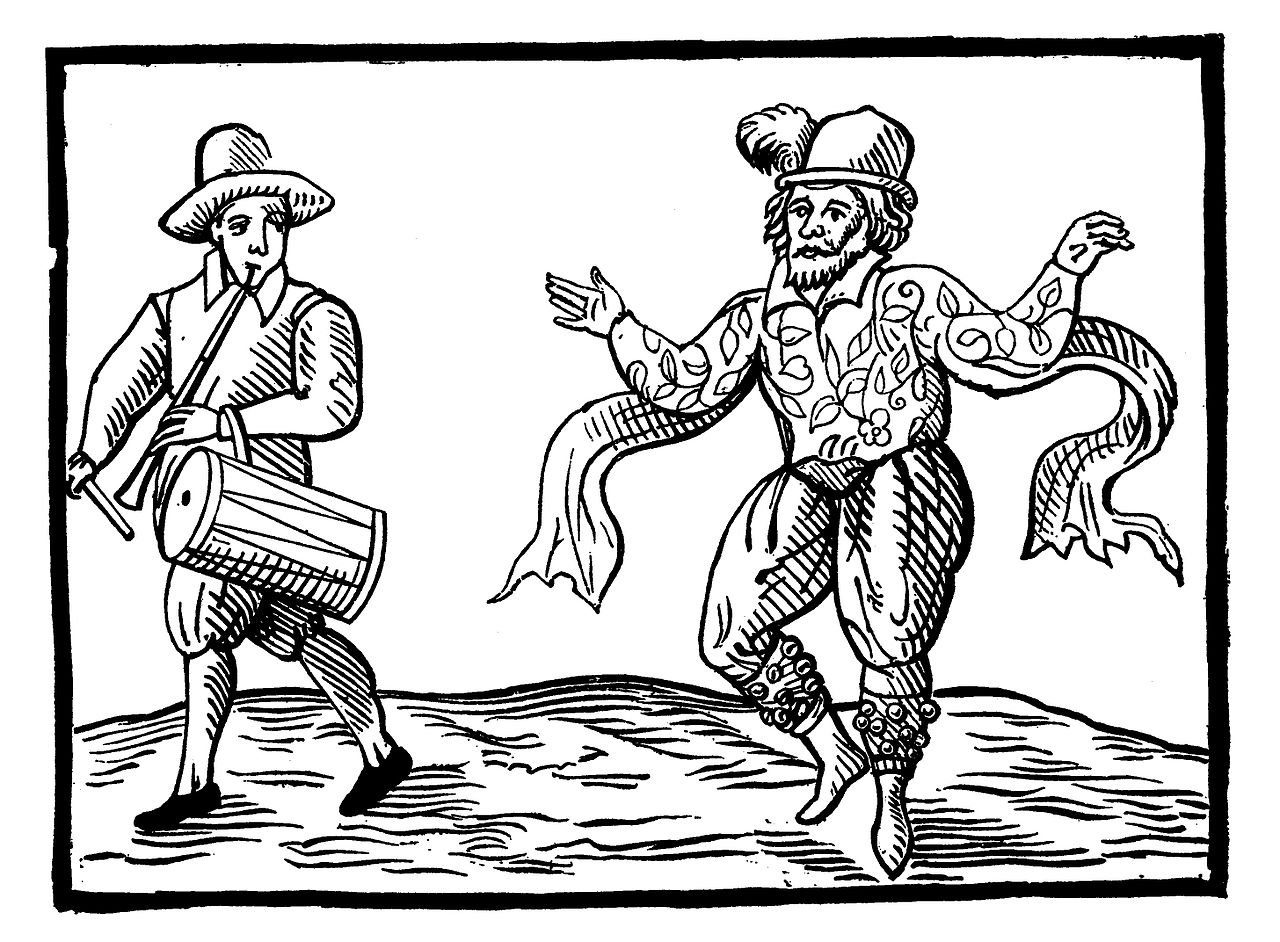
In February 1600 Will Kemp Morris-danced his way from London to Norwich, a distance of approximately a hundred miles.

Kemp (or Kempe), born around 1560 and died, probably of the plague. in 1603, was an actor, dancer and all-round clown. A member of Shakespeare’s company, Chamberlain’s Men, he regularly played the role of the clown in Shakespeare’s plays. He undertook his famous dance after some sort of disagreement within Shakespeare’s company as a result of which Kemp took his shares and left. Although we don’t know what form this disagreement took, it is widely assumed Kemp was very much a scene-stealer who was apt to improvise during a performance – possibly Shakespeare was alluding to Kemp when he has Hamlet declare ‘let those that play your clowns speak no more than is set down for them’. Kemp also had a tendency to dance jigs at the end of a performance that critics declared ruined the mood of a tragic performance.

Afterwards he described his dance as a ‘nine daies wonder’ in a booklet he published, although it actually took him twenty eight days to accomplish as he rested up for a while between each day dancing,

By the time he had joined Chamberlain’s Men, he was already famous for his acting and dancing. He had toured the Low Countries (now referred to as Benelux) and Denmark 1585-86 as a performer with the Earl of Leicester’s Men, performed frequently as a solo dancer and actor – usually performing clownish parts – and his improvised jigs were renowned for being frequently both ridiculous and lewd, which might go some way to explaining the rift with Shakespeare’s company, who by then were attempting to attract a more refined audience.

The dance from London to Norwich was performed as a publicity stunt and also as a way for Kemp to raise money by betting on himself to complete the journey. He was accompanied by a Thomas Slye, who played both the tabor (a small drum) and a fife to accompany the dance steps, and George Spratt who acted as overseer to the spectacle. Kemp wore a feathered cap, a slashed doublet with streamers attached to the shoulders, slashed breeches, and with clusters of jingle bells around his ankles and calves. A large crowd assembled to watch him set off from London at seven in the morning on February 10th 1600, and he continued to attract great crowds the length of his journey, which he completed on March 9th. He wrote the booklet later, as a riposte to those who doubted he had completed the journey.

This isn’t the origin of the phrase nine days wonder, incidentally, that goes back to at least the early thirteen hundreds.

The tune Kemp’s Jig appears in John Playford’s The English Dancing Master of 1651 and is attributed to John Dowland, but it is known that Kemp himself composed some jigs – four examples survive today. Whether Dowland (if it were he) wrote the jig to honour this journey, however, or whether it was a more generic tribute, we don’t know.

The journey, though, was quite an achievement.

I know this is all a bit niche, but having bought myself a sweatshirt featuring the image, I decided to learn a bit more about Mr Kemp and this is the result of that. I already knew about his dancing from London to Norwich, but I knew little about him beyond that.

A Bit of Digging

Well, they arrived yesterday.

I have finally got my family history book formatted and printed, and I reckon it looks quite decent. So all I need to do now is to get it posted out to family members.

While researching all this, I naturally made a lot of discoveries. Some were certainly more unexpected than others, though. From previous research my father had done, we already suspected that my great grandfather had changed his name, possibly on a whim, from Prater to Canning. I was able to confirm this by, amongst other things, a comparison of various dates of birth in his family. This immediately removes the possibility of my searching back to see whether my name has any noble / famous / important roots. This is something that matters a lot to some people, although obviously only along the male line, which is why it seems to matter much more to men.

Although I turned it up too recently for the book, I have learned details about my father’s life in WWII which I would otherwise never have come to know. I had no idea – and seemingly nor had anyone else in the family – that from 1940 until joining the regular army in 1943 and being posted to India and Burma, he had been part of what had been dubbed ‘Churchill’s Secret Army’, soldiers trained to operate behind enemy lines in the event of a German invasion of Britain. Fulfilling the same role as the French Resistance, they would have carried out acts of sabotage and hit-and-run attacks to slow the enemy advance. it was only after that threat had receded that he joined the ‘Regulars’.

And then, less unexpectedly, there were the stories of extreme hardship: the early deaths, the poverty, the workhouse, tuberculosis and pleurisy…

Of course, if it was possible to search back far enough, we would all find we had a common early human ancestor, which gives the lie to the importance of race.

Does any of this research really matter? Well, in some ways, no. Does it sound crazy if I say that despite all my work, it does not matter that much to me? I’m very much in two minds over this. A lot of this felt more like an intellectual exercise than a personal quest. It was interesting to find out where my great grandparents and their parents had lived, for this felt just close enough to be a part of me. But before them? And especially when I could discover nothing more than their names and some vague dates? No, not really. Throughout this project I have been especially keen to be able to put names to old photographs, for this seemed the only way to make these people come alive again, or at least begin to. That I’ve been able to positively identify some of them feels more satisfying than pushing a line back another hundred years, although I do have nearly every branch back at least to the 1700’s, but in every case it is the stories I’ve found out about these people that matter.

But back to my question. Does any of this research matter? I do think it has the potential to bring us a little closer to our families by emphasising our shared history, and I’ve greatly enjoyed long discussions with cousins about our various researches and discoveries. But beyond that? Well, I’ve enjoyed learning the social history involved with my family, the realities of how people actually lived in the towns and countryside over the last few hundred years. And as well as emphasising my connection to my extended family it has also, as I wrote a few month ago, given me a greater sense of connection to the land where I live.

I have enjoyed exploring the past, but I’m not going to live there.

Connections

Through researching my family tree, I’ve discovered some new connections to the land.

It’s not just that I’ve found ancestors in new parts of the country, although that certainly has a bearing on things, it’s more that I have a reinforced sense of a long personal connection to the land, this land, where my ancestors spent their entire lives living and working. A connection so many of us seem to have lost these days. I’m following the threads of folk who scraped a living in villages in Norfolk or Essex or Hampshire, frequently living in poverty or at the very least on the very edges of it. A hard life for most of them. Widows with no way of supporting themselves other than plaiting ‘straw dollies’ for a few pence, labourers in their seventies still having to endure hard physical graft to stay out of the workhouse (where they would have had to work even harder, for even less reward). People for whom starvation would have been a very real threat. Even comparatively healthy families would have relied on all the womenfolk trying to bring a few extra pennies into the household.

Some of these connections are selective – I can reject a connection I’m uncomfortable with, such as through industrial work in towns or cities which is something I have little experience of, and no love of in the first place, but I cannot claim a connection that isn’t there in the first place.

And within this experience, there is the time element – both how long ago these events were, but also how long they lasted, which contributes to the intensity of this connection for me.

These folk weren’t just the very poorest, of course. Amongst my ancestors there are also a wide range of craftsmen and women such as weavers, shoemakers, and printers, but also other poor labourers such as shop assistants, launderesses, servants, stokers, coal porters, cable hands…the list goes on and on. Not that there’s anything special about my family tree – everyone has these folk in their past.

I think – I know – some people just look for royalty or knights in armour when they research their trees. They dream of having the right to a coat of arms, or bragging rights to a famous name. None of us come into it completely open to what we find. We all have some expectations – to push our ‘lines’ back as far as we can, for example, or discover connections to the famous. Personally, I’m delighted to find my ancestors were the urban and rural poor. I don’t want to find the rich and privileged in my tree. Is that inverse snobbery? Perhaps.

But it’s the connection to the land I’m referring to here. I’ve always felt a strong personal connection to the land, to the physical world, and every census entry or marriage certificate I come across showing my ancestors earning their living that way seems to strengthen my own connections as well as a sense of continuity with my forebears.

Sickness and Diseases

I’ve mentioned that I’ve been researching my family tree, and a few days ago I was looking for details of one of my ancestors who lived in what was then a small village just outside Norwich. Looking on the parish records not only did I find the entry for his burial, but then noticed that the rector at that time had begun noting down what each person had died of. It was by no means complete, though, because he had added these notes for a year or so and then just stopped. Whether he’d got fed up with it or been told to stop for some reason, I obviously have no idea. But as I glanced through them, I became fascinated by them. I felt they left quite a lot of information about the place and time (rural England in the 1850’s) and thought a bit of it worth sharing.

My ancestor was on page 5 of these records, and the burials had all been conducted by the same rector from the first entry on page one. He added these notes from entry number two, through to twenty nine, then again for number thirty three, and then stopped. This is a summary of the relevant entries:

1   Male     5 weeks   Dec 1851

2   Male       44         Dec 1851      paralysis

3   Male       14         Jan 1852       consumption

4   Male       53         Jan 1852       consumption

5   Male         6         Jan 1852       scarlet fever

6   Male         3         Jan 1852       scarlet fever

7   Female    17         Feb 1852      typhus fever

8   Male        33         Feb 1852      consumption

9   Female    3¾        Jan 1852      scarlet fever

10 Male        53         Feb 1852      liver complaints. Publican.

11 Male        61         Mar 1852      paralysis, consumption

12 Male        19         Mar 1852      consumption 2½ years

13 Female    62         Apr 1852       cancer

14 Female    78         May 1852      old age

15 Male        33         Apr 1852      consumption

16 Male        55         May 1852     decline and heart disease

17 Female    69         Aug 1852      old age

18 Female      5         Aug 1852      inflammation of bowels

19 Female    13         Aug 1852      typhus fever

20 female     21         Aug 1852     consumption

21 Female    76         Aug 1852     coroner’s inquest. Verdict died by visitation of God

22 Male        63        Sep 1852     coroner’s inquest. Verdict died from injury in the head caused by fall

23 Female     71        Feb 1853      paralytic stroke and old age

24 Male         49        Apr 1853      labourer. Decline

25 Female     71        Feb 1853      coroner’s inquest. died by visitation of God, She dropped down dead when in perfect health

26 Male        85         Apr 1853      labourer. Paralysis

27 Male      infant      May 1853      jaundice

28 Female    64         Jun 1853      drowned herself in 11 inches of water. Morbid religious depression. A dissenter. Verdict temp insanity

29 Female   infant     Jun 1853      thrush

After this there are no further comments from the rector, other than:

33 Male        72        Sep 1853      disease of heart

There is quite a lot that is of interest here, and just from a statistical point of view we can see that nine of the burials were children under sixteen – just under a third of the total. Of those six were five or under. Lots of children died in those days. Yet somewhat surprisingly, fourteen of them – roughly half – were over fifty, with four in their seventies and one of eighty five. A very good age for the time. There doesn’t seem much difference in the average ages males and females lived to, although this is a tiny sample, of course. All the rural poor had tough lives, both male and female, which brings us to the comments added by the rector.

Number twenty six really caught my eye. Male, aged 85, a labourer, died of what the rector calls paralysis. No old age pension for them, they worked until they dropped. Number twenty four is also described as a labourer. Obviously the rector felt it worth mentioning, although why just those two, who knows?

Then we have the common diseases we’ve pretty well consigned to the past, now. Scarlet fever. Typhoid. Consumption – properly called tuberculosis. They killed frequently, especially the young.

And when the cause of death couldn’t be determined, even by inquest? ‘Visitation of God’. Although why those ones weren’t just put down to old age I can’t imagine. Unless somebody saw something…

Two more comments I have to mention, though. Number ten, male, age 53, died of liver complaints. The rector had to mention he was a publican, of course.

And then there is number twenty eight. Female, aged 64, drowned herself in 11 inches of water. Morbid religious depression. A dissenter. Verdict temp insanity. The rector belonged to the Church of England, and I’m sure he relished the suggestion that dissenters were mad. All the different denominations of the church seem to regularly go to war with the others, which, if you fancy a bit of a giggle, I satirised here some while ago.

A Bit Of Family History

As I have mentioned previously, I am sporadically tracing my family tree, something I’ve only really become interested in recently. Perhaps it is mainly an older person’s interest, although I don’t think I’ll explore that now. But I’m keen to pass on the information to my children and grandchildren especially, so they can do further research if they feel like it.

As well as the family connection, though, much of my interest is both the exercise of solving a puzzle – it has much in common with a detective story – and to attempt to ‘see’ something of the person behind a list of dates and names. It is comparatively straightforward to accumulate lists of these folk with no more information than a sort of ‘Fred Bloggs born 1750, married Mary Smith 1770 died 1820’ which is really of little interest to me.

But if you know where to look (and how to search) there is often more information available about our ancestors, although you also need a very large slice of luck to dig up interesting details of the lives of the average person. In my research, then, I have found a few folk, of whom I knew absolutely nothing to start with, not even their names, and have been able to build up a bit of a picture of their lives.

That’s what it’s all about, I reckon.

Here, then, is an example:

My Great Great Grandad was Frederick John Platt. He was born in 1826 or 1827; I cannot find his birth record, but all other documents are consistent in his age.

A couple of census entries:

1851 the family are at 2 Wilmot Street, Bethnal Green. They were: William Platt, 49, Handloom weaver, Ann, 59, Frederick J, 24, Sarah Susanah, 22, also William James Platt, 26, his wife Sarah, 28, and William James 4. All bar William James Junior are Handloom weavers.

1861 at 1 Green Street, Bethnal Green. They are: Frederick J Platt, 34, Broad silk weaver, Louisa S, 30, Broad silk weaver, Louisa M, 6, Frederick W, 5, Henry G, 1, George W, 1 month. All were born in Bethnal Green.

So far so good, but then there is a Crisis.

In 1861 Louisa Sarah Platt of 1 Green Street, age 30, died. It must have been very soon after the census was taken (on 7th April) as she was buried on 21st April. I obtained a copy of her entry in the Death Register, and it tells us she died on 14th April 1861 – ‘Found dead at 1 Green Street, Twig Folly Bridge, Bethnal Green’. She was aged thirty and the cause of death was given as ‘exhaustion after her confinement’. You can see on the 1861 census the youngest, George W, is recorded as one month old.

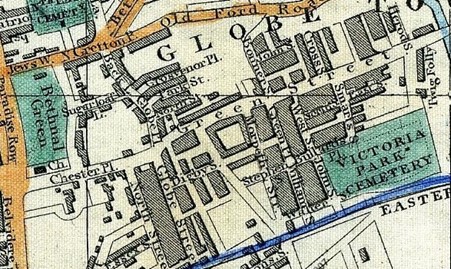
Green Street, Bethnal Green, from Cross’ Map of London 1851. Twig Folly on the right of the map gave its name to the bridge where Green Street crossed Regents Canal.

Then on May 8th 1861 we find the following Poor Law Removal judgement:

Frederick Platt, 34, of 1 Green Street, 5 years last 25 Jan, 3 Parliament Street, Cambridge Road, Mile End, B G (Bethnal Green). Weaver.

Was born at no. 10 Geo. Gardens B G never (ye?) has lived in B G all his life father before him. Had married at St. James the Less 1853, 12 June Co produced to Louisa Sarah, who died 3 weeks ago, Louisa 7, Frederick 5, Henry 17 mos, George 5 weeks, – B G

And then in another hand:

Father pd taxes Harts Lane B G Road about 17 yrs ago and Cranbrook St. about 2 yrs. He lives at 2 Cranbrook St.

I am unclear what the ‘removal’ part of the judgement refers to and can only assume it either means the children were taken from him, or they were all evicted from the property. The final paragraph about his father having paid taxes, I am guessing meant the authorities were then willing to provide some sort of support for the children. He had married Louisa Sarah Whalley sometime between April and June 1853, in Bethnal Green – June 12th according to the Poor Law Judgement – and after she died eight years later, his world seems to have fallen apart. And it seems to have happened so quickly! Less than three weeks after Louisa is buried, this judgement is passed upon the family.

But I suspect the family may already have been in some trouble.

Bethnal Green saw a huge influx of Huguenot immigrants during the late seventeenth and early eighteen centuries, almost exclusively silk weavers. Although I cannot find any evidence to back it up, I was told in my childhood that Mum’s ancestors were Huguenots, and that would suggest the Platts were the ones referred to. Whether Platt is an Anglicized version of a French name, or a Platt had married into a Huguenot family, though, I have not been able to determine. Over the years from the Huguenots’ arrival in Britain, though, various laws were put into effect to protect the British silk industry from foreign competition. However an 1860 treaty with France allowed silks to be imported duty free and very soon the industry was in freefall. Unable to compete in price with the imported cloths, huge numbers of weavers were thrown into poverty.

The next definite sighting of Frederick John Platt is in 1877 when his son, Frederick William, is married. On the form, Frederick John’s occupation is given as undertaker, and Frederick W is a commercial clerk. Clearly, they were no longer part of the weaving community. It is worth noting here that Frederick J’s older brother, William James Platt, has his occupation recorded as undertaker in the 1871 census, having also been a silk weaver prior to this date. It seems probable that Frederick either worked for him, or they were in partnership for a while. William then continues working as an undertaker for the rest of his life

After this, Frederick J seems to again drop off the radar for a while. I have a couple of other possible sightings but cannot find any census record for 1881 that I can be sure are his.

But then on September 15th 1884 Frederick John Platt, widower, 57, marries Sarah Mansfield, widow, 45, at St James the Less, Bethnal Green. By now he is described as a provision merchant of 40 Cranbrook Square.

One way or another, it seems he had managed to rebuild his life.

The 1891 census records a Frederick Platt, 65, ice cream vendor, and Sarah, 52, at 33 Quaker Street, Spitalfields.

And then? A Frederick Platt aged 74 died in Whitechapel, July – September 1899. That seems to be him. If it was, then he seems to have fallen upon hard times again. In January and February 1892 and then frequently from February 1895 through to February 1899 a Frederick Platt, widower, is recorded as being in and out of the workhouse at Stepney. His profession is given variously as wood chopper, labourer, or blacksmith’s assistant, and cause of admission each time as bronchitis or rheumatism.

We don’t realise how lucky we are.

The Compleat Trespasser by John Bainbridge

This time, the review without any distracting rants. Probably.

51pfb0Ihk8L._AC_UY218_

Sub-titled Journeys into Forbidden Britain, it immediately sets out its agenda: it is both a potted history of how the land was stolen from the inhabitants of Britain, and the long struggles to regain access to much of it, with numerous anecdotes of the author’s own escapades trespassing.

The story of how the inhabitants of Britain came to lose their access to the majority of the land is a story that has been repeated throughout most of Europe and beyond. Land forcibly taken by invading armies and distributed partly to their soldiers, but mainly their officials or nobility. Land enclosed by lords and kings for hunting purposes, burning villages and evicting their inhabitants from the land. Land taken by acts of Parliament to further enrich the gentry. Land given by kings to the established church, so that peasants might labour only to feed the rich and corrupt clergy.

Land that has been kept private and jealously guarded both by strict and cruel laws, and by equally cruel methods by the landowners themselves. Thus laws that deemed the starving and dispossessed villager might be executed for taking a rabbit from land he once lived on, to feed his family. Thus the mantrap that would cut a mans leg off. Thus countless thousands beaten and sometimes killed by gamekeepers and owners.

When I attempted to review this a week ago, it ended up turning into a full-blown rant against grouse moors (I do rants so well, these days!), but even today it is not just grouse moors that are fenced off just so the idle rich can enjoy slaughtering wildlife – there is plenty of woodland and more open land enclosed around the country and dedicated to pheasant shooting, for example. There are country houses with huge estates. Land taken by the MOD for training purposes, and never returned. There are many landowners determined to block access to legal rights of way. Although the Countryside Rights of Way act of 2000 was supposed to restore access to most of the countryside, there is still much that is off-limits.

Yet there are good landowners, too. The tales of John’s own trespassing include several encounters with sympathetic landowners happy to see walkers on their land, with the obvious proviso that they cause no damage.

The improved access rights we do have today were earned the hard way. Since Victorian times there have been mass trespasses intended to both bring the issue into the public forum, and to try to force change. The Kinder Trespass of 1932 is probably the most famous, yet many preceded that. It is thanks to the countless trespassers and campaigners of those days that we have improved access rights today.

The book finishes, though, with a plea. Firstly to campaign for further land reform, for better access rights – rights that are enjoyed in Scotland, but not England, Wales or Ireland. And secondly with a warning – the current government campaigned at the last election on a promise to criminalise trespass, so that anyone who deliberately or inadvertently strays from a public footpath onto private land might find themselves on a charge in a criminal court.

Anyone who enjoys the countryside in any form, enjoys spending time there, and walking in it, should read this book. It provides a very good, clear, account of where we are, how we got here, and what has been done to get us someplace better.

But also that we still have some way to go.

Flint Flakes and Very Big Snails

We are now allowed to go out to exercise for an unlimited amount of time each day.

This may not have been top of everyone’s Relaxing-the-Lockdown-Rules-Wish-List, but other than the opportunity to finally begin to see some family and friends, I think it was top of mine. On this first day of slightly increased freedom, I take camera and notebook and go off for a longer walk than I’ve been used to this last couple of months. Nothing particularly long, but it feels good to know there is no reason at all for me to limit my walk or have to justify it to anyone.

Naturally, there are other walks I want to do even more, but I’m still reluctant to use public transport to get to somewhere I want to walk and, to be quite frank, the government has not made it clear whether I’m allowed to (although they’ve given the police a major headache if they want to try to control it). So for the moment, the South Downs will have to wait.

But now I am thinking of a walk I did almost exactly a year ago, to reacquaint myself with an area of the North Downs I lived close to a long time ago. I planned to walk along an ancient trackway running along part of the ridge of the Downs, and marked as such on the Ordinance Survey map. This is an area where many Roman remains have been found over the years, mainly in the wide river valley nearby, but I had no idea how old the trackway was thought to be, whether it pre-dated the Romans or was more recent.

But many of these routes were in use long before the Romans arrived, since the early Britons found the lower lands were frequently too marshy and thickly wooded for either easy settlement or for travel. And so it is highly likely this route is several thousand years old. One of the Old Ways. And just walking along it gives me a sense of continuity with the past.

In a wooded area the footpath passed a wide, shallow pit, although there was nothing marked on my map. Mindful that it was always possible it had been dug out by early settlers mining flints, I stopped and poked around in a few areas of exposed earth until I found a couple of flint flakes that appear to have been worked.

P1060431 (2)

To my un-scholarly eye one flake appears to just be a waste flake struck off the flint being knapped (R), but the other could be the tip of perhaps a knife that was being worked but broke in the process, or even a stone chisel (L).

Having adjusted the focus of my eyesight, as it were, to looking for worked flints, I almost missed the fact that the obvious snail shell partially revealed nearby was larger than it should have been, measuring about 5 cm across.

The Romans brought all sorts of goodies to Britain, including a large edible snail (there’s no accounting for tastes) that we now call the Roman Snail. Although found over much of Europe, they have become rare in recent times. In the UK, too, they are now only found in a few areas, including parts of the North Downs, and are protected under Schedule 5 of the Wildlife and Countryside Act making it illegal to kill, handle or possess them without a licence.

The shell I found obviously belonged to one that had long ago gone to meet its maker (or maybe a few herbs and a thick gravy), although I had no way of telling how long ago.  Whether there is still a population of living snails in that area I don’t know either, since that is information that tends to be kept as secret as possible.

But both the finding of the flint flakes and the snail shell seemed to reinforce that feeling I had of continuity with the past.

On Windover Hill – The Premier

It was Saturday 7th March, and we were in Chichester, Sussex, for the much-anticipated premier of Nathan James’ On Windover Hill cantata.

It took place in the church at Boxgrove Priory, in the village of the same name a few miles outside Chichester. Just over a month ago I posted here about a walk we joined at Windover Hill, viewing and discussing the Long Man of Wilmington – the subject of the cantata, which gives some of the background to this work.

Nathan describes this piece as ‘a result of 3 years of writing and research into the ancient figure and how it has inspired writers, poets, artists, and musicians’.

P1060414 (2)

Nathan introducing the cantata

It was performed by the Royal Philharmonic Concert Orchestra, Harlequin Chamber Choir, and Corra Sound, conducted by Amy Bebbington.

P1060417

The cantata is in nine movements, with each movement scored around a piece from various times ranging from c 1340 BC to 1996. These diverse sources include English folk song, poetry, extracts from plays, literature, and even a piece from 14th century BC Egypt, used here because there is a carving on a chair found in the tomb of Tutankhamun which strongly resembles the Long Man.

The music has a very English feel to it, reminding me strongly at times of Vaughan Williams or Holst, another element that contributes to the sense of it being grounded in Sussex.

Much more about the music, and the story of the project, can be found on the On Windover Hill website, here.

Between several of the movements, there were readings chosen to help illustrate aspects of the mythology of the Long Man – poems, excerpts from books and an extract from an article arguing that the Long Man may have been, in fact, a Long Woman. All pieces by writers challenged by the meaning and significance of the figure. At the back of the church, too, there were a range of artworks inspired by the Long Man. And several times during the performance, a couple of dancers took the floor, their actions visually interpreting the subject of that particular movement.

This, what I might term holistic approach to staging the work, contributed strongly to the listeners total immersion in the work without, I think, distracting from it.

As well as the cantata, the program also consisted of several other pieces, all with a Sussex connection. It began with a beautiful piece by Thomas Weelkes (c 1576-1623) Hosanna to the Son of David. Weelkes, the program notes informed us, was frequently in trouble with the ecclesiastical authorities and was ‘noted and famed for a common drunkard and notorious swearer and blasphemer’. Strangely, I immediately felt an affinity to the fellow.

There were pieces, too, by Frank Bridge, John Ireland, an extract from Goblin Market by Ruth Gipps, and a piece largely unknown today: Wyndore (Windover) by Avril Coleridge-Taylor which was its first performance in this country for 82 years.

The acoustics in the church were wonderful, an especially appropriate setting for a choir. It was a hugely pleasurable and satisfying evening.

P1060405a

The Long Man, photographed on the pre-concert walk

img20200310_16283440

During the afternoon before the concert we wandered around Chichester for a while and I bought a few old postcards of Sussex from the indoor market including, by chance, this one of the Priory church, where the concert was held, about a hundred years ago.

It seemed to fit comfortably into the feeling of history, myth and tradition I felt that day.