Annapurna Circuit, Nepal – 5: A Life Less Lived?

It could have happened.

Everybody needs a challenge.

198a

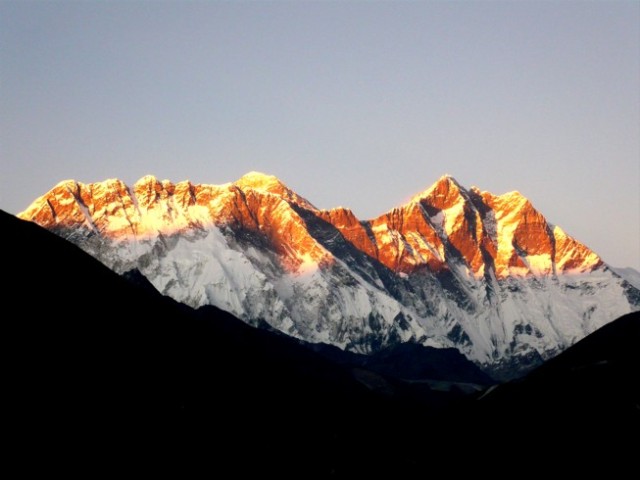
Sunset on Everest and Nuptse from Tengboche, Nepal.

Well, most do. I guess there are a few people who are so content with their lot they have no wish to stray out of the round of their day to day life, but I think they must make up a tiny minority.

And while it is a great achievement to be satisfied with your life, and not to constantly want a more expensive car, or clothes or jewellery, we all need something to strive for, otherwise we tend to stagnate.

Even the most altruistic, who might strive to eradicate poverty, or bring justice where there is none, need a more personal challenge sometimes.

For some it might be speed – the need to have a go on a fast motor cycle or racing car somewhere. Maybe to try a bungee jump. To feel the adrenaline surge that comes with the mixture of excitement and fear.

shakira

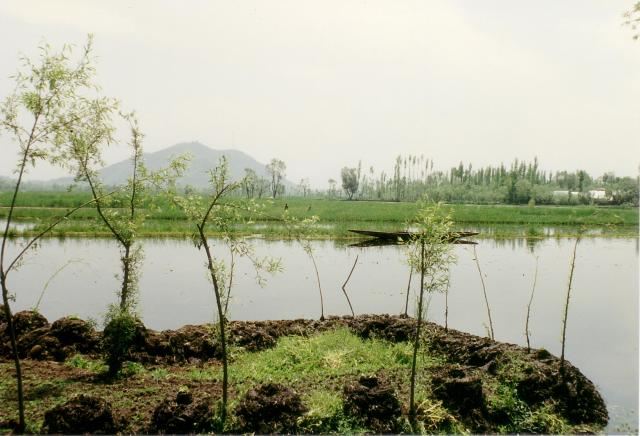
On Lake Dal, Srinagar, Kashmir, India.

For others it might be the very opposite. Many of us need the opportunity to spend time away from the 21st century. Those of us who do not like the noise and speed and intensity of our modern life, need to find respite in places like the mountains, or deserts, or somewhere else remote from modern life. Woodlands at night, perhaps, or a windswept beach on an island. The challenge is frequently to find these places or to access them. Perhaps even to make the time to do so.

img_0012

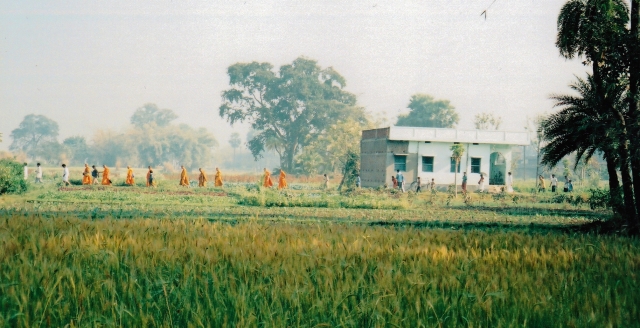
Monks on their way to morning Puja, Bodhgaya, India.

Those are the sort of places I need, and where I often feel I can do my best creative work. The only places I feel I can really relax.

And the reason I had to walk the Annapurna Circuit.

Just while putting together this set of posts, at times I have looked around the room at the photographs of the Annapurnas, the maps, then at my rucksack in the corner, and felt an almost irresistible urge to just…go.

This sense of adventure is frequently in conflict with the other strands of my life, though, because (like most people) my lack of money and the demands of work and family, and other commitments, prevent me just scooting off for a week or month away whenever I feel like it.

105

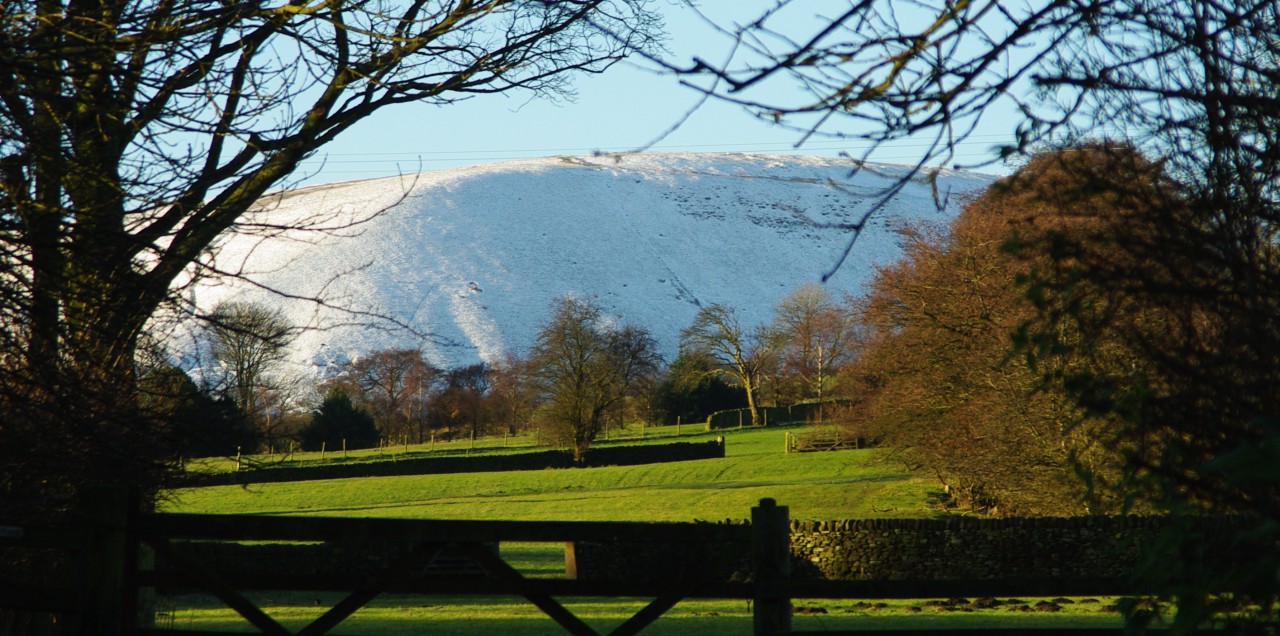
A track through fields and woods a mile or so from where I live.

But I have always tried to take the opportunity to go off to these places when I could, as I reasoned that I couldn’t know how long I would still be able to.

What made me determined to do this was a missed opportunity when I was working temporarily in Peru. I knew that when I finished my six week stint and returned to UK, I might no longer have a job. So when I was offered the chance to stay on for a week to visit Cuzco and Machu Pichu with friends I declined, even though it would only have cost about a hundred dollars for the whole trip. And I regretted it ever afterwards.

179

Little Adam’s Peak, Ella, Sri Lanka.

I have no intention of looking back on my life later and wishing I had done these things when I had the opportunity.

Annapurna Circuit, Nepal -1

In 1988 – thirty years ago! – I walked the Annapurna Circuit. This has long been regarded as one of the top ten walks in the world, and is certainly the walk I have enjoyed most. I put up a post about the circuit a year and a half ago (here) should you wish to read it, but as a celebration of that anniversary, I thought I would put up some more photographs over several posts.

Today, they are all from our second day’s walk.

IMG_0016

We camped the whole way, since there was virtually no accommodation on the route then. It was sometimes possible to sleep on the floor of a tea-house, but that usually meant an uncomfortable night in a very smoky atmosphere, and probably not a great deal warmer than a tent. It meant we were travelling with four guides, a couple of cooks, a couple of ‘kitchen boys’, and an average of fifteen to twenty porters (every so often one or two would leave, and others get hired from a village we were passing through).

IMG_0012

We began our walk from Gorkha, walking through the Terai – the sub-tropical forest region that stretches across most of Southern Nepal and much of the Himalayan Foothills of Northern India. This was a land of small rural villages, terraced fields carved painstakingly out of the hillsides, and, naturally, wooded hillsides.

Much of the woodland had already gone, cut both as clearance for fields and for fuel and fodder. It was already leading to much soil erosion and the degradation of the remaining soils. With the passage of thirty years, this can only have got worse.

On day 2 we walked from our campsite beside the Dharandi Khola to the settlement of Chepe Ghat.

IMG_0013

Transport in these areas was entirely by foot, usually in the form of porters who carried massive loads upon their backs. Occasionally by pony, or by bullock, but never by yak – they do not survive at these comparatively low altitudes. In 1988, walking the Annapurna Circuit was entirely on tracks and paths, since there were no roads of any description on our route. Today, there are motorable roads along part of it, but back then we did not see or hear a motorised vehicle for the duration of the trek.

IMG_0014

Building materials in these areas were, and predominantly still are, wood, thatch, and mud. Stone was used only in larger settlements.

The boy pictured above, incidentally, will now be in his late thirties.

IMG_0015

Wooded hillsides, with the terraced fields belonging to a nearby village encroaching.

IMG_0004

Rice paddy – terraced fields flooded for the planting of rice, the staple crop of the Nepal Lowlands.

Prayer Flags

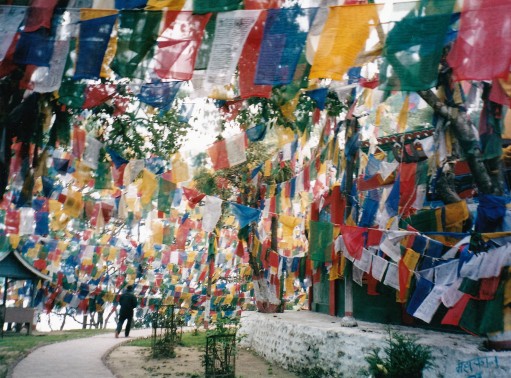
Prayer flags are found wherever Tibetan Buddhism is found. As they flutter in the breeze, they use this wind to send blessings out into the world. Through many parts of the Himalaya they adorn monasteries and humble homes, chortens and bamboo flagpoles. They are tied in their hundreds and thousands to bridges, above mountain peaks, and in the courtyards of every conceivable building.

Elsewhere, they are to be found wherever exiled Tibetans live, and wherever their school of Buddhism flourishes.

The makers of the flags intend the prayers and blessings that adorn them not for their own benefit, but for the benefit of all beings.

eleven

Prayer flags in the Yumtang Valley, Sikkim, India.

prayer flags

Prayer flags, Observatory Hill, Darjeeling, India.

IMG_0005

Prayer flags outside a monastery in Sikkim, India.

106a

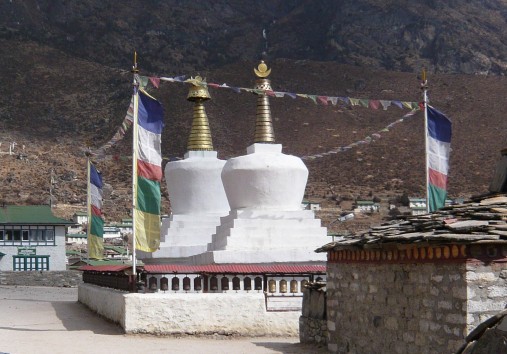
Prayer flags adorn a pair of chortens and walls of prayer wheels in Khumjung, Nepal.

139a

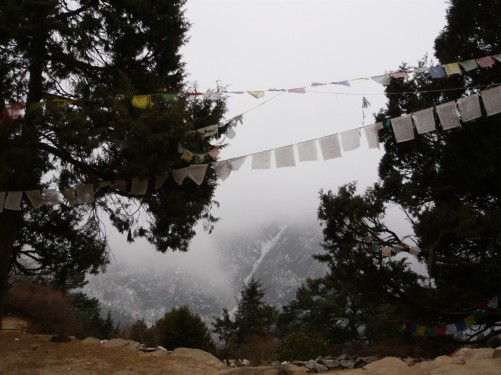
Prayer flags at Tengboche, Nepal.

141a

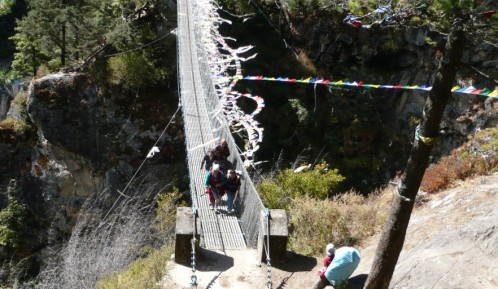
And adorning a bridge of the Dudh Khosi, again in Nepal.

Kanchenjunga

071a

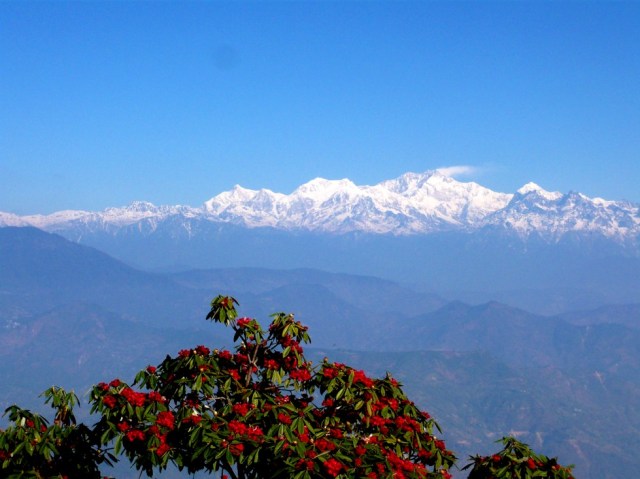
Kanchenjunga, the third highest peak in the Himalaya (and the world) taken from Observatory Hill, Darjeeling. It is the peak right of centre, with the spindrift blowing from the summit.

Have a great Thursday.

Just Look at Ghat!

Ouch! Probably my worst title yet!

I can’t help it…I’ve not been well…

…well, only a cold, but you know what we men are like.

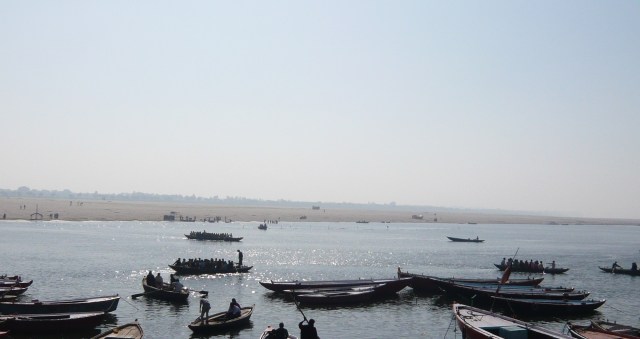
In another attempt to feel instantly better, I’ve nipped across to North India (only in my imagination, unfortunately), to picture Kedar Ghat, on the banks of the Ganges, in Varanasi.

056a

Ghats, a Hindi word, are sets of steps leading down to a river (and also mountain ranges or passes – The eastern and Western Ghats in Central India). It has also come to mean a level place at the edge of a river where Hindus cremate their dead.

In Varanasi, there are between 84 and 87 ghats, depending upon who you get this information from,. The Manikarnika Ghat, or Ghats (possibly this is the origin of the confusion over the number) is the ‘burning ghat’, where cremations are carried out 24 hours a day, all through the year. The source fire there has supposedly been burning for thousands of years, but photography is actively discouraged, hence my only shot is one taken from a distance.

046a

Of course, the ghats are also used for bathing. Hindus bathe en masse there, as a dip in the Ganges is meant to wash away sins. Important pujas (ceremonies) take place at sunrise and sunset. Boat trips to view the ghats are very popular, and finally much of the city’s laundry gets done at the dhobi ghats (dhobi meaning laundry).

040a

Namaste!

Go On A Journey!

Everyone should go on a journey; a journey of discovery.

Even if they only do it once.

The journey will be different for everyone. No two journeys will be the same. But what they will have in common is that they will all be journeys where the traveller discovers something about themselves, as well as the environment where they have chosen to journey. The essence of the journey is that it gives the traveller both time and space to think; that on the journey they allow themselves to be open to new sights and thoughts and people.

boat

For some, it will be a carefully curated tour to a country with a different culture to their own. Perhaps a Westerner travelling to Nepal or Cambodia, or an Indian visiting Spain or Iceland, with a carefully prepared itinerary designed to help them get the most out of their journey.

For some, it could be much the same, but as an independent traveller. They would have the flexibility to either keep to a strict itinerary, or to go off somewhere new as the whim takes them. Because everyone’s sense of adventure is different.

For some, it will be a long, long trek through difficult terrain, pushing themselves physically and mentally every step of the way.

img_0010

For some, it might also be a long journey, but under easier conditions, where the aim is more one of contemplation, perhaps a pilgrimage of sorts.

For others, the difficult terrain might be that of their prejudices and fears – the terrain of the mind.

006-2

What starts as a pilgrimage might end up in your discovering that you do not believe in God; well, that is fine. Remember, it is perfectly possible to be a spiritual person without believing in any god.

Although what ‘spiritual’ actually means is not so easy to nail down. I think of it as pertaining to the spirit, rather than to material things. In that sense, I would associate altruism with the spiritual, and greed with the material. A sense of calm and peace with the spiritual, a rowdy hedonism with the material.

For some, the journey might be from their house to a town or village a few miles away, and the journey might take no longer than a day.

034a

It is essential, though, that the journey is undertaken for the sake of the journey. The destination is, in some ways, unimportant. It is what happens on that journey that matters.

Many, perhaps, will journey without realising that they have done so, or arrive at their destination not realising that is what it is. They might only realise later.

Some will arrive at a totally unexpected destination, and perhaps that is the best destination of all.

Go on, then, off you go!

Southern India (1)

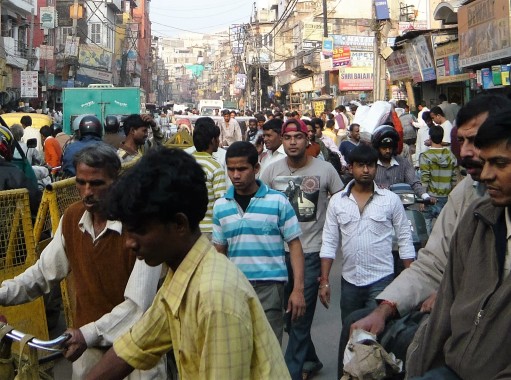
Southern India differs from the north in several respects. The first difference that the visitor tends to notice, once they have got away from the typical Indian maelstrom of airport, traffic, city centre, etc, is that with the less densely concentrated population comes a somewhat more laid-back atmosphere and attitude than in the north. The hassles and pressures, the touts, are still there, but seem somehow less intense.

The second real difference is in the culture. Southern India was never really assimilated into the Mogul empire, and only ever partly conquered, so there is a huge wealth of Hindu architecture and a proportional lack of Islamic, with next to no Buddhist remains and no continuing tradition of Buddhism at all. At times, it seems as though the visitor has entered a different country, but India has a way of reasserting itself on the senses…

trichy stall

Stall outside Sri Ranganathaswamy Temple, Tiruchirappalli (Trichy), Tamil Nadu State. All over India, amongst the heat, dust and drabness that pervades the majority of the population’s day to day life, one finds colour.

trichy garland seller

Garland seller outside Rock Fort Temple complex, Trichy. The garlands will be used to decorate statues of gods during pujas (ceremonies) conducted in the Temples.

rock fort temple

Rock Fort temple, Trichy.  A view of the main temple from the pathway that leads to the tiny temple at the top of the rock. Non Hindus are not allowed into the main temple, dedicated to Shiva, or the temple at the top dedicated to Ganesh…although for a small donation, the priest is willing to waive this rule…

From my journal:

‘The trip is not particularly uncomfortable. It is a typical five hour trip through India – dust, buffaloes, half a dozen schoolchildren stuffed into an autorickshaw, wait-till-the-other-guy-blinks over-taking, temples large, medium and small, huge dry river beds, The Cauvery full of water, trees, strange crops, broken down trucks, train lines stretching arrow-straight into the distance, rows and rows of stalls with neat piles of fruit and vegetables, rows of hanging water bottles from the roof, biscuits, samozas, cigarettes and crisps, a child squatting in the dirt, mum feeding the family beneath the tree, Tiffin Ready signs, smart petrol stations, mud huts, cement buildings, palm shacks, huge residences surrounded by high walls – all concrete, police traffic blocks (ignored), it all blurs into one.’

trichy temple 2

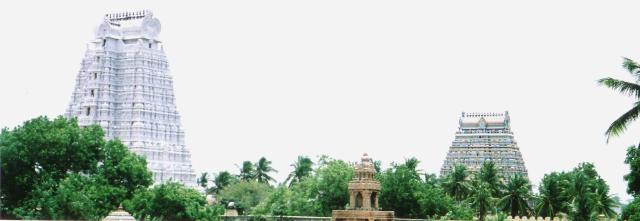
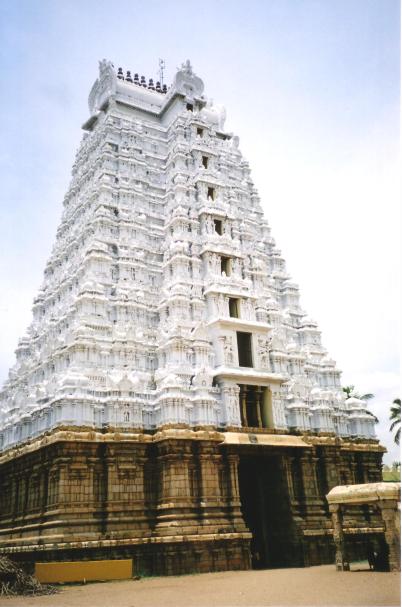
Part of Sri Ranganathaswamy Temple complex. This is the largest of all temple complexes in India, covering a staggering 60 hectares, and is dedicated to Vishnu. The Gopuram (tower) on the left is painted white, as a symbol of purity, and is one of the buildings that non-hindus are not permitted to enter.

white goporam trichy

The White gopuram, in all its glory.

trichy puja 2

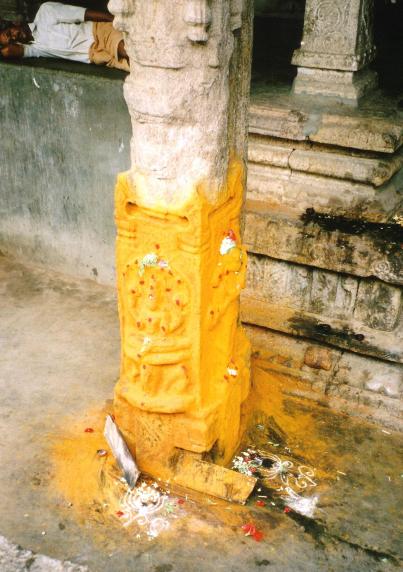
Pillar in Sri Ranganathaswamy Temple, liberally decorated with coloured powders and with offerings of incense, rice and flowers. Devotees of the god concerned will conduct their own personal pujas to ensure health and prosperity, or perhaps for some more specific purpose, such as to request the birth of a son or success in a particular undertaking. Although this temple is dedicated to Vishnu, other gods are represented there and prayed to.

trichy puja 1

Another, nearby, pillar in the same temple. Although in the same temple and close to the pillar in the previous picture, this shrine will be to another, different, god. Its use, however, will be the same.

Monsoon

monsoon

Monsoon – 18ins x 24ins , Acrylic on board.

I painted this a long time ago.

Although I have been caught up in a few very heavy downpours in India, I have never been there during the monsoon. And I was reminded of that a day or two ago while having an online conversation with another blogger.

It is something that I would like to experience, sometime. In India, it is an exciting, a very welcome time – after the temperature has been steadily climbing for months, and everywhere is dry and parched, the rains finally arrive to cool the air, and the earth bursts into life.

Everyone rejoices!

But westerners avoid it. Why go to India during the monsoon, just to get wet? is the general feeling.

Yet I have a yearning to witness it, and to use it in my writing, too. To write…take photos…paint…

And just to experience it!

Ladakh 3


IMG_0027

The Wheel of Life, Tibetan Buddhist wall painting, Thikse Gompa. The Wheel represents the cycle of being, the various realms of existence, and the three poisons (desire, ignorance and hatred).

IMG_0026

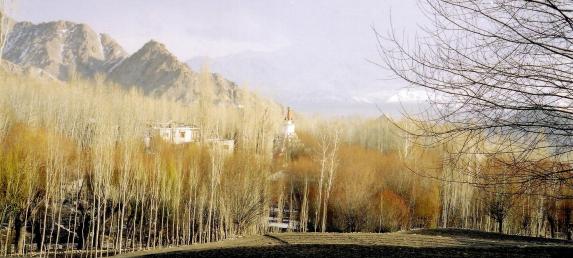
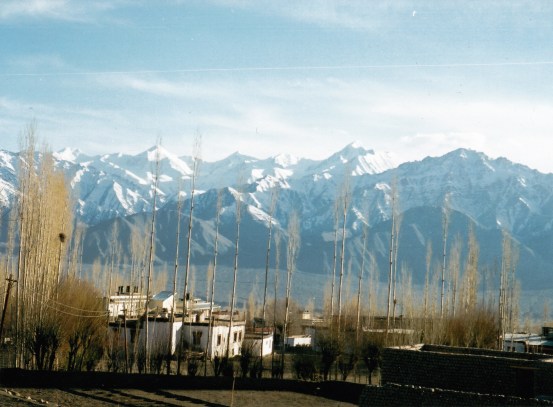
View of the Stok Mountains, Part of the Himalaya Range, above farms and poplars on the edge of Leh, Ladakh.

From my diary, Friday 15th April 2005:

Outside, my hosts are planting their potatoes, today. It’s been fascinating watching over the last week, as they’ve dug over the whole vegetable garden (about an acre), then divided it up into a total of about fifty smallish and four large plots, all neatly divided with earth walls, between which are carefully dug channels to the stream that runs along the side.

Then, over the last couple of days, half of the plots have had compost dug in and the channels opened one by one to flood each plot for a set time, then closed and the water allowed to soak into the earth.

The first of the large plots is now being planted with potatoes, presumably saved from last year’s crop, and some more digging is commencing at the far end of the garden, where so far there are no small plots.

I’ve just noticed what’s happening at the far end of the garden. It’s going to be one huge potato patch. Dad is digging, Mum is planting, whilst Granny is sorting the potatoes ready for planting. The little girl is happily employed in making mud-pies, like small children anywhere in the world under these circumstances!


The monastery at Thikse, Ladakh. Virtually the whole of the hill is covered in buildings belonging to the monastery, whilst the Gompa or temple crowns the top. Founded in the fifteenth century by monks of the Gelugpa, or ‘yellow hat’ school of Tibetan Buddhism, to which the Dalai Lamas belong.

Wednesday 13th April 2005:

12.45 and I’m sitting on a rock in hot sunshine at the foot of Thikse Gompa. The bus ride here was remarkable. Where else in India would you find that they don’t bother charging anyone for just going a couple of stops, or that they’d wait a few minutes whilst a passenger nipped off the bus to buy some bread? All along here, passed all this desert scenery, so similar to Oman. And so many fairy-tale castles and palaces and the like hanging precariously to the tops of cliffs. 
IMG_0028

Building at Thikse Gompa.

If it is so beautiful now, in winter, then what must it be like in the other seasons? I’d dearly love to come back to see! And after all the heat, dust and pollution in Delhi, well, need I say more? I’ve not even been asked once for baksheesh, either. 

Mandala painted onto roof of entrance to Shanti Stupa, Leh. The Shanti Stupa, or Japanese Peace Pagoda, is one of more than 70 built around the world by the Japanese Buddhist Nipponzan Myohoji Organisation, which was run by Fujii Guruji. They were built to promote world peace.

indus at chog

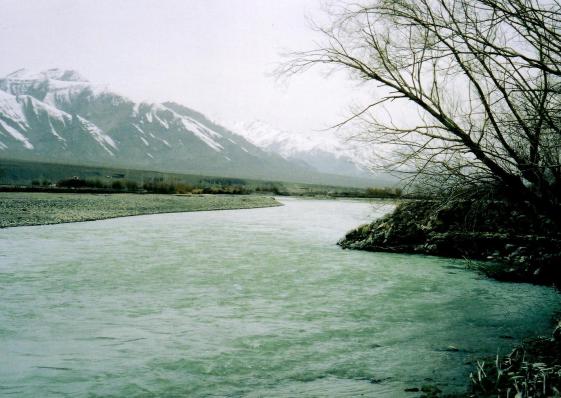
The River Indus at Choglamsar . The Indus originates in Tibet, near Lake Mansarovar – a lake sacred to both Hindus and Buddhists – and after flowing through Northern Kashmir, including Ladakh, passes into, and flows the length of, Pakistan, to the Arabian Sea. So, ironically, the river that gave its name to the state of India, flows mainly through Pakistan.

trees

Trees on the edge of Leh. Trees are highly important to Ladakhis – they provide timber for building, fuel, food in the form of walnuts and apricots, and fodder for animals. In all of Ladakh, the only trees that grow are willow, poplar, walnut and apricot.
Visit to Kashmir

I fell in love with Kashmir.

It was 1989, and I had come to India to have a closer look. A year before, I had flown to Delhi and the same day taken the bus to Kathmandu to go trekking in Nepal.

This meant that I had a lot of hours sitting and watching Northern India go past the windows of the bus, and this had piqued my interest and convinced me I should go and have a proper look.

So I arrived and, a couple of days later, took the bus up to Srinagar, a journey of 24 hours. In those days, I never kept a travel journal, which is something I regret now. It makes it difficult to piece together the details and leaves me, at best, with impressions and, of course, a number of photographs.

The photos, though, were taken on a cheap camera, and I did not take many.

But I had a week in Srinagar and although I did not venture far afield from there, I loved what I saw of the valley with its gardens, Lake Dal with its confusion of meandering paths through fields and grass, naturally, the houseboats on the lake and also the shakiras, the sampan-like boats used by the fishermen and the traders on the lake.

shakirab

Shakira on Lake Dal

I found a houseboat when I arrived, managing to resist ending up in a hotel in town that was being pressed on me by a fellow on the bus. I seem to remember I found my houseboat by going to the lake, hiring a shakira and asking the boatman to take me to the first of a long line of moored houseboats, where I asked if there was a room. I think at the second or third I struck lucky.

I keep trying to remember the name of my houseboat.

Occasionally, during their waking day, a dreamer will catch a glimpse, a snapshot – no, not even that; perhaps no more than a hint, a flavour of a previous night’s dream. Something akin to catching a scent on the breeze that is gone before it is even realised that it was there. That is the best way I can describe the teasing hint I may get of the name of that boat. I think ‘Ah, yes, it began with ‘S’…no, wait, it didn’t, but there was definitely an ‘S’ in it somewhere. Perhaps…’ then it has gone.

But it was my own floating palace for a week. A marvel of beautifully carved wood, a magnificent bedroom and living room all to myself, and a fellow who lived on board (not the owner, I gathered) who cooked my meals. When I wasn’t ashore exploring, I sat on the deck and read.

I remember the Shalimar Gardens, and that there were at least one or two more; masses of flowers, large lawns, trees…I wandered around there with the high mountains towering above us.

And, there was the beginning of the agitation. At that point, I knew next to nothing of India’s history or politics, and although I could detect the tensions, I was unaware of what they comprised. Once or twice, there were isolated gunshots in the distance, especially at night. ‘Bandits’, said my fellow on board, rather too casually. I came across a mass demonstration outside a mosque in town, with either the police or the army, I’ve no idea which, a very heavy presence. There was a lot of shouting, and the atmosphere was hostile enough for me to make myself scarce fairly quickly.

But I personally encountered nothing but politeness and good humour, and other than the underlying tensions, despite getting ripped off now and again in shops (it was Kashmir, and I was a tourist!), I felt comfortable and happy there. When I left the valley to return to Delhi and thence further afield, it was with the thought I would return again one day.

Regrettably, though, each time I have returned, it has not been considered a safe destination.

Perhaps, though…perhaps…one day…