The Old Way 5

Poem five out of six.

054

The Old Way 5


The Old Way now rises,

Leaving the rich damp soil behind

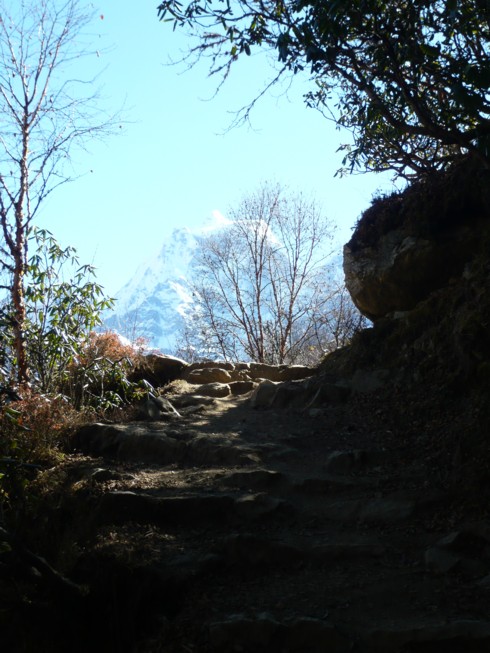
And attacking the ridge.

It becomes a wound, a scar,

A deep, dry incision in the chalk.

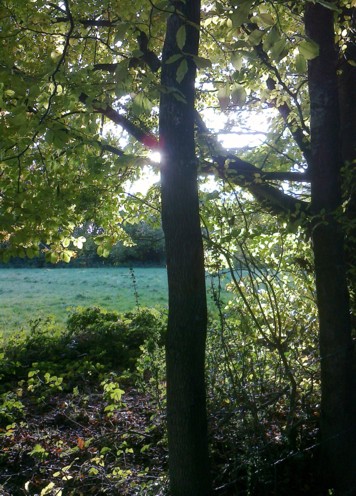
It runs up beneath the shelter of ancient trees,

Their roots knotted and matted beside the path,

It passes a mound, faintly visible in the turf;

The ghost of a cottage, if buildings can become ghosts.

Although is there any reason why they shouldn’t?

If they die abandoned, deserted and unloved,

After long years, perhaps only their sadness remains.


There are other ghosts here, too.

You might tell me it is only in my imagination

That I hear the plod of hooves, or

Voices speaking in strange tongues,

That I hear the creaking of cart and harness.

But I have heard them.

I know that we are walking in the footsteps of giants,

And giants do not fade away readily.


Those Old Paths

We seem to be in the middle of a spell of warm, sunny weather. It seems Spring really has arrived, although things could always change quickly, of course. But it’s the sort of weather that tempts me out to go walking as much as I can. We are extremely fortunate in the UK to have such a wonderful network of footpaths, open to the public.

042a

Dartmoor footpath

Many of the ancient tracks are still just that; just trackways that have never been turned into roads over the years. Often, this is due to their locations in the landscapes they traverse. Neolithic or Bronze Age man lived in a landscape that frequently comprised dense, almost impenetrable, forest, with networks of streams meandering through marshy lowlands, and wherever possible they would utilise the higher ground to move around, and hence we have long-distance footpaths today still following these same routes such as the Ridgeway, while modern roads tend to utilise the lower, flatter land where possible. Walking these Old Ways (and it is impossible to even mention them without referencing Robert Macfarlane’s wonderful book, The Old Ways!) always gives me goosebumps, as I feel I’m following in the steps of these prehistoric travellers.

And yes, we are lucky. Not only do we have so many of these paths, but we have the right to walk them whenever we please. But this has not always been the case. Up until comparatively recently, huge areas of the British countryside were owned by the landed gentry who denied the public any access. In 1932, the first mass trespass by five hundred men and women at Kinder Scout, in the Peak District, led to the imprisonment of five of the trespassers but this led to a second, three weeks later at nearby Castleton, involving ten thousand trespassers.

This growing movement, demanding the right to roam, led eventually to the creation of the first of the national parks in 1951, and to the Countryside Right Of Way act in 2000. So today it is possible to walk plentiful footpaths pretty well anywhere in the country, thanks to this incredibly successful movement of direct action.

My header picture at the very top of the page, incidentally, is a view of the Peak District looking towards Kinder Scout.

And it’s another gorgeous day today, so we’re off for a walk to make the most of it. I’ll catch up with everyone later.

On A Home Visit

On A Home Visit

038a

It has been a long time.


But when I used to live here

Did I notice how neatly

The trees seem to fit

Between earth and sky?


Did I realise

How right it all was?


The just-ness of the hills

Rising to the east,

And the is-ness

Of fields and streams.


My world of changeless certainty.


If I Could Just Wave A Wand…

337a

Pandering to my Inner Vagabond, here…

If I could just wave a wand,

I would wander the world.

With my notebook in hand,

And a bag on my back.


I would sleep under hedges,

In hotels and haylofts.

Drink beers under trees,

And eat cheese on the moor.


I’d watch clouds over hilltops,

And boats on the ocean.

Shapes and shadows at sunset,

A moon with a view.


And I’d write trivial poems

Of snowfall and sunlight,

Birds singing at dawn

And the sounds of a stream.


There’s the lure of a skyline,

And skylarks above me,

Wine and wood smoke my welcome

At the end of the day.


To travel, to journey,

There’s magic in wandering

Over moorland and downland,

Through woods and through fields.


The world’s full of wonders

All waiting for wanderers.

Let me follow these paths

For as long as I can.


Sojourn on Dartmoor

I’ve been on Dartmoor. My goodness, it was nice to get away.

016a

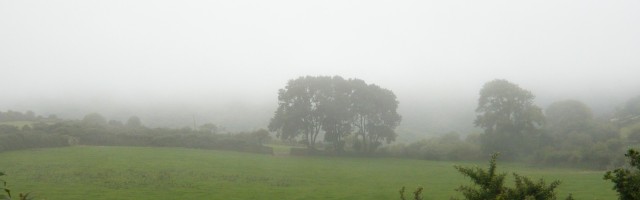
Dartmoor is frequently misty and moody, as it was on one walk.

021a

Yet it can often be fine and sunny. But whichever it is, I always think of it as unfailingly beautiful.

049a

The sheep get everywhere, including on the top of old spoil heaps from derelict mine workings.

036a

Hooten Wheals is one such disused mine, with a plethora of remnants of old buildings and machine structures still extant. I believe the circular structures are the remains of buddles, circular shallow settling tanks used to extract the minerals from the rock.

056a

There are also plentiful remains of farms, houses and all sorts of settlements, from prehistoric times through to the recent past. These buildings at Swincombe are probably not particularly old.

052a

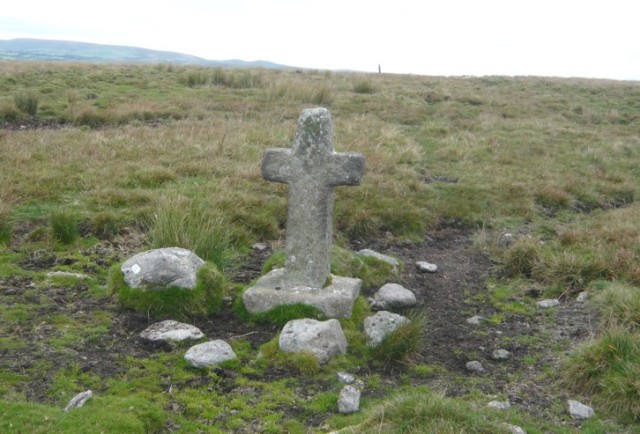
Old stone crosses are found all over Dartmoor. Their uses include marking the boundaries of the influences of various abbeys and waymarking paths. This one (and the one in the distance) are on Ter Hill.

042a

And because Dartmoor is so open, you get skies.

Wonderful skies.

Very Random Sri Lanka!

Finally, it’s warm and sunny here! Hooray!

So here are a few random pictures I took in Sri Lanka some while ago. So what relevance is there in that? None, really…

108

I just like the randomness of them.

150

Lurking Kingfisher…

206

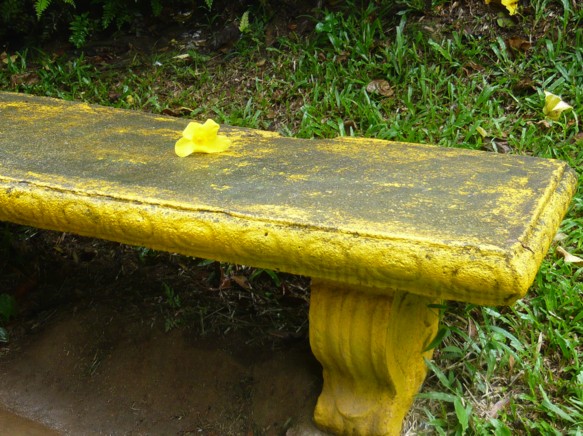
That, incidentally, is a Cannon Ball Tree.

206a

And that’s why.

210

And I have no idea what that tree is called, but the strange roots are little more than a hand-breadth wide, and as tall as I am.

Annapurna Circuit, Nepal – 4

Part Four – from 30 years ago.

IMG_0037

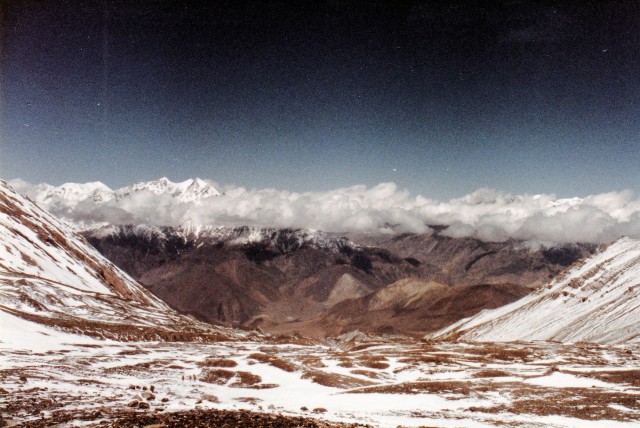
On the western side of Thorung La, the climate is much drier and in places the scenery is very much that of a desert landscape.


IMG_0039

As you descend, though, you soon come across settled areas where meltwater from the snows and glaciers higher up enable vegetation to grow.


IMG_0038

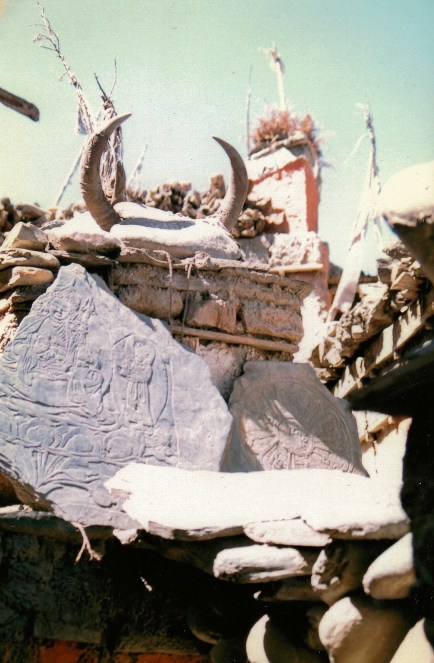
Mani stones plus a fine set of argali horns on top of a wall in Kagbeni. The argali are the wild sheep of the Himalaya.


IMG_0040

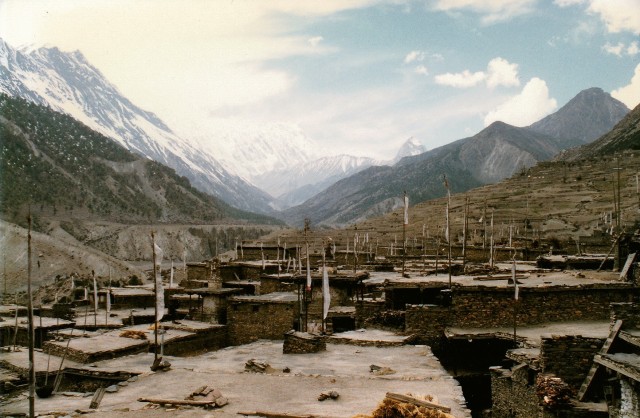
In Tukuche, at 2590m – less than half the altitude of Thorung la, which we had crossed just two days before.


IMG_0041

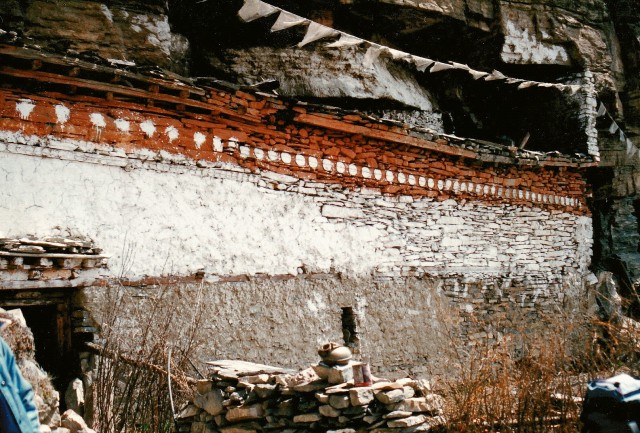
It was in places like this, that we really felt we could be in another century. Buildings of stone and beautifully carved wood, ponies for transport, no wheeled vehicles, and the two fellows to the right of the picture are busy crushing lengths of bamboo to a fibrous pulp, ready to make into paper.

It was in places like these, actually, that I felt I could just leave the world behind and spend the rest of my life. Yes, totally impractical, I know, but…


IMG_0042

We came for the high peaks, but the mountains lower down have a breathtaking beauty of their own.


IMG_0043

Sunrise on Poon Hill is a treat most trekkers ensure they don’t miss. Unrivalled mountain views, and in the spring the massed flowers of the rhododendron forests.


IMG_0044

Ah, yes. Did I just mention the rhododendron forests?


IMG_0045

Photos just don’t seem to do them justice.


IMG_0046

And then a few days later it was over, and we were back in Kathmandu…

…and that is a different kind of wonderful…

Annapurna Circuit, Nepal – 3

At Manang, we pitched our tents on the flat roofs of the buildings…

IMG_0028

…essentially, it is the only flat area in the village that doesn’t either have someone living on it or crops growing on it.


IMG_0029

A Buddhist temple in Manang. We took care to visit the priest and receive his blessing for the crossing of the pass in a few days time. The high pass- Thorung La – is at 5416m and  is the highest pass in the world, and who knows what the weather and fate might decide to throw at us.


IMG_0030

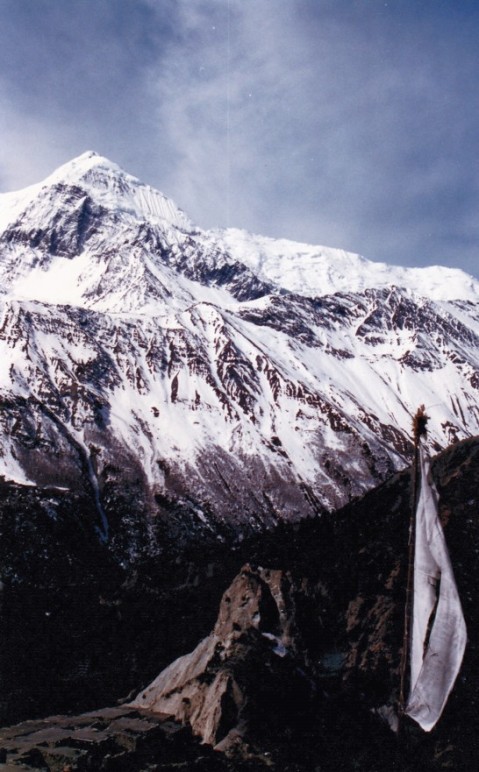
A view of Annapurna I (I think!) from Manang. Annapurna I is the tenth highest mountain in the world, but also one of the most dangerous. The reason for my uncertainty is that the route of the trek takes us around some twenty or so peaks, including Annapurnas I – IV, Gangapurna, Tara Kang and Khangsar Kang, all of which can be seen from the Manang part of the trail.


IMG_0031

Nomadic herders’ camp above Ledar, at about 4300m. Theirs is not an easy life.


IMG_0032

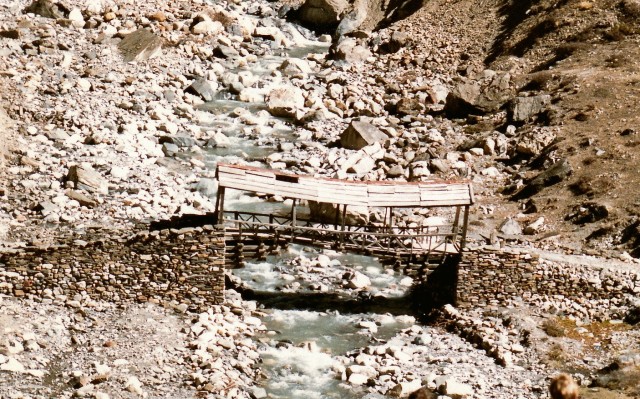
Bridge across the Khone Khola, near where we camped before crossing the pass. The bridge is covered to protect it from snowfall.


IMG_0033

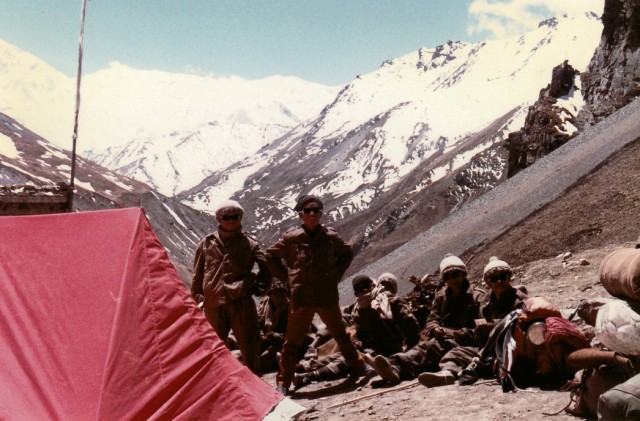
The porters at Thorung Phedi, where we camped before crossing the pass.


IMG_0034

A couple of hours later…


IMG_0035

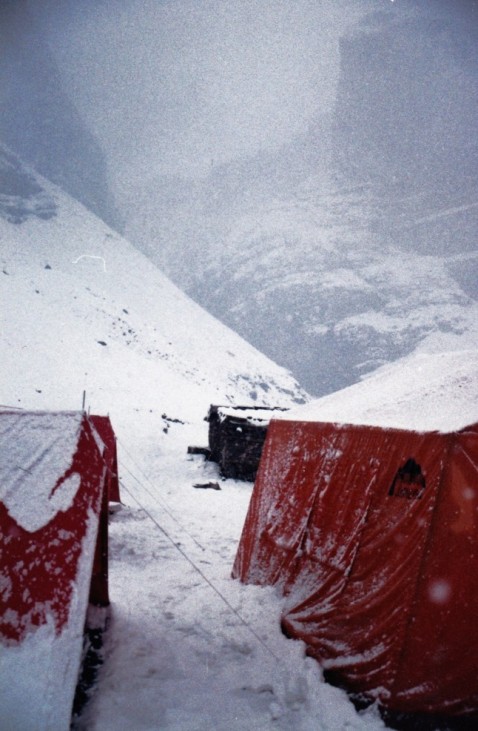
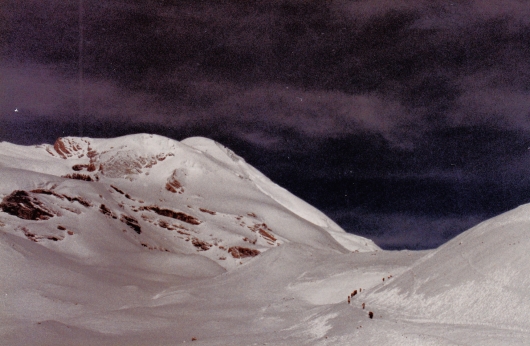
We were snowed in the next day (and you can get very bored stuck in a tent for a day), but the following day we set off at dawn to cross the pass (Note the small figures passing the first rock).


IMG_0036

Some of the rocky, icy, snowy, lumpy bits beside us as we crossed the pass.


IMG_0011

After several hours hard slog through the snow, and the pass crossed, we began descending the western side down towards the village of Muktinath.

All Hail The Conquering Hero!

I’ve never wanted to ‘conquer’ mountains.
img_0010

Or any other parts of the world, really.

I’ve always felt this was the wrong way to think of a journey. It was ridiculous to think I could impose my will upon a mountain, or on a desert, or indeed upon any part of my route. That I could, perhaps, somehow bend it to my will.

I feel it is more a case of preparing as best as possible, including mentally, and then perhaps said mountain will tolerate my presence; will allow me passage.

‘Conquering’ also carries the implication of invasion, of fighting, of strife. That is not the sort of relationship I want with mountains, or with any other place I choose to travel.

Certainly, in the past I have travelled at least partly with that mindset at times.

IMG_0005

Some of you may recall I wrote about an extremely foolish journey I took in Oman when I lived there almost 30 years ago (Mr. Stupid Goes For a Walk). Although I was running low on water, I pushed myself to the limit to reach the final ridge of hills on the route I had decided I was going to achieve one day, nearly killing my stupid self in the process. And although I achieved my aim, I didn’t feel victorious.

Only a bit stupid.

I prefer instead to think of myself as a visitor. And as a visitor, I need to have some manners. You do not expect to find the visitors pushing through your house and demanding to see this or to be given that, so I don’t.

I am not out to break records, nor to prove how tough I am.

This does not imply a lack of ambition, nor a lack of determination. Indeed, I have both – it’s just that the mindset is a little different. In particular, I give myself different priorities. I want to reach my goal, but if I don’t it does not matter. I think I’m more attuned to my own safety, and perhaps that of others. I hope I can be receptive to the feelings of others, too.

A good example in the climbing world is that of the mountains in Nepal that climbers are forbidden to reach the summit of, due to the belief that they are the abode of gods. Theoretically, a climber will stop some 10 meters or so short of the summit. Opinion is naturally divided over whether a climber would, or wouldn’t, in the absence of any witnesses, respect that ban.

I would respect it every time.

The mountains, of course, are inanimate. They do not wish me harm or otherwise. Neither do deserts or oceans. Even the most inhospitable of landscapes is neutral. It does not care whether I succeed in my aim to reach or traverse a particular part of it, and it will not hinder or help me in the attempt.

154

My feelings about a landscape are just my reactions to it, and if I should choose to give this landscape a kindly or vindictive character, I am only projecting my own feelings onto it.

This may give me comfort, or otherwise, but will make no material difference.

Maybe I am simply suggesting it’s good to travel with humility.

I have touched upon that before!

Prayer Flags

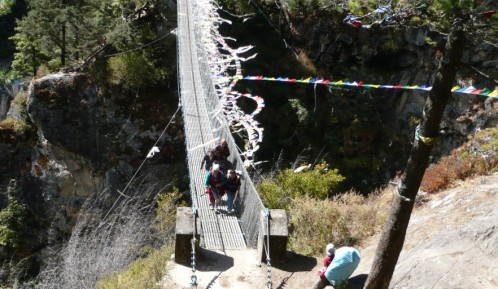
Prayer flags are found wherever Tibetan Buddhism is found. As they flutter in the breeze, they use this wind to send blessings out into the world. Through many parts of the Himalaya they adorn monasteries and humble homes, chortens and bamboo flagpoles. They are tied in their hundreds and thousands to bridges, above mountain peaks, and in the courtyards of every conceivable building.

Elsewhere, they are to be found wherever exiled Tibetans live, and wherever their school of Buddhism flourishes.

The makers of the flags intend the prayers and blessings that adorn them not for their own benefit, but for the benefit of all beings.

eleven

Prayer flags in the Yumtang Valley, Sikkim, India.

prayer flags

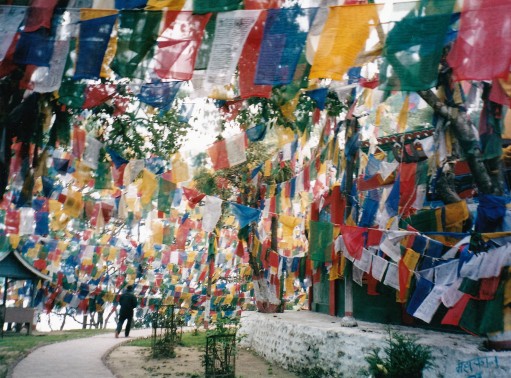
Prayer flags, Observatory Hill, Darjeeling, India.

IMG_0005

Prayer flags outside a monastery in Sikkim, India.

106a

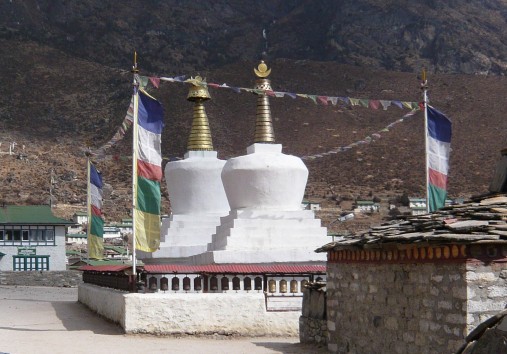
Prayer flags adorn a pair of chortens and walls of prayer wheels in Khumjung, Nepal.

139a

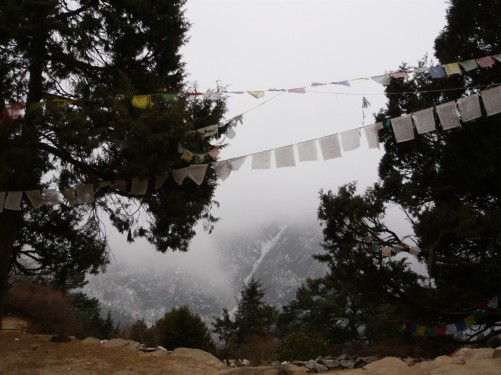
Prayer flags at Tengboche, Nepal.

141a

And adorning a bridge of the Dudh Khosi, again in Nepal.