26th August 2023

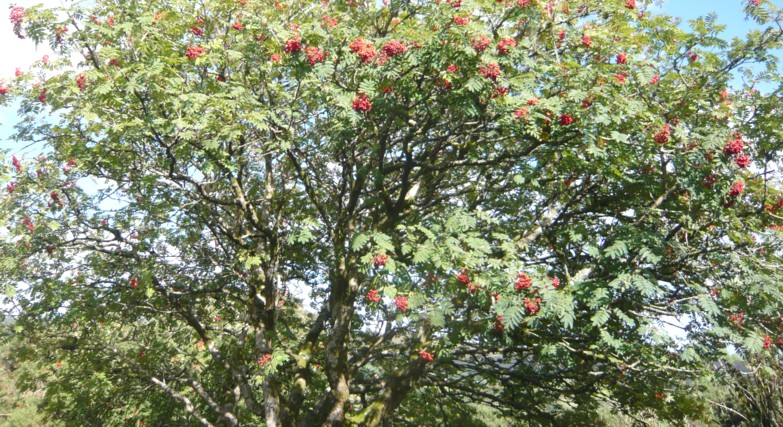
I tested one of the few apples on our tree in the middle of the month to see how ripe it was, and it came away from the branch easily. We shouldn’t be picking apples in mid-August, surely? But it’s a poor year, too. There are barely a dozen apples on the tree, whereas last year we must have had at least five times as many. And our crab apple, usually weighed down with fruit which we leave in situ for the birds over winter, is almost equally bare. Our neighbour’s Rowan tree looks beautiful, although Rowan trees always do, but it definitely has fewer berries on it than usual. Our Hazel tree also seems to have far fewer nuts than last year.

And in the wild?
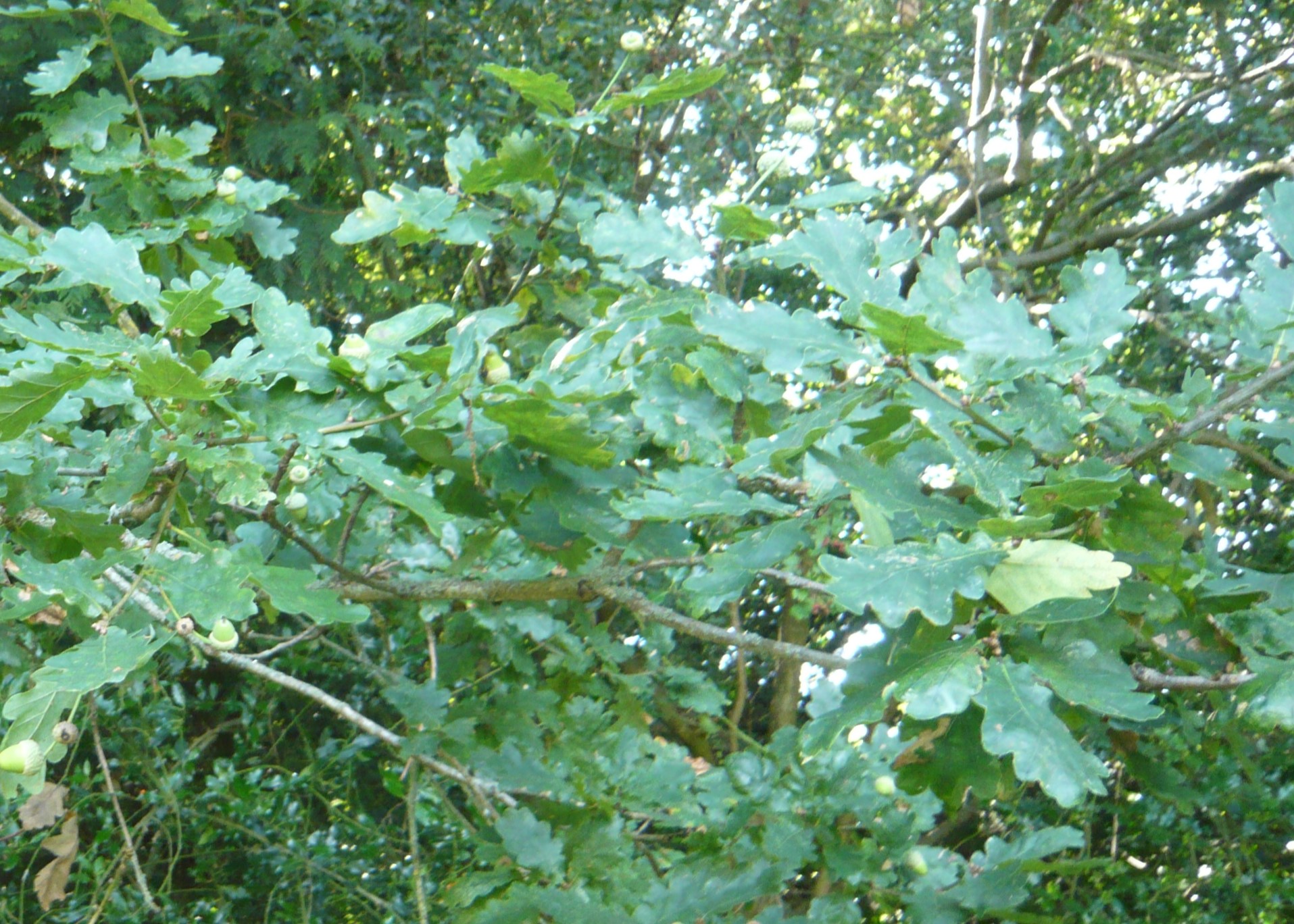
Bit of a mixed bag, really. Some of the hazel trees near us are fairly heaving with nuts, while others have very few. The oaks have a good crop of acorns, but nothing on last year when the woodland floor was covered an inch or two deep. But last year was a spectacularly good mast year. This year the hawthorns have a decent amount of berries but nothing special, much like the elders, while the hollies seem to be loading up with a whole mass of them. That, at least, is the picture in my little corner of South East England. Last winter was quite mild. But even should we have a harsh winter this year, the outlook for wildlife seems not too bad from the nuts and berries perspective.

These things do often seem to follow a cycle of alternate years, although I don’t know why that should be. I had thought the apple blossom was a little late this year, but I really don’t know whether that’s just my imagination.

On Tuesday evening I went for a short walk. It had been a hot day and earlier I had seen three tiger moths, which was rather a treat. By the time I left the house, though, a little before eight, the air was cool, the birdsong seemed a little louder than usual, and there was a magical light in the sky as the sun disappeared below the horizon. The church clock struck eight as it did so. In the woods, there were now patches of sudden night where the trees grew close together, through which the path could be seen like a pale wisp of misty light. By the time the church clock chimed the quarter hour it was quite dark, although patches of daylight still showed in the clearings. Soon there was so little light I headed out of the woods and homeward.

A few minutes before half past, a mixed flock of jackdaws and rooks flew over, the jackdaws chuckling and gossiping noisily as usual as they headed east towards their gathering place on the edge of the town. There, they will be joined by other flocks and once all are there, just before dark, they will all fly off together to their night’s roost.

Although it is still August, the air already seems to have an autumnal feel to it.

Ah, Bluebells

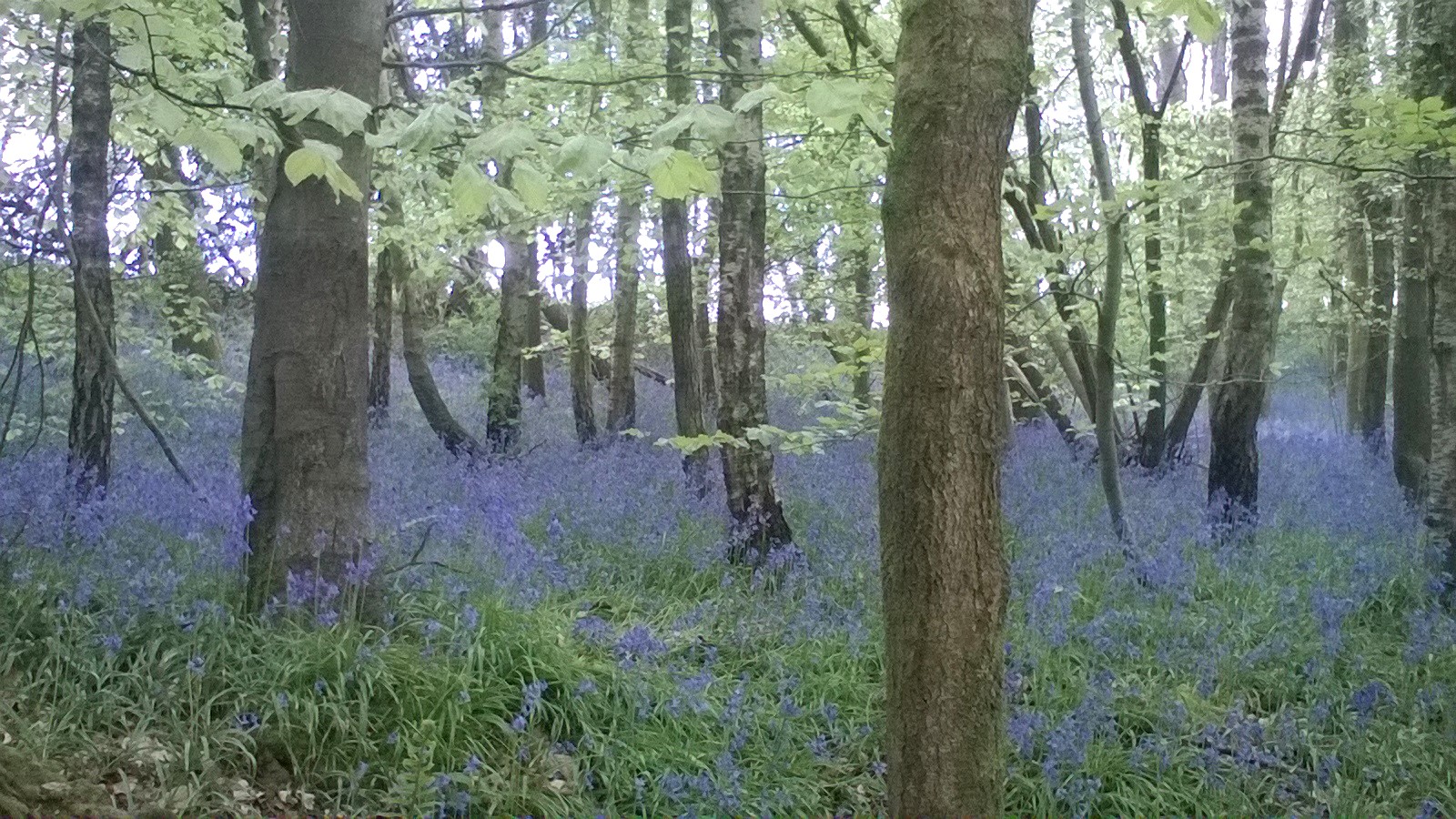
At the weekend we went for a walk to look at the bluebells. Nothing else was happening, so it seemed a good opportunity. They always look superb in this wood a couple of miles away from where we live and the sun even came out for a while. I reckon we might just be into Summer, now.

Apocalypse Deferred Just A Tiny Little Bit

Yesterday, I went for a walk around parts of Sussex and Kent. The sun shone – Hooray! I managed the whole walk without aching too much afterwards – Hooray again! I said good morning to some sheep and patted a very nice horse. I just knew it was going to be a Good Day.

At one point I went along a footpath I haven’t used for several years, and was delighted to see this:

And then another four miles or so later there was this:

The council have made this area a Designated Roadside Nature Reserve. Established for several years now, it has a rich variety of wildflowers and grasses, and is fairly humming with insect life.

Perhaps there is a little hope for us, after all.

The Compleat Trespasser by John Bainbridge

This time, the review without any distracting rants. Probably.

51pfb0Ihk8L._AC_UY218_

Sub-titled Journeys into Forbidden Britain, it immediately sets out its agenda: it is both a potted history of how the land was stolen from the inhabitants of Britain, and the long struggles to regain access to much of it, with numerous anecdotes of the author’s own escapades trespassing.

The story of how the inhabitants of Britain came to lose their access to the majority of the land is a story that has been repeated throughout most of Europe and beyond. Land forcibly taken by invading armies and distributed partly to their soldiers, but mainly their officials or nobility. Land enclosed by lords and kings for hunting purposes, burning villages and evicting their inhabitants from the land. Land taken by acts of Parliament to further enrich the gentry. Land given by kings to the established church, so that peasants might labour only to feed the rich and corrupt clergy.

Land that has been kept private and jealously guarded both by strict and cruel laws, and by equally cruel methods by the landowners themselves. Thus laws that deemed the starving and dispossessed villager might be executed for taking a rabbit from land he once lived on, to feed his family. Thus the mantrap that would cut a mans leg off. Thus countless thousands beaten and sometimes killed by gamekeepers and owners.

When I attempted to review this a week ago, it ended up turning into a full-blown rant against grouse moors (I do rants so well, these days!), but even today it is not just grouse moors that are fenced off just so the idle rich can enjoy slaughtering wildlife – there is plenty of woodland and more open land enclosed around the country and dedicated to pheasant shooting, for example. There are country houses with huge estates. Land taken by the MOD for training purposes, and never returned. There are many landowners determined to block access to legal rights of way. Although the Countryside Rights of Way act of 2000 was supposed to restore access to most of the countryside, there is still much that is off-limits.

Yet there are good landowners, too. The tales of John’s own trespassing include several encounters with sympathetic landowners happy to see walkers on their land, with the obvious proviso that they cause no damage.

The improved access rights we do have today were earned the hard way. Since Victorian times there have been mass trespasses intended to both bring the issue into the public forum, and to try to force change. The Kinder Trespass of 1932 is probably the most famous, yet many preceded that. It is thanks to the countless trespassers and campaigners of those days that we have improved access rights today.

The book finishes, though, with a plea. Firstly to campaign for further land reform, for better access rights – rights that are enjoyed in Scotland, but not England, Wales or Ireland. And secondly with a warning – the current government campaigned at the last election on a promise to criminalise trespass, so that anyone who deliberately or inadvertently strays from a public footpath onto private land might find themselves on a charge in a criminal court.

Anyone who enjoys the countryside in any form, enjoys spending time there, and walking in it, should read this book. It provides a very good, clear, account of where we are, how we got here, and what has been done to get us someplace better.

But also that we still have some way to go.

Review of Wilding by Isabella Tree

I wrote this just over a month ago, and never got around to posting it, for some reason.

91wfR0v1kNL._AC_UY218_ML3_

I have just finished reading Wilding, and I am almost overwhelmed with several feelings. The first is that I need to come back to this book after a month or two and re-read it, since there is just so much to take in. The second is that this book presents so much information that appears new to us in the twenty first century, yet was common knowledge some fifty to a hundred years ago and was hiding all the while in plain sight, as well as some new conclusions that were also, really, hiding in plain sight. And third, a feeling this might just be one of the most important books I have ever read.

This means I am attempting what appears to be ridiculous, and that is to review a book I don’t think I am yet ready to fully appreciate. But first impressions count for a lot, so here goes, although to keep this brief enough for one blog post, I can hardly even skim the surface.

Knepp is an estate in Sussex, England, which the author and her husband farmed for many years the way most farming is done nowadays – intensively. But as returns gradually diminished and the soil became more and more degraded despite the application of the usual chemical cocktails, they decided in desperation to take a leap of faith and re-wild part of the farm. The reasoning was they were going broke farming traditionally, so something new was needed – perhaps something revolutionary. What had they got to lose?

It was a huge learning curve for them, and many of the steps they took had unforeseen consequences. By allowing the land to revert to the condition it would have been in thousands of years ago, they discovered that many of our birds and insects, for example, actually favour environments and foods different to those we have assumed they do. Interestingly, on reading books written a hundred years or so ago about, for example, birds, they were simply rediscovering what was known then, but overlooked since. Just one example – pigeons do not actually prefer the seeds of cereal crops, but wild grass seed. The fact that they eat so much cereal seed today is due to the destruction of the areas of wild grass they would gave grazed before.

Probably the most important conclusion to take from this book is that a return to a more traditional, environmentally-friendly form of farming is not only better for the environment, but in the long term is even better for farmers who might be initially worried about losing out financially. It’s a win-win situation in that it would enable much wildlife to recover from its precarious, endangered, situation, it would reduce the risk of flooding during periods of heavy rainfall, restore soil fertility without pumping massive loads of chemicals onto the land and, consequently, into the water systems, and reward farmers with not only a better environment but healthier crops and stock which, in turn, would be healthier and more nutritious for the consumer.

Along with most others, I have always understood that back in the Neolithic period, when man was first making his mark upon the landscape in what would become Britain, most of the land was covered in thick, dense, woodland. I also understood that the large wildlife here – the megafauna – consisted of the likes of elk, cattle (aurochs), wild horse, mammoth and the such-like. Basically the kind of large animals that graze and browse the open, lightly wooded, grasslands of the African savanna today. Could we really not see the contradiction in this? This strongly suggests that the natural post-glacial vegetation of the British Isles was an open woodland, rich in undergrowth and grass, maintained by the regular grazing and browsing of this megafauna.

And from that, we understand that much of the habitat association we make today with our native wildlife is just plain wrong – we see birds and animals favouring a particular habitat and assume that is their preference, rather than understanding we have forced them into this by removing their real preferred ones.

There is so much to take in and think about in the this book, as I said at the beginning of this post, that a single review can only begin to hint at the mass of information to take in.

If you have any interest at all in our environment and what we have done to it, this book is an essential read.

A Little Piece Of Wilderness

I went for a walk yesterday, in search of wilderness.

Although we live on the edge of a small town, surrounded by gentle countryside, I still contrive to find some wilderness. It takes me about ten minutes to leave the streets and houses behind, and then I slow my pace and feel myself relax. Tensions drop away as soon as I am surrounded by trees.

There is little wilderness to be had where I walk, yet that does not mean there is none.

Hedgerows can be corridors of wilderness. Perhaps a transient wilderness, but a wilderness all the same. Many hedgerows in the British Isles are hundreds of years old, and although each individual one may be comparatively small, places within them may have been undisturbed for most of that time and during that time many species of plants have flourished there and smaller creatures made their homes.

My path goes through a thin belt of woodland, too open to be classed as a hedgerow and too open to have private, wild, places, but once I emerge into the daylight again, there is a hedgerow alongside the path. And for a short distance, the hedgerow widens several feet, and becomes a true wilderness.

002

Here, a patch of elder, sycamore and ash trees are surrounded by a dense undergrowth of brambles, interspersed with patches of nettles, a couple of holly bushes, and a few smaller plants squeezing into the daylight where they can.

It is the home of flies and spiders and beetles, visited while I am there by blue tits, magpies and some smaller birds I cannot identify.

Deep within it, there will be mice and shrews, and very likely larger mammals making their homes.

It is impenetrable by anyone without hacking their way in, and fortunately there is no incentive for anyone to do that.

It is wild, and I love that it is there.

In Praise Of Trees

It has been mind-buggeringly hot and humid for most of the last week, breaking records for mind-buggeringly hot heat here in the UK. But now, with heavy rain and gloom and a delicious green light filling the kitchen from the trees and bushes outside in the garden, it not only feels refreshingly cooler but looks it, too.

During this last week, almost the only way I could bear to be outside at all, was sitting on our lawn in the shade of the gorgeous hazel tree that dominates the garden.

005a

In so many countries, trees are planted to provide shade whether it be for travellers, or for residents in towns and villages or city squares.

They understand the value of the shade the trees provide in hotter climates, but in the UK we, and by that I mean governments and entrepreneurs and business people, we seem to be obsessed with cutting down trees, almost for the sake of it.

012a

Yet we can no longer pretend we have no idea how vital trees are; for us, for the ecosystem, for the planet. We need them to remove the carbon from the air and to replenish oxygen. They are habitats for huge numbers of wildlife. Their roots help bind and provide stability to the soil, preventing erosion, landslides, and the spread of deserts. Where they exist in sufficiently large numbers the water vapour they give off helps to bring down local temperatures and increase rainfall.

067a

They are sources of food for animals and for people, and for thousands of years their wood has been used for building dwellings, making furniture and utensils, fencing, tools, boats and wagons, and as a beautiful raw material for artworks.

And they soothe the soul!

Used intelligently and sustainably, they will continue to perform this role for as long as we wish.

001a

Yet despite all we now know, we continue to cut down trees at a ridiculous rate. In Brazil, we are losing rainforest now the size of three football fields per minute! The rainforest in Indonesia is also being cut down at a rapid rate. The HS2 rail link planned for the UK will cost a stupid amount of money and destroy massive amounts of woodland, just to take a little time off rail journeys that already happen.

IMG_0018a

Yet there are many smaller – petty – instances of trees being cut down that amount to official vandalism, no less. I feel particularly strongly that in many towns in the UK it has long been the policy that when trees planted along streets have become larger than the council thinks appropriate, they cut them down but rarely if ever replace them with new, younger, ones.

The call to re-wild areas of the UK is growing, and I feel we should now be devoting as much land as possible to the creation of new woodland, as well as re-planting hedgerows to replace fences, and individual trees in gardens and parks and along roads.

And stop cutting them down!

Wordy Wednesday 5

Words.

land

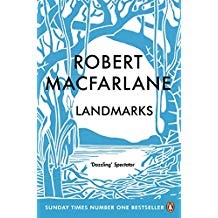
On World Book day I blogged about the wonderful collaboration between Robert Macfarlane and Jackie Morris, The Lost Words, and in this I suggested that perhaps it grew out of Robert Macfarlane’s book Landmarks.

But Landmarks is a marvellous book in its own right, and has much the the same aim as The Lost Words, in that it introduces the reader to scores of words it is unlikely they will have come across before.

These are almost exclusively words from Britain used to describe objects and phenomena in the natural world, be it a word peculiar to East Anglia for a small stream (a currel, since you ask), a word from Sussex for a heap of dung (a maxon), or, from Suffolk, a measure of herrings or sprats (a cade).

Most of these are obscure because they are words in local dialect, and therefore only used in a small number of places, or have fallen into disuse and been virtually lost over the years, or are very specialised words that it is unlikely the majority of people would ever come across.

The book is filled with background stories by the author, either of his own experiences or those of other writers and scholars with a deep love and understanding of words and the natural world, which makes the whole book far more than simply a glossary of lost words.

The reader is introduced to a wealth of knowledge and experience on all aspects of the subject, from seas and rivers to woodlands and mountains, farmed land, the strange no-man’s land at the edge of settlements, and even deep underground.

Personally, I have been trying to drop the word smeuse into conversations since reading the book. It is a Sussex word, and so was / is in use fairly locally to me and means…well, read the book and find out what it means.

Oh, and maxon. Naturally.

Certainly a five star read.

Annapurna Circuit, Nepal -1

In 1988 – thirty years ago! – I walked the Annapurna Circuit. This has long been regarded as one of the top ten walks in the world, and is certainly the walk I have enjoyed most. I put up a post about the circuit a year and a half ago (here) should you wish to read it, but as a celebration of that anniversary, I thought I would put up some more photographs over several posts.

Today, they are all from our second day’s walk.

IMG_0016

We camped the whole way, since there was virtually no accommodation on the route then. It was sometimes possible to sleep on the floor of a tea-house, but that usually meant an uncomfortable night in a very smoky atmosphere, and probably not a great deal warmer than a tent. It meant we were travelling with four guides, a couple of cooks, a couple of ‘kitchen boys’, and an average of fifteen to twenty porters (every so often one or two would leave, and others get hired from a village we were passing through).

IMG_0012

We began our walk from Gorkha, walking through the Terai – the sub-tropical forest region that stretches across most of Southern Nepal and much of the Himalayan Foothills of Northern India. This was a land of small rural villages, terraced fields carved painstakingly out of the hillsides, and, naturally, wooded hillsides.

Much of the woodland had already gone, cut both as clearance for fields and for fuel and fodder. It was already leading to much soil erosion and the degradation of the remaining soils. With the passage of thirty years, this can only have got worse.

On day 2 we walked from our campsite beside the Dharandi Khola to the settlement of Chepe Ghat.

IMG_0013

Transport in these areas was entirely by foot, usually in the form of porters who carried massive loads upon their backs. Occasionally by pony, or by bullock, but never by yak – they do not survive at these comparatively low altitudes. In 1988, walking the Annapurna Circuit was entirely on tracks and paths, since there were no roads of any description on our route. Today, there are motorable roads along part of it, but back then we did not see or hear a motorised vehicle for the duration of the trek.

IMG_0014

Building materials in these areas were, and predominantly still are, wood, thatch, and mud. Stone was used only in larger settlements.

The boy pictured above, incidentally, will now be in his late thirties.

IMG_0015

Wooded hillsides, with the terraced fields belonging to a nearby village encroaching.

IMG_0004

Rice paddy – terraced fields flooded for the planting of rice, the staple crop of the Nepal Lowlands.