Varanasi and Sarnath

The city of Varanasi is probably the most important place in India to Hindus, whilst the ruins of Sarnath, some 10km away, mark the remains of a site of great importance to Buddhists. I stayed there for three days, some 8 years ago.
039
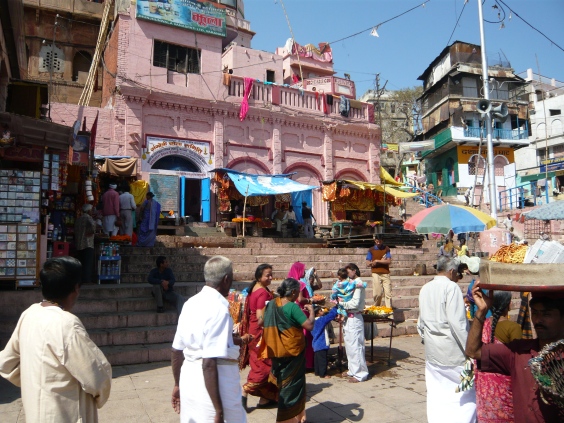
Dasaswamedh Ghat, Varanasi. Taken from the top of the steps (ghats). The River Ganges is the holiest river to Hindus, and Varanasi is the one of the holiest cities. Previously named Benares (and often so still called) and Kashi (City of Life), it is visited by Hindus in their millions who come to bathe in the Ganges to purify their souls. In a final journey, many are cremated here and their ashes cast into the river, believing that this will help to achieve liberation from rebirth.

040

The river Ganges from Dasaswamedh Ghat, Varanasi.

038

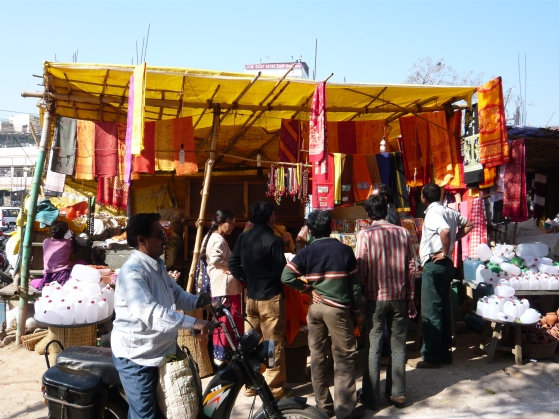
Stalls on the ghats at Varanasi. Varanasi never seems less than vibrant and colourful.

055

And another stall near the ghats.

049

Down at the ghats I was trailed by this cheerful young rogue demanding money to have his photo taken or to show me the sights or sell me souvenirs or lead me to stalls where I could purchase to my heart’s content or…whatever.

037

Street scene in Varanasi. The church in the middle distance is Saint Thomas’. This was taken quite early in the morning when I was on my way to the ghats. Early afternoon as I was returning, it was packed solid, traffic completely unable to move.

004

10km outside Varanasi lie the ruins of Sarnath. After the Buddha had achieved enlightenment at Bodhgaya, he came to Sarnarth – a walk of some 250kms or so, through what would have been highly dangerous country then – to seek out his former companions and in the Deer Park there he gave his first sermon, on the turning of the wheel of law. This comprises the Buddha’s path to Enlightenment: the Four Noble Truths, the Eightfold path and the Middle Way. In the 3rd century BC, the emperor Ashoka, a convert to Buddhism after witnessing the terrible carnage of a war he had unleashed, built stupas and monasteries here as well as an engraved pillar. These survived until the end of the 12th century when they were destroyed during the Muslim invasions and not rediscovered until 1834 by a British archaeological team.

008


This altar stone in the ruins of Sarnath) is still being used by pilgrims for pujas.

013.JPG

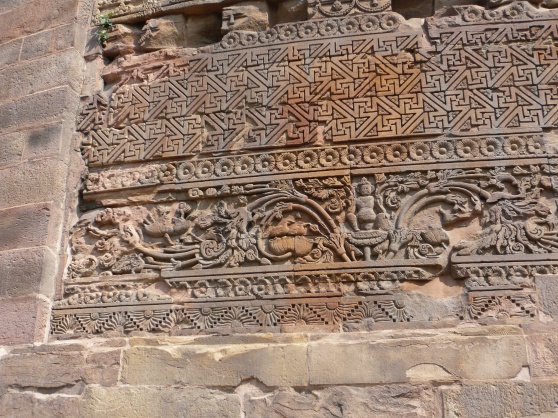
Dhamekh Stupa at Sarnath . This solid cylindrical tower, 33m in height, supposedly marks the place where the Buddha gave his first sermon. The base is stone, covered in delicate carvings, and the upper part brick.

016.JPG

Carvings adorning the base of the Dhamekh Stupa.

How India Changed an Englishman

I wrote a piece for The Good Men Project, about my time in India and how I came to write Making friends with the Crocodile’. Sushi Menon kindly edited it to make it readable, and gave it a title, and you can find it here:

How India Changed An Englishman

Making Friends with the Crocodile cover

Pitfalls for Writers – no.6: Historical Accuracy


‘Dear Mr. Author.

Whilst reading your book ‘Oh what fun and laughter we had during the time the Black Death wiped out our village’ the other day, I was disappointed to notice that you mentioned July 23rd 1449 as having been a sunny day in your fictitious village. From the descriptions you provide, you have clearly located said village a little to the south of present day Norwich, and my extensive researches prove that July 23rd 1449 would have been a rainy day there.

Yours disgruntledly,

A Pedant.’

How accurate do you need to be, as a writer, with historical facts?

If you are writing a non-fiction book, you have to be scrupulously accurate, no matter what subject it is.

End of.

On the other hand, if you are writing fiction, you have a certain amount of leeway. First of all, though, it is worth saying that if you sell enough copies of your book you will eventually attract correspondents like the fellow above. Is that something to worry about? Only if they get to know where you live, perhaps. Otherwise, send them a nice reply, thanking them for their diligence, and assuring them that you will correct your dreadful fault in the next edition. On the other hand:

‘Dear Mr Author.

The Black Death was actually sweeping the country in 1349, not 1449.

Yours smugly,

A Historian.’

This time, you’ve screwed up.

And yes, it matters.

Very minor inaccuracies are bound to slip through, and very few people will notice them. And if they do, they will not think anything of them.

Except for Arthur Pedant, of course.

The big things are another matter. Imagine reading a novel set in the days around the Russian Revolution, and then the author tells you that the Bolsheviks rose up against the state in 1927 instead of 1917. Or that they were led in the beginning by Stalin. Immediately, the author’s credibility has evaporated, as has their story.

Because the reader no longer believes the author, and they no longer accept their story.

The moral here, then, is don’t skimp on the research!

It is possible to radically change the facts of history, but the difference is that to do this the author must present it as the whole point of the story. In steampunk novels, the whole history of Victorian Britain is altered, but the reader accepts this as it is the premise behind the genre. It is seen not as a mistake, but as a narrative invention.

In many science fiction novels, the premise is a future that is the result of a different history than that which actually happened. For example, the Germans won the Second World War, or of different worlds or dimensions in which history diverges from the accepted version. Again, this is accepted by the reader, as it is the premise that the story is set on.

It is possible to break this rule, but to do so the author has to break it in such a way that it is quickly obvious that they have done it deliberately, and not by mistake.

One might, for example, set a novel in Victorian England that is not steampunk – a detective story, perhaps – but in which Queen Victoria is assassinated in 1860. As this is something that no one could possibly put in by accident, it will be seen as part of the invented narrative and accepted.

Well, probably. Where is Arthur Pedant?

The Past is Another Country…

…they do things differently there (L.P.Hartley )

Almost 20 years ago I was a care-worker, paying visits to support elderly folk who were, for various reasons, unable to cope on their own. I would provide support in a number of ways – cooking, washing and dressing,and cleaning, for example.

One man I visited quite often would talk a lot about his younger days – as is natural. He had a wealth of stories, and I always told him he should get someone to write them down. It is the ordinary person’s stories that are frequently the most interesting, and the ones that we usually don’t hear. Famous politicians, sports stars, movie stars…well, they write autobiographies, or have them written for them, and we hear all about the other famous people they knew and the hotels they stayed in…yawn, yawn, yawn.

But we hear far less about the family in the village 80 years ago, their day to day life and how the outside world impacted upon them.

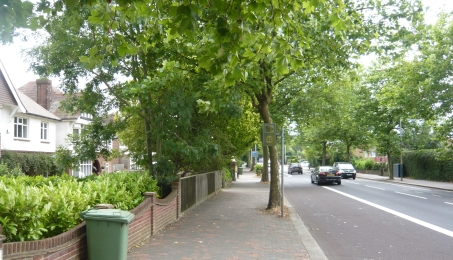
Below, there is a photo of London Road, just outside of Tunbridge Wells, taken earlier today.

005

My client told me that during his youth, he would walk back along this road after an evening out in town, describing how there was nothing but open fields on both sides for much of the walk. Looking at it now, it is hard to picture that, since I have never known it any way other than how it looks now.

But prior to this, in his childhood, he lived in the village of Groombridge, on the other side of Tunbridge Wells, and he told me how, as a schoolboy during the First World War, he and his classmates ran out of the class one day and across a field, to see a German Zeppelin airship that had just been shot down.

It is stories like this, that are the genuinely interesting stories that come out of the past.

And for my large Work In Progress, the past really is a foreign country. Much of it is set in Persia and India, in a time frame that covers some 300 years up until the late 19th century.

Now, I was about to write that if it is difficult for me to picture the main road near where I live as it was some 50 to 75 years ago, then it is far more difficult for me to picture the places in India and Persia where and when I have set my novel, but then I realised that this is not actually true.

And so this post is now taking a turn that I had not expected when I sat down to write it.

The Indian capital at the time was at Fatehpur Sikri, which today is just the remains of those buildings – it was only occupied for some 22 years, and then abandoned. I have visited the site and walked around it, and it is quite easy to imagine it occupied by Akhbar, his court, and the general population.

I have never been to Persia (modern day Iran), so my impressions are formed only at second hand. And much of what I have read consists of works about the 1500’s, and I am familiar with many of the paintings of the period, so again it seems almost natural to imagine it as it was then.

And then when I have travelled in India, as well as in the Middle East, I have spent a lot of time visiting the old parts of the towns and cities, and many rural areas where life follows the same patterns that it has for hundreds of years, and so, again, it seems more natural to picture the settings for my book in those time periods that concern me.

Finally, researching these areas, I often come across old black and white photos of places of interest to me, and since I have not been there, they are the only impression of these places that I have.

Of course, Tunbridge Wells in the Victorian era is much harder for me to visualise. All of the modern buildings get in the way of my imagination. All of the roads are surfaced with tarmac, the open spaces have largely gone, and many parts of the common that used to be open and windswept are now covered in trees.

On a slightly different note….

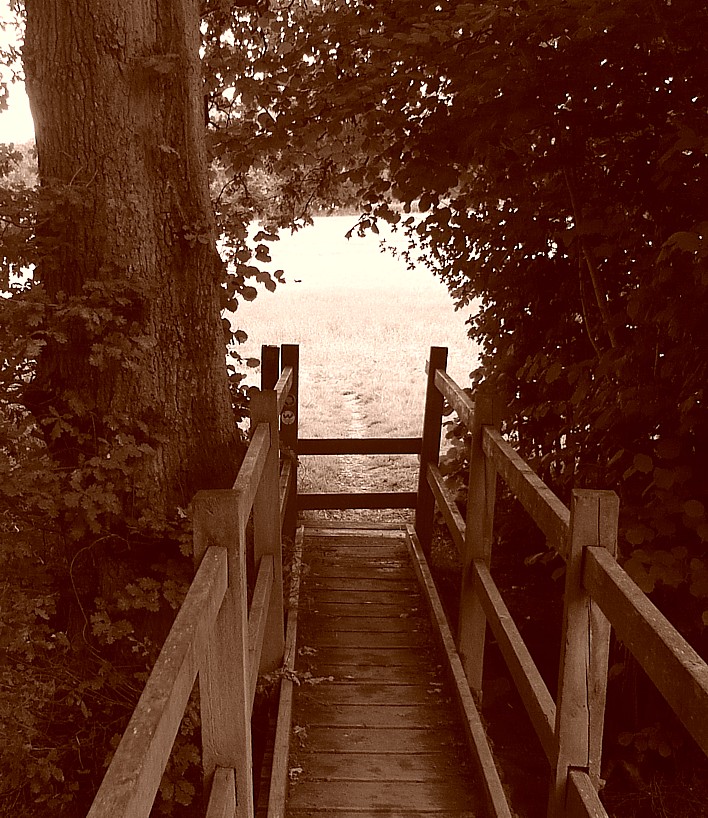
As a project, I occasionally take photos in sepia of the area around where I live, as though they might have been taken about 80 years ago – around the time that my elderly client was walking along the London Road, winds blowing across the fields either side of him, and the only light from the moon. Each photo that I take has something in it to show that it was taken recently though, rather than a long time ago, such as a modern vehicle, a modern street lamp, road markings, or modern windows. The shot below is an example.

Holden Pond

Easy to feel that it might be taken in 1930.

The Book is Released – Hurrah!


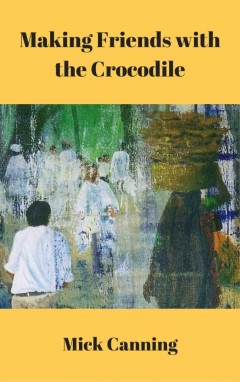
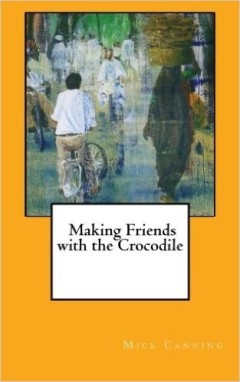
Making Friends with the Crocodile‘ is now released!

Making Friends with the Crocodile cover                             POD cover

Kindle edition                                                     Paperback edition

Anyone who has already pre-ordered it on Kindle / Amazon should have received it by now, and in countries where there is no pre-order facility, such as India, the Kindle edition is also now available to buy.

The paperback is available from the Amazon.com, Amazon.ca, Amazon.co.uk and Amazon.eu sites only – this is a quirk of Amazon – but can also be ordered from the estore at CreateSpace, at the following link:

https://www.createspace.com/6301808

And now, I wait to see what people think of the book, with a considerable amount of nervousness.

If you do buy a copy, please consider leaving a review either at Amazon, or on Goodreads, if you are a member (better still, at both!). Reviews are genuinely the lifeblood of a writer, and do help to sell books.

Finally, the blurb again…

‘Siddiqa was only just into her teens when she was forced to leave her home to live with her new husband and his family in another village. The years have passed, and now Siddiqa has three children of her own. Her grown up son has brought his new wife, Naira, to live with them, so Siddiqa is no longer the lowliest in the household, for she has a daughter-in-law.

Life in rural India is particularly harsh for women. This novel explores themes of female oppression and tradition and asks whether the next generation will find life any easier.’


The Morning After…

Wow, what a weekend!

After the book launch, the parties!

Celebrations!

Oh, and when I looked out of the window to see the streams of bunting all the way along the road, and the swarms of well-wishers gathering outside the house, I was so excited!

Then once I had gone out and signed loads and loads of autographs, I was being chased all over town for interviews by all the big newspapers!

And then I…

Well, okay. That’s not strictly true.

It’s not very true at all.

In fact, it’s not true in even the teeniest tiniest littlest way.

My life does not seem to have altered in the slightest and, actually, I’m glad about that.

070 (2)

Right, now it’s time to get on with the next stage.

I’ve put a link on the image of the book on my sidebar, which goes directly to my book page on Amazon (thanks, Stuart!).

And I’m looking at the best way to create Print on Demand paperback copies of the book, probably by using CreateSpace (lots of recommendations), and hope to have that sorted out in a couple of days. I don’t think it’s too difficult, but my way of dealing with new technology tends to be by shouting at it and slamming doors, so I may take longer than other writers.

But since the release date of the Kindle copy is June 4th, I should have time to arrange for the paperback to be released on the same date.

So, what next?

Actually, it will be great to feel that I can focus on just writing again, and not just constant editing and revision, so it’s back to the long Work in Progress, ‘The Assassin’s Garden’. This has a timeline that stretches from Medieval Persia through Medieval India and the British Raj, through to Edwardian England. It’s already a long novel and nowhere near finished, so I suspect that I might eventually have a trilogy on my hands.

I might even write a short story or two.

Ooh, it’s exciting. I do love this writing lark!

Published!

Well, blimey, Making Friends with the Crocodile is now published on Kindle and is up on Amazon as we speak!

Making Friends with the -Crocodile

About a week ago, I reached the point where I felt that the editing was finally complete, or, at least, if it wasn’t, then I might just pick at it for ages without really making any further difference, and so it was time to get the process finished.

What a relief.

It feels as though I have been under pressure for weeks. I’ve felt tired, I’ve felt tense.

Ooh, I’ve been irritable!

All this pressure, of course, is of my own making. A lot of it, I suspect, being due to this being my first foray into publishing.

I knew that I needed to format my text for Kindle, and heard that Scrivener was a useful tool for that. And so I downloaded Scrivener, and spent a couple of hours working through the tutorial until I decided that it just wasn’t going to happen for me.

I’m sure it is very useful, but I was getting to the point where I felt like chucking the laptop at the wall.

So I went and looked in detail at the instructions for publishing on Kindle, and found that you could just save your file in the correct format and then upload that.

Bye, bye Scrivener.

I looked at a few Kindle books and then wrote the stuff at the front and back of the book – about copyrights and stuff like that.

I inserted my table of contents.

I already had my book cover ready.

I wrote the blurb:

‘Siddiqa was only just into her teens when she was forced to leave her home to live with her new husband and his family in another village. The years have passed, and now Siddiqa has three children of her own. Her grown up son has brought his new wife, Naira, to live with them, so Siddiqa is no longer the lowliest in the household, for she has a daughter-in-law.

Life in rural India is particularly harsh for women. This novel explores themes of female oppression and tradition and asks whether the next generation will find life any easier.’

Working out how to upload to Kindle, and to complete all of the forms and tick boxes proved a little long winded, but reasonably straightforward.

So then, suddenly, there it was. Sitting on Amazon, available for pre-order, with a launch date of 4th June. Although for some reason, unfortunately, pre-order is not available in India.

And now it feels much like stepping off of a crowded and noisy street into summer sunshine; the sounds of the shouting and the traffic disappearing and being replaced by birdsong.

IMGP2282

Woo-hoo!

And what a buzz to go and look at my own author page on Amazon, with my own book there!

Woo-hoo again!

For the moment, as I say, it is only available for pre-order, and will be released on 4th June. But if anyone does feel inclined to buy it, pre-orders will help boost the ratings when it actually launches.

I am going to look again at Print on Demand, in a day or so. Initially, I had ruled it out, mainly because the one site that I looked at required the customer (i.e. me) to order and pay for a set number in advance, and I assumed that would always be the case, but now I think that is possibly not so. Certainly, the Amazon tool, CreateSpace, looks as though it might work more the way that Kindle does.

It will be great if it does, since I really prefer to have a physical copy of a book, and I know there are still a few other people out there who still feel that way.

So…now to get my head around promotion…

My First Long Trip to India (3)

I had read a little bit about Bodhgaya before I travelled out to India, and if I had taken any notice of what I had read, I don’t suppose I would have gone there at all.

The place was crawling with bandits.

I was likely to be kidnapped.

I was certain to be shot and robbed.
IMG

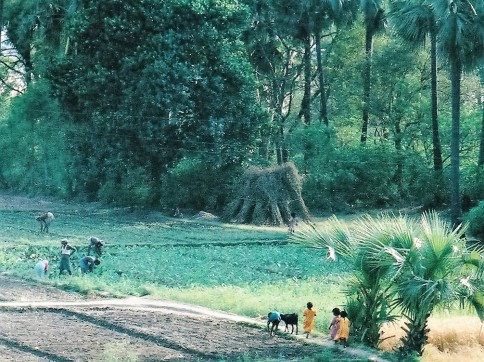
Sitting in the autotaxi as it bumped its way through the countryside between Gaya and Bodhgaya, with the sun shining on the fields and trees, this all seemed most unlikely. Yet, for those who lived there, these fears were very real. Later on in my stay, I travelled with another westerner and two Indians by jeep to Patna, which was a four hour drive.

We were delayed in Patna as the jeep broke down, the result being that we were several hours late in setting out on our return journey. It was beginning to get dark soon after we left Patna, and the two Indians on board were clearly very fearful of being stopped. They said that if we encountered a roadblock, it was quite likely to have been set up by bandits, and that we would veer off of the road and drive hell for leather – anywhere – to avoid them. They were less worried about crashing the jeep in the darkness somewhere than they were of the bandits. I used this as the basis of an incident in my forthcoming novel ‘Making Friends with the Crocodile’. *shameless plug*+.

+Well, why not. It’s my blog, after all.

But, I’m getting ahead of myself, and so back to the autotaxi. My driver had no idea where the guest house was that I wanted to go to, but cheerfully said that would be no problem. Once we reached Bodhgaya, he asked a few people where it was, and I was soon offloaded on the doorstep.

Once I had checked in, I walked into the town to explore and, more importantly, track down some supper.

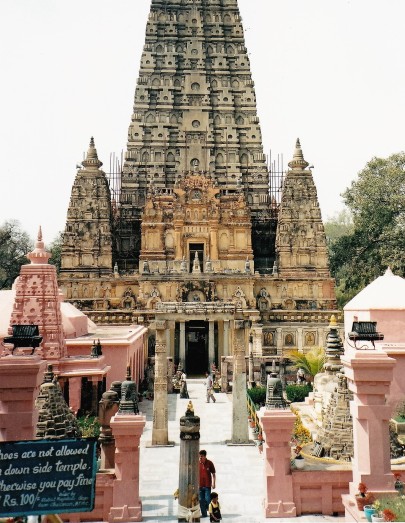
By the time I reached the Mahabodhi Temple Park, it was dark. The temple looked absolutely stunning lit up by a number of spotlights, but I deliberately decided not to go in until the next day. I felt that I should wait until I felt a little cleaner and fresher. There was no rush; I was there for some time. I was looking forward to getting to know Bodhgaya better and treating it as home for a month or so.
IMG_0003

The road outside, which was the only one in Bodhgaya that was well-paved (and pedestrianized, no less!) was, not surprisingly, full of various vendors and supplicants. But they were not overly pushy, not overly expensive, and interesting. I bought some incense, partly just to help to drive the mozzies out of my room! Just standing outside the park gates I got a great feeling of well-being and pleasure.

The following morning, after breakfast, I visited the temple.

Stunning, I had thought the previous evening, and, yes, stunning it was.

Not stunning in the sense that the Taj Mahal, for example, is stunning, although the architecture is interesting; there was just a massive sense of place, of solidity, and the thought came into my head that Hindus and Buddhists alike ascribe the centre of the world to Mount Meru, but this felt like the centre to me. As I was walking around, several times I just felt an unexpected urge to burst into tears.

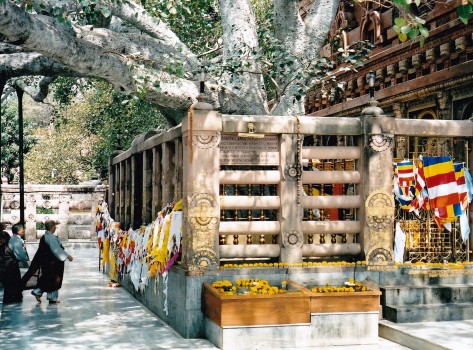
All around the temple, there were pilgrims and tourists. At one side, there is an old Neem tree, supposedly a 4th generation descendant of the one that the Buddha sat beneath to achieve enlightenment, two and half millennia ago. When it is grown at a Buddhist temple, it is referred to as a Bodhi (which literally means ‘enlightenment’) Tree.
IMG_0002

The reason that this site is so special, however, is that this was the actual site of the Buddha’s enlightenment. For a Buddhist, places just don’t come more special than this.

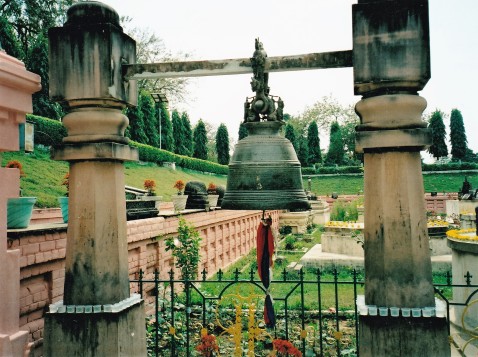
Everywhere, groups of pilgrims were conducting pujas (ceremonies); there were large numbers of Japanese and Korean pilgrims, but also many from other countries. This is reflected in the large number of Buddhist temples built in other places around Bodhgaya. There are a dozen or so temples built by Buddhist orders from all of the countries with substantial Buddhist populations, such as Thai, Chinese, Tibetan, Vietnamese…lots to visit, I decided. Outside the gates, a CD of chanting monks was playing. Despite the swarm of visitors, the whole place exuded peace, and I found myself just gently strolling around, sitting, watching everything…
IMG_0001

It was lunchtime, I found with surprise, when I left the temple grounds.

The presence of so many Buddhists in Bodhgaya has led to the setting up of a number of ‘projects’. These take many forms, but there are a good number of medical projects, schools, and orphanages, all set up to provide these services free to those that would otherwise not be able to afford them. Bihar is the poorest state in India, with higher levels of poverty, lower life expectancy and lower rates of literacy than any other state (the last time I checked!).

Human nature being what it is, a few of these are scams. I had checked out the project that I had volunteered for as well as I was able to beforehand, and was reasonably certain that it was genuine. I was volunteering my time, rather than donating money, so I was fairly sure that I would be able to see what was happening on the project as I worked, and if I was helping to (for example) improve the English of a few children, then that would be beneficial regardless of anything else.

I made contact with the project organiser and told him I had arrived in Bodhgaya.

The next morning I was at the orphanage.
Ooh, it’s nearly finished!

I’m getting excited, now.

My novel, ‘Making Friends with the Crocodile’ is hopefully ready for its final edit.

This part of the journey seems to be taking a great deal of time, but this might be because it is my first foray into publishing. I know that there is still much to do – formatting, advertising, proof-reading, the publishing itself, amongst a plethora of smaller but no less important tasks – but I am finally beginning to feel that I am getting there.

Curiously, after what I wrote in my last post, I never found any of the characters threatening to hijack the plot in any way. Although I never planned it out in any detail, I had a rough plan in my head, which, remarkably, I kept to. Perhaps it is because the subject matter is strong. I don’t know.

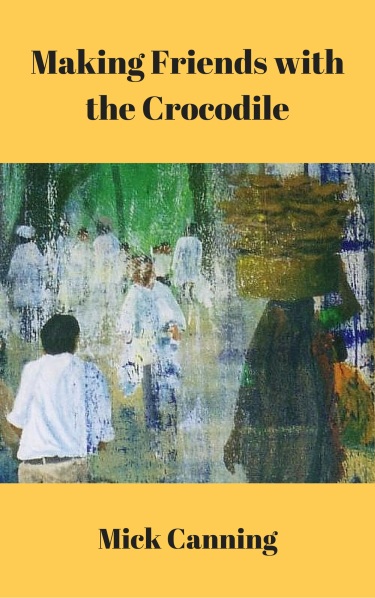
And I think that I have settled upon the cover (the artwork is my own).

Making Friends With The Crocodile cover 1

I may play around with the wording, slightly, for example I might take out the words ‘A Novel’.

For some background; the story is set in a village in Northern India, some fifteen odd years ago. It is about the deteriorating relationship between two women in a family: the mother and her daughter in law. Like this relationship frequently is, it is a strained, fractious one, not helped by that society’s attitudes towards women and their roles in general. And when one of them gets caught up in events beyond her control, these attitudes become dreadfully destructive.

As always, your thoughts would be very much appreciated.

Pitfalls for Writers – 4) Language; a bit of a follow-up

Back somewhere deep in the mists of time, I published ‘Pitfalls for Writers 1’. In this, I discussed some of the potential problems of language in a novel.

If I am to write a story of medieval Persia, for example, I will write it in English. No one who reads it is going to be fooled into thinking that my characters were really speaking in English. But this on its own is not enough. There must be something in the language I use that reminds the reader that the story setting really is medieval Persia.

P1050055

And so I suggested using a flavour of the speech. I might sprinkle the conversation with words such as ‘dirham’ (a unit of currency), or ‘djinns’ (genies). The characters might smoke a ‘qalyan’, which is how they would have referred to what we generally call a hookah. A greeting might be ‘Salām ʿalaykom’.

In the comment stream that followed, I concluded that I might employ a glossary, but certainly not footnotes.

This has now become most relevant to me.

About a month ago, I finished reading Anuradha Roy’s ‘The Folded Earth’. It is a novel that is set in India, written by an Indian writer, yet it uses a glossary, although she is presumably writing in the first instance for an Indian audience. This glossary explains a few words and phrases that many western readers would be unfamiliar with, although I would expect the majority of Indian readers to know them all.

My own novel is being read now by generous beta readers, and some of the discussion is over the use of the appropriate Hindi / Urdu words in the text.

And so, with ‘The Folded Earth’ as an example, I shall definitely use a glossary.

Next, it is important to employ the correct voice.

Speech:

Clearly, if the protagonists of a story are sitting down to a meal, they might complain about the amount of fat on the meat, but they would be most unlikely to refer to it as ‘adipose tissue’. Unless one or both were, for example, surgeons.

Very few people would be likely to refer to two items as being ‘in casual juxtaposition’. They would be far more likely to say something along the lines of ‘oh, they look a bit odd next to each other.’ As tempting as it might be for the author to show off their vocabulary, it is something that should be used most carefully.

Narrator:

If the story actually has a narrator, then this becomes even more important. The country bumpkin relating an everyday tale of rustic shenanigans should not be employing sophisticated and subtle wordplay. He or she should only be employing language that they would naturally use.

Author’s voice:

Even if there is no actual narrator, it remains important to use only language that would be natural to the situation. For example, it sounds plain wrong to describe a group of Vikings ‘computing’ an answer to a problem, even if it is only the author describing it that way.

Generally, of course, and I know that some will disagree with this, it is usually better to avoid all flowery and showy language in novels, and use simple language well.

Finally, a jarring note found in a few modern novels set in older times, is that the characters often think like modern folk. Reading these books as against books written, perhaps, 150 years ago, it is not just the style and language of the writing that are different, but also the prejudices. The hero of a novel set in 1840 is going to have casual prejudices against, perhaps, people of another race, women, etc etc. We tend to be reluctant to set these down in print, nowadays, perhaps as if by doing so we are almost admitting to having these prejudices ourselves.

However, if we want to depict our characters realistically, we need to do so ‘warts and all’. And if the writer is going to depict them otherwise, then he or she needs to have a good reason why they do.