The May Day festival, Beltane, is a survival, or revival, from the Iron Age, celebrated in Celtic communities – Scotland and Ireland particularly – and revived as a full festival in Scotland in the 1980’s by the Beltane Fire Society. Beltane was a fire festival, although nothing of that remains in the festivities carried out in England. Beltane was first mentioned by name in Irish writings from the late 800’s / early 900’s.
The English version of this festival involves cutting flowers and greenery and dancing around a maypole, which things are also carried out during Beltane, celebrating the beginning of Summer which begins on May 1st. When I was a child, dancing around the maypole was the chief, possibly only, activity carried out on May Day. I have a photograph of my brother, my cousin, and myself, dressed up for the May Day Fair at which there was maypole dancing, but no obvious indication of surplus greenery. Past generations in England celebrated May Day with a day of celebrations which while including maypole dancing as an important manifestation of encouraging the fertility of the soil (and the festival-goers!) would also have included plenty of food and drink and general gaiety.
Mayhem, if you like.
This year, I managed two May Day days out.
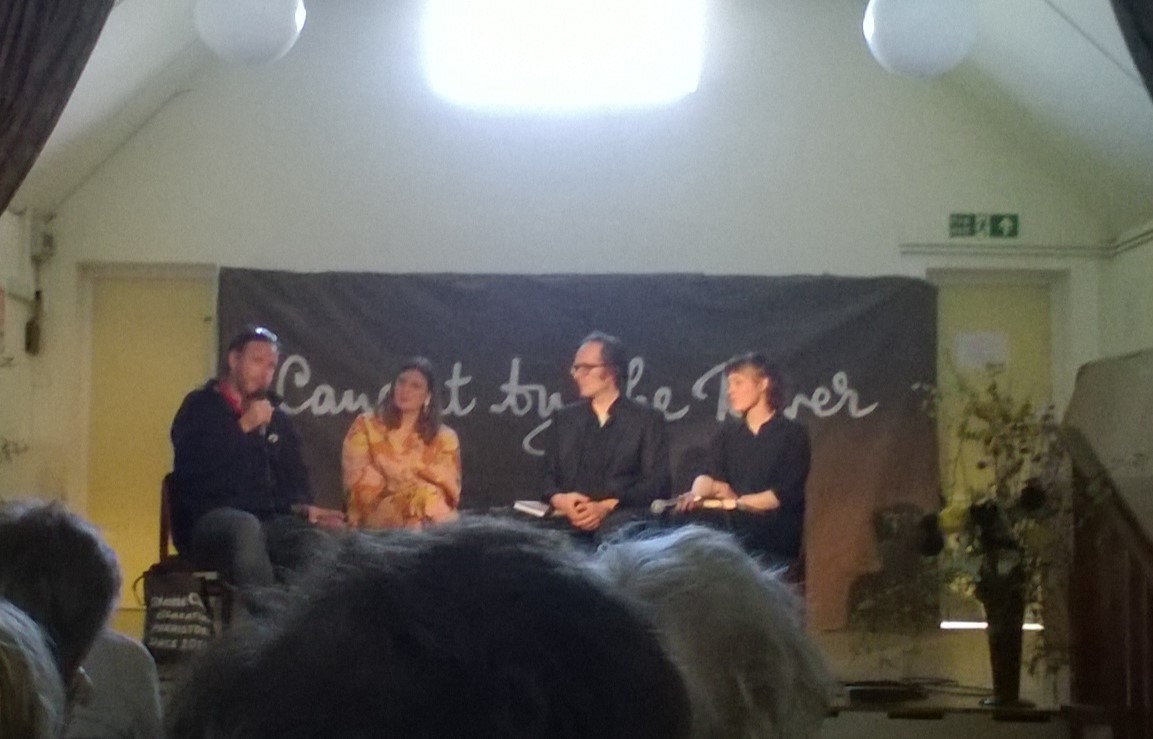
On Saturday, two days before May Day, I visited Kingston near Lewes, in Sussex, for the Caught by the River Mayday event. Caught by the River describe themselves as an arts/nature/culture clash and you can read all about them here. I have followed them now for several years, and this seems as good a time as any to mention that their coverage of arts, nature, and culture are second to none and if you’re not yet following them, well, you should be.
There was mask-making to begin with, especially to involve the children, the makers encouraged to incorporate flowers and greenery into their masks, and almost inevitably a certain amount of folk-horror found its way into some of these.
Nice, Richard.
This was followed by a promenade around the maypole, after which the activity moved indoors.
There were films, talks, and discussions, subjects including rivers, village life in the early eighteenth century, art, standing stones and the like, and the environment. After which, in the late afternoon, we all promenaded up the hillside to the Gurdy Stone.
This is the Gurdy Stone, a modern standing stone on a hillside overlooking Kingston. Here, Local Psycho (Jem Finer and Jimmy Cauty), held a gathering to encode the music of their Hurdy Gurdy song into the stone “To mark the 50,000 year return of the Green Comet and release of The Hurdy-Gurdy song on Heavenly Recordings.”
Throughout the day, naturally, we all had access to the pub.
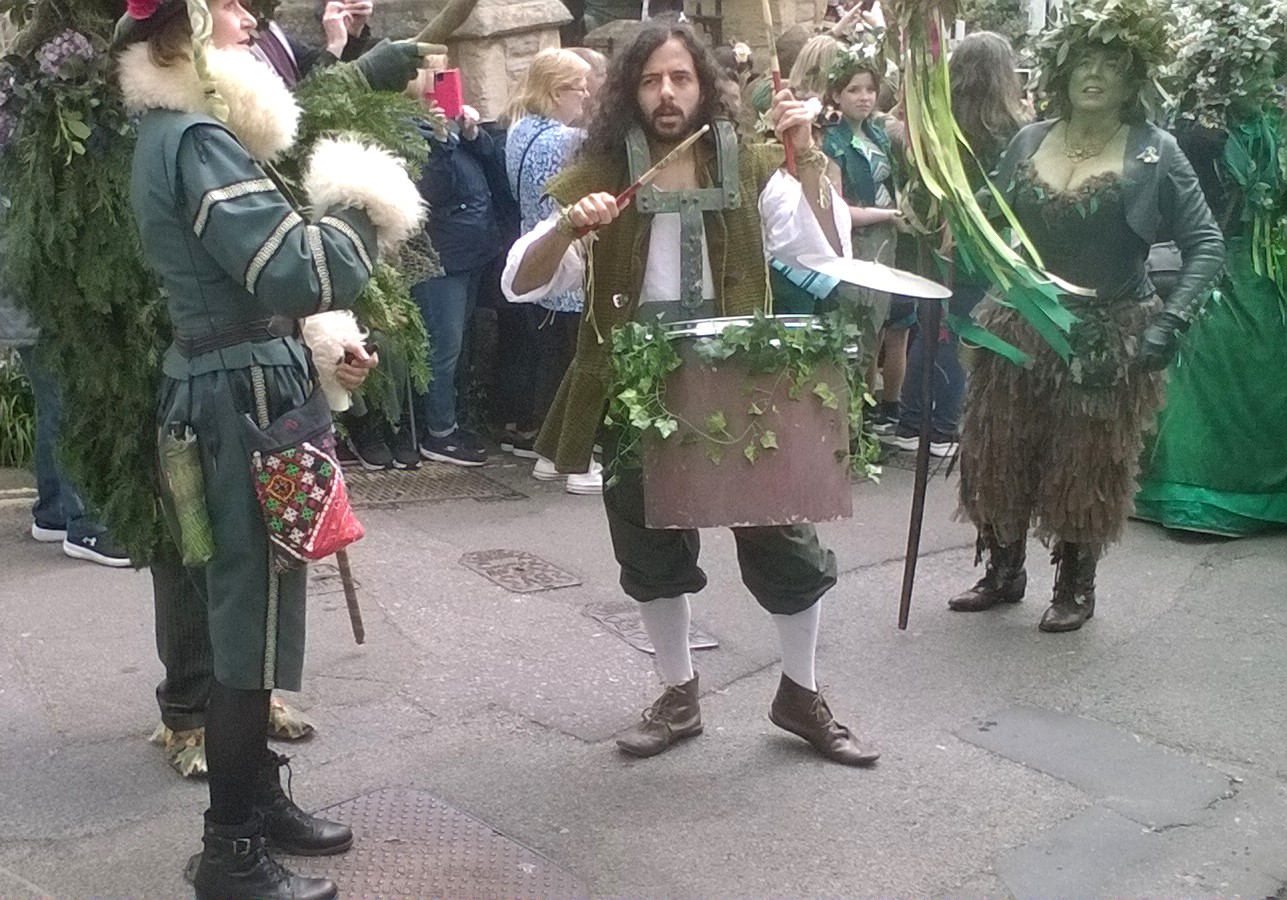
And then on Monday, which was May Day, we went down to Hastings. It rather felt as though everyone in South East England must be in the town, either at the Jack in the Green festivities or watching blokes on motorbikes roaring up and down the seafront for no discernible reason. I don’t much like crowds, and some of this was very difficult. But away from the huge horsepower and testosterone nonsense, amongst the Jack in the Green celebrations the atmosphere was brilliant and the large numbers of people perfectly acceptable. Jack in the Green is a manifestation of the spirit of spring, related to the Green Man, a dancing figure covered in greenery.
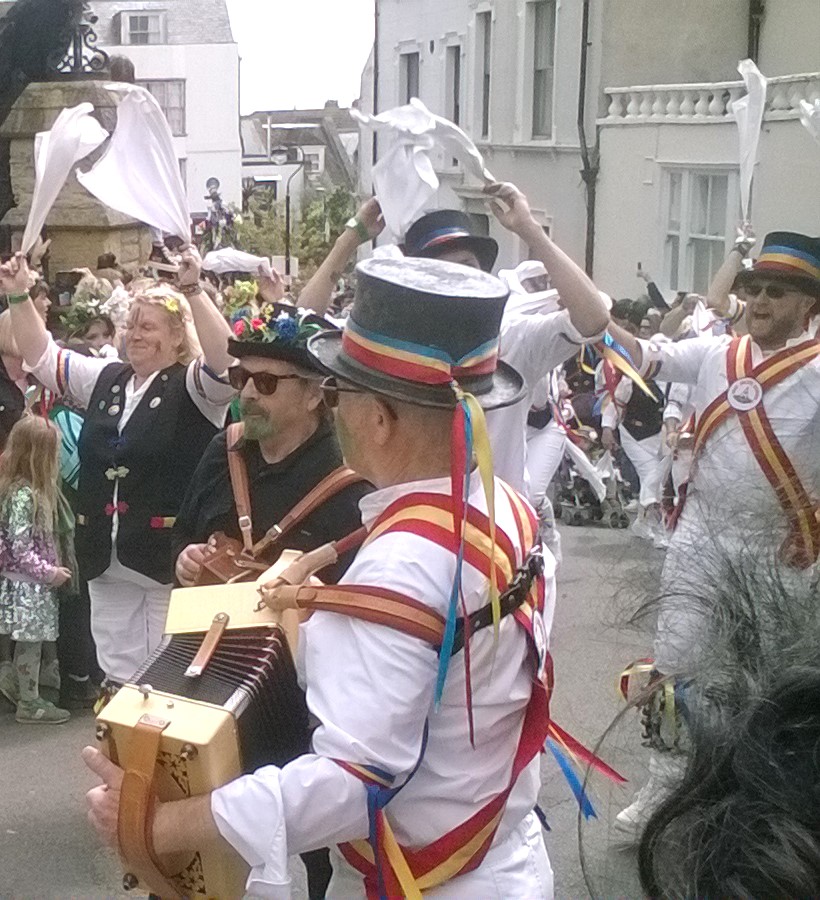
The festival in Hastings has grown over the years into a large event involving musicians, dancers, Morris sides, huge figures in addition to Jack in the Green such as the Queen of the May, a witch, and others, plus any number of people joining in the procession around the town, all decorated with as much, or as little, greenery and/or flowers as they feel suitable.
There you go, a Morris side.
Followed by a large witch with a cat. Why the witch? I’ve no idea. Why not? I suppose.
And there you have it. Music. Drumming. Greenery. Crowd involvement. Summer is icumen in and winter’s gone away-o.
I had a conversation with a blogging friend a few days ago, in the course of which she asked me if I knew why it was that so many Westerners seemed drawn to Eastern beliefs, especially the more ‘esoteric’ ones.
I briefly mentioned the fascination the East has held for Westerners throughout history, and the fact that many in the West have drawn away from traditional religion – specifically Christianity – in the last fifty or sixty years especially, and that leaves a void: when you have been brought up within a belief system, that needs to be replaced by something. The Beatles nudged a whole generation in that direction by visiting the Maharishi in Rishikesh in the 1960’s / 1970’s, and there followed a whole slew of books on the subject, many seeming to want to outdo the others in sheer weirdness. But even before that there had been a lot of interest in both Buddhism and Hinduism from the late Victorian period onward, with a number of popular books available.
I can’t claim to be immune to this, either. I also rejected Christianity long ago, but felt I needed something to take its place despite deciding the concept of gods had no place in my life. The world is a wonderful and incredibly beautiful and fascinating place, all of which is explained perfectly well by science. But I do need something to satisfy the spiritual part of me – a part that, surely, all of us have?
I have read a lot about Buddhism, and for a long while thought of myself as a Buddhist. In a way, I still do, although I can’t entirely buy into the belief sets of any of the three major schools of Buddhism. But I did read Buddhism Without Beliefs by Stephen Batchelor. I can’t remember the details of the book, but that is unimportant, it’s the message of the title in this case. I like Buddhism. I like its core message, which pared down to basics is simply to be kind to everyone and everything. It is the only religion I know that has no need for gods. Oh, sure, they’re there if you want them, but no one is ordering you to have one.
This doesn’t have to be ‘esoteric’ or ‘eastern’, either. It can apply just as well here in the west. And it doesn’t require sacred writings or rituals, I find poetry or a walk in the woods does just as well for me.
I’m listening to the heavy rain as I write this – which is something that seems to happen a lot at the moment, but is something I find particularly soothing. I wonder at the origins of this; is it something primeval, hidden deep in my DNA from the times we lived in caves or rough shelters and we could take comfort from the fact we were snug, and perhaps large sharp-toothed beasts were taking a similar break somewhere and not out looking for early humans to eat? Or is it perhaps just a forgotten memory of a very calming experience I once had, which my subconscious has decided to hang onto for my benefit, but without telling me why? I am aware of a few of the times I’ve experienced it, such as lying in a tent at night hearing the pounding of the rain on the canvas, with a wonderful feeling of warmth and snugness. Then there was another time in the mountains of Spain, coming across an abandoned cottage just as a rainstorm hit and spending the next half an hour or so just sitting on a bench and leaning against the wall, listening to the rain and thinking. I’m sure there must be many more.
In these rainstorms, I feel as though I’m immersed in nature – something that always makes me feel calm and relaxed, and which is but a step from what the Japanese call Forest Bathing. Forest Bathing is essentially taking a walk in woodland, using all your senses to connect with that environment. This reminds me strongly of meditation, especially meditation as I learned it in a Buddhist environment, which is where I’m going with all this rambling. If I have an actual religion now, it has to be nature. A belief in nature as something important, beneficial and precious. I wouldn’t ‘worship’ nature – ‘worship’, for me, has connotations of supplicants on bended knees with hands clasped together intoning religious dogma and praying, but I do have strong feelings of respect and admiration for nature, which I suppose you could call the same thing.
It just seems a pity that more people don’t seem able to accord it the same respect.
Well, my favourite twelve, anyway. One a month, if you like, although that wasn’t how I read them. Or perhaps the twelve book reviews of Christmas – oops, no. Missed that one. Anyway…these are some of the books I read in 2022, not books that were first published this year. But I seem to have read so many good books in 2022, it’s difficult to make a choice and this has ended up being a little arbitrary.
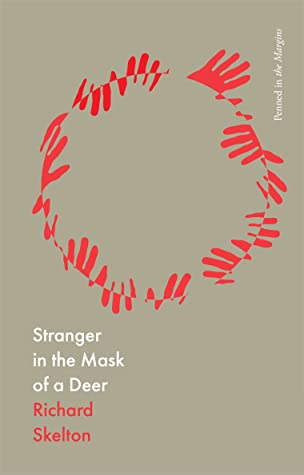
Stranger in the Mask of a Deer by Richard Skelton. It has been a long time since I last read something new and immediately put it into my top ten reads, but this remarkable work is straight in there. A few weeks later I had to re-read it, captivated by its dream-like quality.
It is essentially a poetic narrative ranging between the present day and Palaeolithic Britain, told by humans both ancient and modern, and by non-human voices. Its essence is life and ritual, the connection between humans and animals, between humans and the land they occupy, and the elements surrounding them.
The remains of deer skulls complete with antlers, but with eye holes punched into the skull so they might be worn as masks, have been found at Star Carr in Yorkshire, dating to approximately eleven thousand years ago. It is presumed these masks would have been used in rituals…
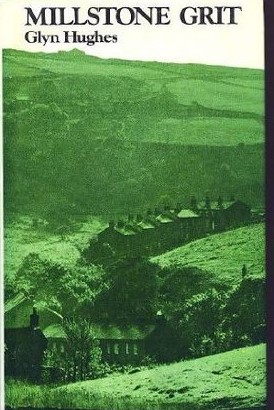
Millstone Grit by Glyn Hughes. This very readable book was originally published in 1975, describing a fifty mile walk the author took through East Lancashire and the West Riding of Yorkshire; an exploration of the moorlands and villages alongside the industrial towns, all of them suffering in their own ways from the effects of the loss of traditional industries in that area. It is about Hughes’ attachment to this area he came to live in, the clash between human and non-human landscapes, and about working class history in these places, but above all else about some most remarkable people he meets along the way.
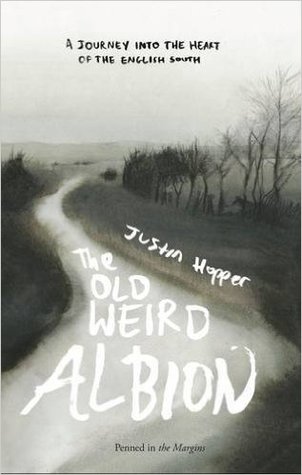
I re-read The Old Weird Albion by Justin Hopper. This is a book about tracing a mystery in his family’s past, beginning with a woman preparing to throw herself off Beachy Head, a notorious spot for suicides, but also about the effects the landscape of the South Downs has had upon people.
This is a book I reviewed on this blog when I first read it three years ago – the link is here – and I’ll just put an extract of that review here: ‘He has a gift for sifting and selecting the weird in these relationships, not just at sites that might be naturally expected to encourage the weird, such as Chanctonbury Ring, high on the Downs above Steyning or in old ruined buildings, but also in humdrum blocks of flats in modern developments. He references modern phenomena like crop circles and throughout there is the presence of ‘magic’, in the sense of a natural force. Many of the people he meets are an eccentric mix of the weird, too, although I choose this description carefully, largely in the old, original meaning of the word of ‘fate’ or ‘destiny’.’
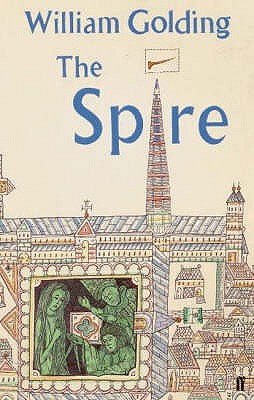
Another re-read, this time of a book I first read some forty years ago. The Spire by William Golding is a novel set in medieval England, in an unspecified city somewhere in the south. It is a story essentially about pride and hubris, about the Dean of a church determined to have built a great spire on his church, despite warnings that the foundations will not be able to support such a colossal structure. The ending seems predictable and yet that is not really where the story is going, being more concerned with the characters inhabiting that space.
The setting is the church and environs, and it evokes the feel of the ecclesiastic medieval as successfully as The Name of the Rose does. One test of how good a novel set in historical times is, is whether it transports the reader easily to that setting. I certainly found it did.
I bought Hemisphere by Pete Green at an event where poets read excerpts from their work. It is effectively a poetic journey around the northern hemisphere, beginning in Scotland, the journey approximating to the latitude of the arctic circle. The writing conveys a tremendous sense of place and feels very right for the cold edgelands described.
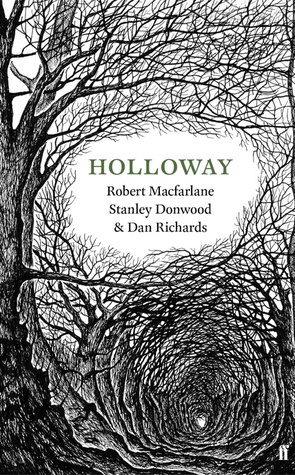
Holloway by Robert MacFarlane and Dan Richards, with illustrations by Stanley Donwood is a short book, describing a journey MacFarlane, Donwood, and Richards made in Dorset, essentially a revisit of a trip MacFarlane made previously with Roger Deakin for an earlier book, exploring holloways. Holloways, often known as sunken tracks or paths, are old – frequently very old – paths made over the centuries by the passage of feet, both human and animal, and perhaps by the wheels of wagons and carts. It is a short journey – perhaps ‘experience’ would be a better word – describing wild camps and walking, cycling and visiting old buildings; in some ways, perhaps it is really no more than a short camping trip, undertaken by a group of men acting out a boyhood adventure. The writing, though, by both MacFarlane and Richards is exquisitely poetic and Donwood’s illustrations never less than beautiful.
Notes on the Sonnets by Luke Kennard.
‘Luke Kennard recasts Shakespeare’s 154 sonnets as a series of anarchic prose poems set in the same joyless house party.
A physicist explains dark matter in the kitchen. A crying man is consoled by a Sigmund Freud action figure. An out-of-hours doctor sells phials of dark red liquid from a briefcase. Someone takes out a guitar.
Wry, insolent and self-eviscerating, Notes on the Sonnets riddles the Bard with the anxieties of the modern age, bringing Kennard’s affectionate critique to subjects as various as love, marriage, God, metaphysics and a sad horse.’
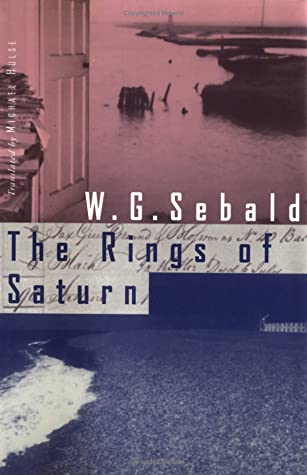
The Rings of Saturn by W. G. Sebald had been on my ‘to-read’ list for a long time, but I finally got around to picking up a copy this year. On one level, this is a walking journey taken by the author along the Suffolk coast in the early 1990’s, describing both places and people he comes across, but really, it is much deeper than that and is a psychogeographical work par excellence. Throughout the journey, we are never quite certain whether events are happening to the author, or have happened in the past, or perhaps to someone else at some other time. He goes off in unexpected directions, literary, historical, and physical, exploring a wide and eclectic range of subjects yet throughout there is a cohesion to the narrative.
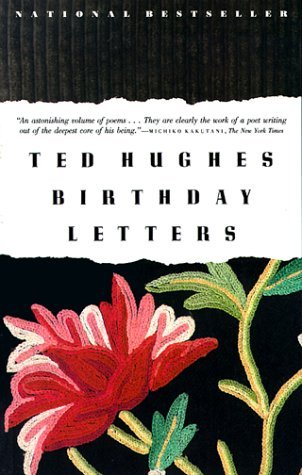
The Birthday Letters are a not-quite-series of poems Ted Hughes wrote to his wife the American poet Sylvia Plath after her death. Personally, I find them to be probably his most accessible poems and wonder whether that says something about me, although this isn’t the time to go into that. Theirs was a difficult relationship, and her suicide (as well as that of a later lover of his) frequently colours people’s opinions of Hughes. Inevitably, these are often extremely personal poems, so much so that at times I feel a slight discomfort reading them, as if I’d opened someone’s private correspondence by accident, but Hughes wrote them as an attempt to restore her to him, and published them almost for the public to read as his own account of her life and death.
Sadly, Roger Deakin only wrote three books, of which Notes From Walnut Tree Farm is compiled from diary entries he kept during the last six years of his life. In these notes, he recorded his day to day life on the farm, walks on nearby Mellis Common, the yearly cycle of the natural world all around him, and his thoughts on literature, the importance of nature, and musings on the past.
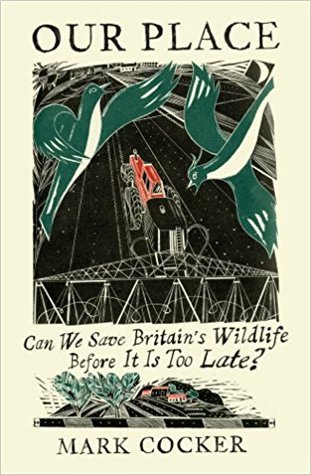
Our Place by Mark Cocker is an exploration of the history of environmental thought and politics in Great Britain and, especially, the way forward. It asks pertinent questions like who owns the land and why? And who benefits from green policies? Not afraid to be radical in its suggestions, it asks why there is such a disconnect between the British public’s sympathy for and championing of the countryside and the reality of its current condition.
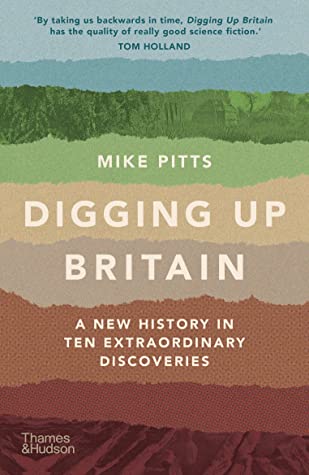
Digging up Britain by Mike Pitts tells the story of Britain’s history and prehistory in ten astonishing excavations. As someone who has always had an interest in history and pre-history, I found this book a timely reminder of the huge strides taken forward in our understanding of the past over the last ten years or so, due to such important tools as DNA analysis as well as the painstaking work of those who excavate and interpret these sites. There are some remarkable tales in this book.
I’ve been feeling a bit flat recently, although that’s not uncommon at this time of the year.
I know I’m currently craving solitude and simplicity, wanting to spend some time somewhere a little remote. An area of moorland, such as Dartmoor or the Pennines, would do me very nicely. Even better if there were some woodlands nearby, too. Although there would be no people around (ideally), there would be wildlife to watch and hills and valleys and those woods to explore. Maybe some interesting ruins nearby…
Simplicity, that’s what I’d want. Somewhere with no wifi, no TV, no phone signal or even radio. A decent supply of food and a few beers because, as Jerome K Jerome said, thirst is a dangerous thing. A fire to sit beside in the evening. Somewhere small and basic with no luxuries.
I’d take some books. Several sorts, so I could pick one up or swap to another depending upon my mood. At least one book of poetry, perhaps Stranger in the Mask of a Deer which I read for the first time a few months ago, and then re-read recently because it was so damned good. Maybe a Seamus Heaney collection, including the ‘Station Island’ sequence of poems, or a collection by Russian poet Yevgeny Yevtushenko for the marvellous long poem Zima Junction. Maybe I’d just take all of those.
I’d include some sort of detective novel for pure escapism, then one or two books by the likes of Robert Macfarlane – books that would inform me about the landscape I had decided to inhabit for a while.
I wouldn’t just be walking and exploring, or reading. I have a few poems I need to finish off, one about salmon and one about the Winter Solstice. In this environment I think I’d be inspired to finish them, hopefully write some more.
One of the things about growing…older, let’s say…and I’m not saying it’s a good thing or a bad thing, is the growing realisation that we’re never going to live in that place that we are convinced is perfect for us, or have the day to day lifestyle that is everything we want.
One consolation for the writer, even if it’s rather a shallow consolation, is the opportunity to write these places and lifestyles for ourselves. For the last year or so, nearly all my creative writing has been rather experimental, which is one reason I’ve not put much up on here. Rather than focusing on writing the complexities of a story arc, I have been very much concerned with the character of the characters I have written, and possibly even more concerned with the environment they occupy.
In a way, then, I’m exploring different versions of myself – although that, surely, is what all writers do anyway? – and it is instructive how much all of these versions have in common. For anyone who knows me, the information that these scenes involve almost nothing of town or city should come as little surprise. But it’s a learning process, a personal learning process. And even the photos I’ve chosen to accompany this post serve to reinforce what I already know about myself.
And the other strand that occurred to me as I thought about all this, is how it has brought home to me that the priority in my writing – my absolute, number one priority – is that first and foremost I am writing for myself. Whatever I write has to please a rather demanding reader; myself. And if that means my writing is even less ‘commercial’ than it was before, then so be it.
Strangely, this seems to have removed the pressure of time. I’ve always ended a writing day either pleased with the amount I’ve written or berating myself for not having written more. As if that was the sole measure of how successful or productive my day had been! Now, though, writing just for myself, success can be equated with how good I feel the output is; and by ‘good’ I mean quality (as defined by me, for me). So even a few lines that work well may be a good day’s work. I think this time pressure, this fixation with writing a certain amount each day, is a purely commercial pressure; an I-need-to-finish-another-book thing.
Nature dies down in winter. Certainly, at those latitudes where the days become much shorter and the temperatures plummet. Both wind and rain seem to become more frequent. Snow. It is a period of rest and renewal after autumn has put on a final glorious display of colour. Animals adapt to this in one of three ways: some will eat and eat of the autumn bounty of, especially, fruit, putting on large fat reserves and surviving the winter in a state of hibernation, their heart-rates dropping to a scarcely believable one or two beats a minute, their bodies slowly using these fat reserves for the little energy required to maintain a flickering life through those months. Some migrate, seeking a warmer climate until spring returns. These animals are, due to the obvious logistics required to travel hundreds of miles to reach those more hospitable climes, the larger animals and many of the birds. Travel over those kinds of distances would be out of the question for the smaller ones. Others stay put and, in the case of the plant eaters, scratch out a meagre living on whatever leaves and grasses survive through the winter. The carnivores, of course, stay and try to catch them.
Our Neolithic ancestors’ life cycles would be attuned to this pattern too. Autumn must have been lived fast and furiously. In the same way our medieval ancestors worked long hours to bring in the harvests, Neolithic man and woman must have used all the dwindling daylight to bring in as much food and fuel and dry bedding as possible before the winter period. Then by the end of autumn gathering would have largely ceased and they would have moved into a winter rhythm of life.
But how did they get through winter? What of the food they had gathered? Presumably, they had no way of storing fruit – could any of it be dried? Was it fermented for drink? Or was it all eaten as soon as it was gathered, as though they were all so many dormice seeking to build up their reserves? And could this, in fact, have been a part of their strategy to get through those months? To eat and eat until the perishable foods were all gone, and then to stop all but the most essential activities. To expend as little energy as possible and stay as warm as they could. Spending as much time as possible asleep.
And yet, they would still need to eat, and so with dwindling food reserves they would slaughter any beasts kept for that purpose, possibly smoking the meat to enable it to keep for as long as possible. Hunting would continue and might, in some ways, become a little easier. With less vegetation around, there would be less cover for their prey, and in snow there would be clear tracks to follow. But presumably this prey would still need to be pursued, and this would use precious energy, unless they relied more upon pits and snares.
Inhospitable deserts. High mountain passes. Hills or moorland in thick, blanketing fog or sudden treacherous snowfall.
A situation in which I test my skills and resilience to the limit, aware of the consequences of a miscalculation or of taking my eye off the ball for too long. Certainly not a case of me fightingagainst the desert, or the mountain, because it’s not a battle. I have no need to ‘conquer’ anything, merely to respectfully request safe passage.
At the moment I have to accept second best, walking in woodlands near my home. At least there are fewer people around while it is raining, although those who are include a posse of shrieking children – honestly, where are the wolves and bears when you need them? Two hundred years ago in Britain children would either have avoided all but the lightest of woodland, or passed through as silently as possible. Although the bears and wolves were long gone by then, the children would have been raised on a diet of nursery stories that taught them the dangers of venturing into wild places, the remnants of very necessary advice from those earlier times when careless children frequently got eaten.
Happy days!
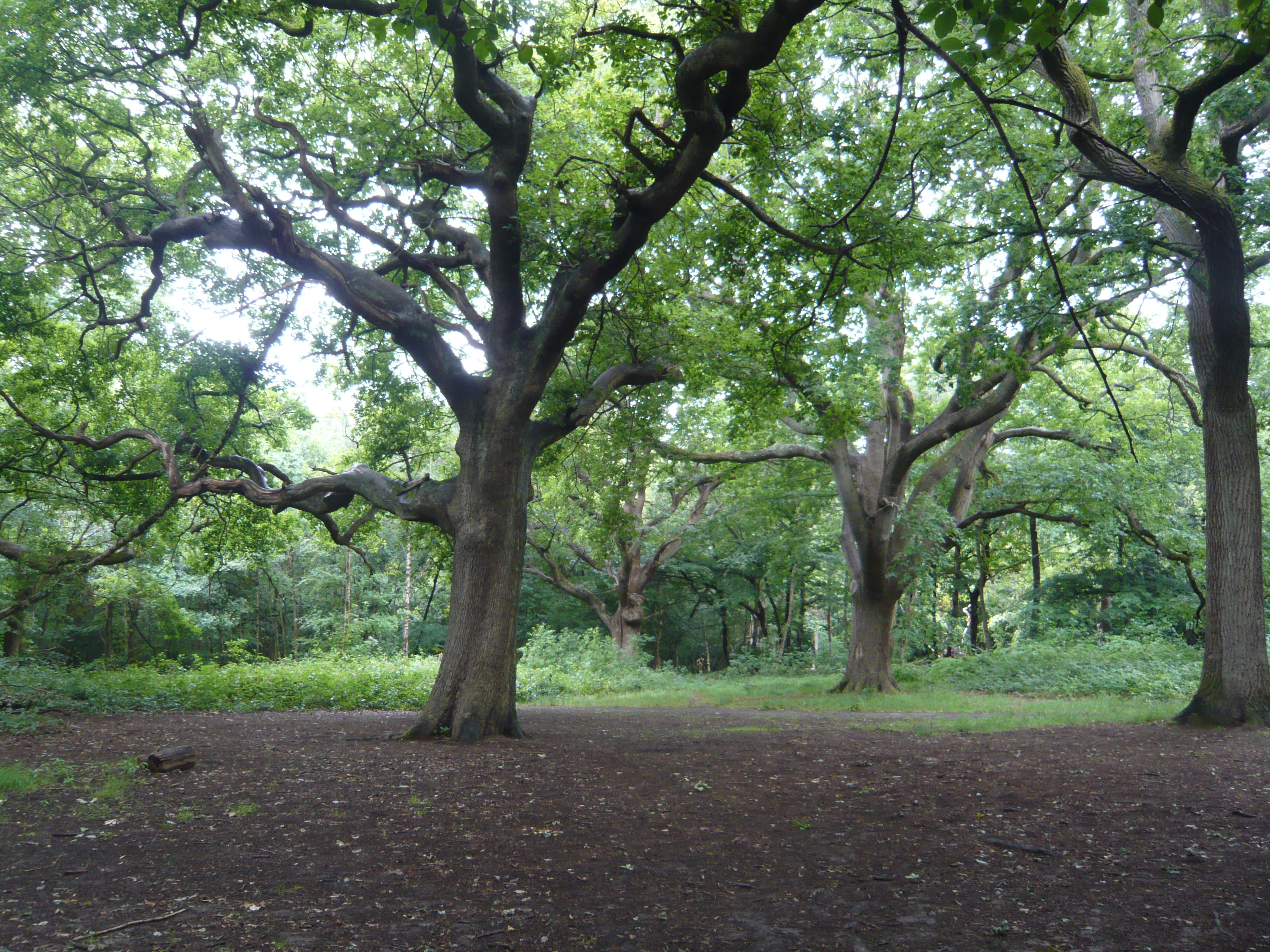
Don’t misunderstand me, I love these woodlands, and am very grateful I can get to them easily. Within them, for example, is this wonderful grove of oak trees. The oaks are not particularly old, probably around two hundred years I would imagine, but are stunningly beautiful. Some have branches thick with moss, all have wonderfully sculpted bark and all are home to huge numbers of creatures.
Already one or two have a limb dropping to the ground for extra stability. And the grove as an ecosystem within the wider woodland is perfect – each tree is around twenty five meters from its neighbours, which appears perfect when I look at the size of the canopy of each tree: its branches just about meet the branches of its neighbours, but there is no sense of their growth being restricted. I wonder whether this is chance, the result of long centuries of naturally evolving woodland – when one tree dies and eventually falls, that newly-opened space exploited by another seedling, or perhaps intelligent planting by a long-forgotten landowner?
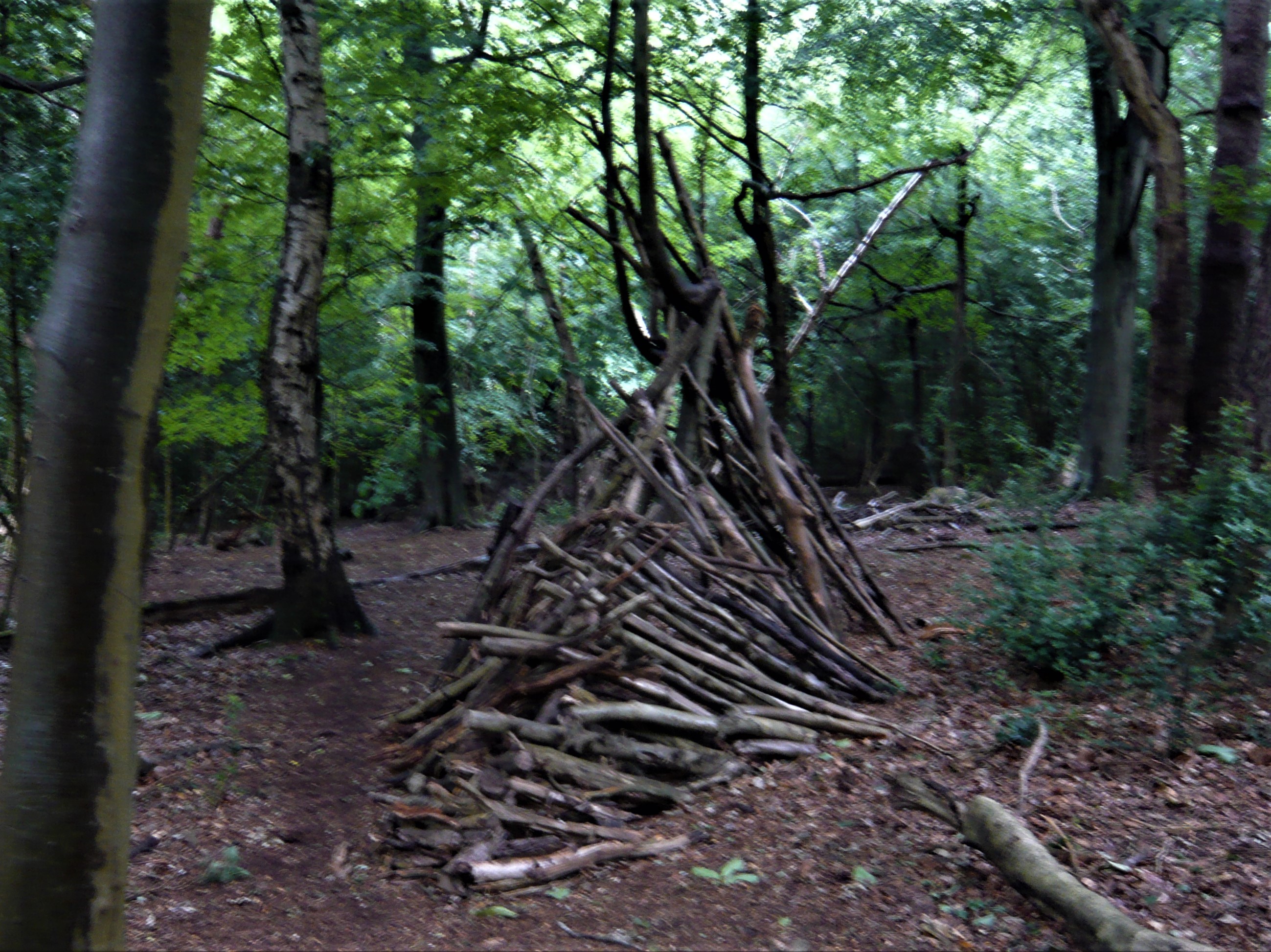
Where the woods are managed, especially the cutting in those areas where the holly is spreading in dense swathes crowding out all other growth, there are stacks of cut logs and branches exploited by children (shrieking or otherwise) to make dens. None of them would keep out the weather, but that’s not really their point. What I particularly like about them, other than it’s good to find children who want to play in this environment, rather than just sit in front of a screen, is most of these dens end up resembling the skeleton of some fantastic monster. And although that hardly turns these woods into a wilderness, it does give them just the faintest frisson of excitement, especially in the gloom.
And reminds me I want to be in the wilderness…
As is basic human nature, of course, the longer the restrictions (either imposed or of my own choosing) go on, the more I yearn for that wilderness.
This time, the review without any distracting rants. Probably.
Sub-titled Journeys into Forbidden Britain, it immediately sets out its agenda: it is both a potted history of how the land was stolen from the inhabitants of Britain, and the long struggles to regain access to much of it, with numerous anecdotes of the author’s own escapades trespassing.
The story of how the inhabitants of Britain came to lose their access to the majority of the land is a story that has been repeated throughout most of Europe and beyond. Land forcibly taken by invading armies and distributed partly to their soldiers, but mainly their officials or nobility. Land enclosed by lords and kings for hunting purposes, burning villages and evicting their inhabitants from the land. Land taken by acts of Parliament to further enrich the gentry. Land given by kings to the established church, so that peasants might labour only to feed the rich and corrupt clergy.
Land that has been kept private and jealously guarded both by strict and cruel laws, and by equally cruel methods by the landowners themselves. Thus laws that deemed the starving and dispossessed villager might be executed for taking a rabbit from land he once lived on, to feed his family. Thus the mantrap that would cut a mans leg off. Thus countless thousands beaten and sometimes killed by gamekeepers and owners.
When I attempted to review this a week ago, it ended up turning into a full-blown rant against grouse moors (I do rants so well, these days!), but even today it is not just grouse moors that are fenced off just so the idle rich can enjoy slaughtering wildlife – there is plenty of woodland and more open land enclosed around the country and dedicated to pheasant shooting, for example. There are country houses with huge estates. Land taken by the MOD for training purposes, and never returned. There are many landowners determined to block access to legal rights of way. Although the Countryside Rights of Way act of 2000 was supposed to restore access to most of the countryside, there is still much that is off-limits.
Yet there are good landowners, too. The tales of John’s own trespassing include several encounters with sympathetic landowners happy to see walkers on their land, with the obvious proviso that they cause no damage.
The improved access rights we do have today were earned the hard way. Since Victorian times there have been mass trespasses intended to both bring the issue into the public forum, and to try to force change. The Kinder Trespass of 1932 is probably the most famous, yet many preceded that. It is thanks to the countless trespassers and campaigners of those days that we have improved access rights today.
The book finishes, though, with a plea. Firstly to campaign for further land reform, for better access rights – rights that are enjoyed in Scotland, but not England, Wales or Ireland. And secondly with a warning – the current government campaigned at the last election on a promise to criminalise trespass, so that anyone who deliberately or inadvertently strays from a public footpath onto private land might find themselves on a charge in a criminal court.
Anyone who enjoys the countryside in any form, enjoys spending time there, and walking in it, should read this book. It provides a very good, clear, account of where we are, how we got here, and what has been done to get us someplace better.
My intention was to review it today, but as I was writing the review it gradually turned into a polemic against grouse moors and the people who own them. So I’m going to run with that and write the review (properly) next week instead.
So, why is this about grouse moors? Well, in The Compleat Trespasser, grouse moors are one of the habitats John mentions in relation to trespassing.
There’s so much to detest about grouse moors.
Firstly, the fact that they tend to be very large areas of land owned by one rich person who wants to keep everyone else off that land; land that is, to use the hackneyed but nonetheless accurate phrase, the birthright of everyone in this country. Land that has, like much other land, been stolen from us originally by force and then passed around from one rich and powerful person to another. Land that, at one time, people would have depended upon for their livelihoods in a multitude of forms, whether it was growing food, gathering wood for shelter or for fire, fodder for their livestock, or somewhere to live.
Secondly, that same owner does everything in their power to destroy all wildlife other than the grouse they protect, so those grouse can then be killed either by their rich chums, or by others who can afford to pay for the pleasure of killing other creatures. Foxes, rats, rabbits, badgers, crows, hawks…the list is pretty well endless. Trapped, poisoned, shot…the result being a landscape as devoid of life as any desert. And I hate that arrogance that says ‘all these wild animals are my property.’
Thirdly, the drab uniformity of the landscape. Nothing but heather growing, and that burned in ten year cycles to maintain that barren uniformity. And this in turn contributes to accelerated run off and flooding in periods of heavy rainfall, affecting land lower down – often villages or small towns.
And, I daresay, the lack of cover makes it easier for the gamekeepers to watch for intruders.
But, at last opinions are beginning to slowly, but surely, turn against these dreadful habitats and their dreadful owners. I’m sure it will take a while yet, but I’m hopeful that in my lifetime we will see a ban on commercial grouse moors and the beginning of their re-wilding.
Well, I don’t know about you, but what with you-know-what and the lockdown I feel a bit bleurgh at the moment, so to try to inject a little cheer – or whimsy, anyway – I thought I’d re-post an old one:
Once upon a time, a long, long time ago, God created the world. And he looked upon the world and said ‘Well, so far so good’.
And the world was full of beautiful things and good things and a great bounty of useful things that humans would later ransack and destroy in the name of greed, although that is a story for another day.
But when the people whom God had created looked upon his great works, they said unto Him ‘How might we thank you, oh God? How might we show our gratitude for your benevolence?’
And God replied ‘Oh, I don’t know. I really wish you wouldn’t bother. But if you must, just make me a sandwich, or something. I’m feeling a bit peckish after all that creating.’
And so the people made haste to slice bread and find Good Things to become a tasty and delicious filling for the sandwich they had made for their God. And there arose minor disputes such as whether ham and cheese really went together in a sandwich, or whether mayonnaise actually counted as food, but the people settled their quarrel in an amicable fashion and so the sandwich was created and placed upon a golden plate that was decorated with the names of angels and archangels, and set about with small mountains of salad and just a little dash of mustard in case God should fancy some.
And then one among them rose up and said ‘Wait, for we must cut this sandwich before we present it to our God, unless it be a bit too large for him to handle and he drop pieces of cheese from the sides or drip mayonnaise in his holy lap.’
And all at once there arose discord, for some were found who would cut the sandwich in a diagonal fashion, and yet others who declared that would be an affront to His holiness and that the only Right Way would be to cut the sandwich into equal rectangles.
And lo, the factions took up weapons and fought, yea, even in the Holy Kitchen, and they did massacre one another and each declared that the other faction was a worshipper of Satan, who was completely bemused by all this, since he had no followers (not even on Facebook), and they did create rival churches and rival nations and declared undying enmity against each other, spending the next few thousand years thinking up new and more imaginative ways to hate and kill and destroy each other.
And God groaned and held his head in his hands and said ‘Oh verily, what a cock-up this has become. I think I shall destroy the lot of them.’













 Mick Canning