Dodgy digestion in Dharamshala

I am not sure why, but I frequently think of the room that I stayed in when I went to McCloud Ganj in 2009. It was not my best trip to India, since it was the one time that I have picked up a bad stomach bug that I could not shake off for the entire duration of my trip. I had a few days in Jaipur, the condition of my digestive system rapidly going downhill despite medication and fasting, and finally took the bus back to Delhi where I felt strangely comfortable in the familiar warren of Paharganj.

When I felt that my stomach had at least stabilised, although it was by no means cured, I decided I was well enough to go and spend a week or so in Dharamshala. Or McCloud Ganj, which is what most people mean when they mention Dharamshala. McCloud Ganj is where the Dalai Lama and many Tibetan refugees actually live; Dharamshala is a town close by. Anyway, instead of taking the bus – a twelve hour journey that I just couldn’t face – I splashed out and took a flight.

Actually, the flight was wonderful.

The plane was a twin engine prop, rather than a jet, carrying just a few passengers. If one has to travel by air, then I think that there is no nicer way of doing it. We were crossing the North Indian plains for a while, then all of a sudden the Himalaya jagged up like freshly whitened teeth from side to side across the horizon. We slowly approached, the ground beginning to rise up into hills and the towns disappearing. We passed Shimla atop a ridge, with its airport running along a second ridge, looking for all the world as though the top had been sliced off – and perhaps it had.

Eventually we came into land – a tiny airport where the aircraft taxied up to the small building, switched off, and then when we got out all was quiet. After the hum of the engines during the flight, the sudden silence with the mountains staring down at us, and the air clear and cool, was breathtaking and almost indescribably beautiful. I just wanted to stand still and drink it all in, but was eventually ushered into the terminal.

And the aircraft terminal was small enough to feel that it was built on a human scale. A few rooms and halls, and not too many people around. And even those people appeared to be in no real hurry, unlike the larger airports that I usually find myself in.

I thought immediately of Leh airport, in Ladakh. That had the same feel.

So I picked up my luggage, and went outside to get a taxi to McLeod Ganj (or Gunj).

Once in McLeod Ganj, I checked into my room at Hotel Ladies Venture. It was basic, but it was clean, had hot water, a bed with lots of blankets, a table and a chair. For RS 200/- a night I had nothing to complain about, and if you wish to read this as a recommendation, then feel free to do so.

219

I shall write a proper blog post on McCloud Ganj at some point, but suffice to say I did very little during the week that I was there, other than wander around and look at the mountains, read, eat and drink, and visit the Tsuglagkhang Complex; the temples and the residence of the Dalai Lama (who was out when I visited).

But my guest house room has stuck in my mind.

By the end of my second day there, I had slightly rearranged the room to get it how I wanted it. My few books were lined up on the windowsill. Various belongings were on the table. I had hung a string of prayer flags along the wall. Little touches.

I have stayed in far nicer rooms. I have enjoyed better health at other times. But every time that I feel my life is too cluttered; too full of unnecessary junk and too complicated, it is this room that suddenly springs to mind, and I’m not entirely certain why.

It might have something to do with the fact that I do travel light, and so have nothing with me but essentials plus a few books and my notebook (although I would argue that they are also essentials!).

It might have something to do with the fact that my room that week felt like a bit of a refuge, partly because I still felt unwell, although I am not entirely convinced by this since I loved the town, the people were lovely, and I was completely at ease there.

I think that it is simply symbolic of the feeling that I constantly have that I need desperately to declutter and simplify my life. I think that when feelings of stress and anxiety threaten to overwhelm me, then it is an image of a refuge. I think that it is a reminder of much that I love about India and its people.

Dammit, I need to get out there again!

Himalayan Foothills

I am going offline for a few days, since I need a bit of a break, so I will leave you with a selection of photographs from the Himalayan Foothills, Northern India. When I log on again in a few days, I’ll catch up with everyone’s blogs and comments.

By ‘Foothills’ I mean the ranges of hills and smaller mountains that guard the approach to the Himalaya proper, where the big beasties rise up to heights of over 8000m with permanent ice and snow cover. The old Raj hill stations such as Nainital and Darjeeling were built at heights of around 2000m – high by UK standards, but certainly not by Himalayan ones.

one

Naini Tal, Nainital Town, Northern India. Morning Light. Nainital lake, (‘naina’ is Sanskrit for eye and ‘tal’ means lake) in Hindu mythology, is one of the emerald green eyes of Sati, Shiva’s wife. This was my first view of it after getting off of the overnight bus from Delhi.

two

Gadhar Kunkyop Ling Gompa, Nainital. Unlike many other Himalayan towns, Nainital has no sizeable Tibetan population, and this Monastery, perched high to the North East, overlooking the lake, is the only one in Nainital and home to just seven monks.

three

Morning mist, Nainital.

four

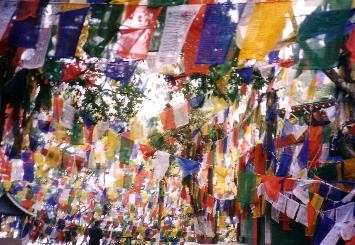
A sea of prayer flags on Observatory Hill, Darjeeling. Darjeeling, unlike Nainital, has a large Tibetan population and many Gompas both in the town and the surrounding hills. Observatory Hill is the site of the original temple of Dorje Ling, long destroyed, but after which the town was named, once the British had persuaded the then ruler of the area, the Chogyal of Sikkim, to lease them the land to build a hill station. The hill is now home to a Hindu shrine, with the British built church of Saint Andrew close-by.

But no Gompa.

five

The ‘Toy Train’ stopped outside Samten Choling Gompa at Ghoom, near Darjeeling. This train runs for 51 miles from Siliguri to Darjeeling, rising a total of just over 7000 ft. It has numerous steep gradients and sharp curves, including the famous one at ‘Agony Point’ – originally the loop there was a diameter of only 59.5 ft and the train literally overhung the mountainside as it rounded the curve. All in all, quite a remarkable engineering feat and deservedly a World Heritage site.

six

Druk Sangak Gompa, a large Buddhist monastery on the edge of Darjeeling, West Bengal. A fairly new gompa, it was inaugurated by the Dalai Lama in 1992.
seven

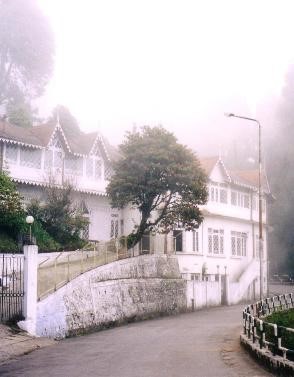
Not Chelmsford, UK, but Darjeeling, West Bengal). Many of the old British hill stations, such as Darjeeling, still retain much of their colonial character.
eight

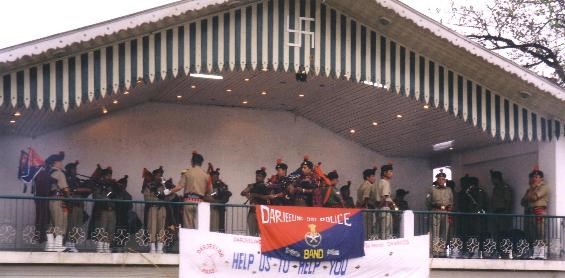
A clash of cultures! And what a clash. East meets west, with brass band in the park meeting the Indian Himalaya, courtesy of the Darjeeling Police Band. The band played in a bandstand on the Chowrasta, the open square at the top of Darjeeling, close to Observatory Hill. In the days of the Raj, this would, no doubt, have been familiar to all who lived there. Close your eyes and think of England…
nine

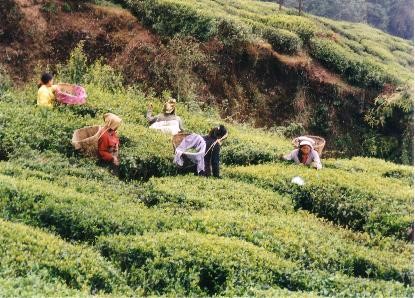
Tea pickers, Darjeeling. Think of Darjeeling, think of tea. In the hills surrounding Darjeeling are numerous tea estates, where the job of tea picking, sorting, drying and packing goes on much as it has done for the last 150 years.

ten

Buddhist painting on rock wall, by open air shrine, Darjeeling. As well as the larger gompas, you come across small shrines and gompas unexpectedly around odd corners everywhere.

eleven

Prayer Lags in Yumthang Valley, Northern Sikkim. This is as far north in Sikkim that you are allowed to travel, just a few miles south and west of Tibet. Everybody is still very touchy about borders.

twelve

Crossing a bridge in the Yumthang valley. It should be safe, considering the number of prayer flags!

thirteen

Unnamed 6000m peaks overlooking the Yumthang Valley. We asked our guide the names of these peaks, only to be disparagingly told ‘They don’t have names. They’re less than 6000m tall.
fourteen

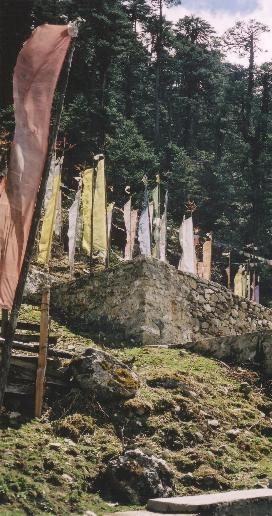
And more prayer flags…

fifteen

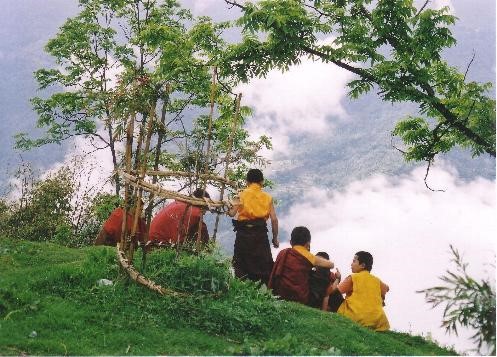
Young monks on a hillside, Phodong Gompa, Sikkim.

sixteen

Monastery wall painting, Lachung Gompa, Northern Sikkim. Lachung Gompa is about 2km above Lachung village, at a height of about 3000m. It is not a ‘working’ gompa, the monks living down in the village rather than at the gompa, so it is generally kept locked and only used on festivals and full moon days.
seventeen

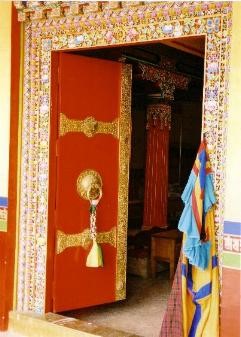
Monastery door, Tharpa Choling Gompa, Kalimpong, W.B. Kalimpong, not far from Darjeeling, but 1000 metres lower, has also a large Tibetan population.

eighteen

Statue of Chenrezig (Avalokiteshvara), Durpin Gompa, Kalimpong, West Bengal. Chenrezig (Tibetan) or Avalokiteshvara is the Bodhisattva (a being who has partly or completely attained the state of enlightenment) of compassion. The well-known mantra ‘Om Mani Padme Hum’ is dedicated to him.

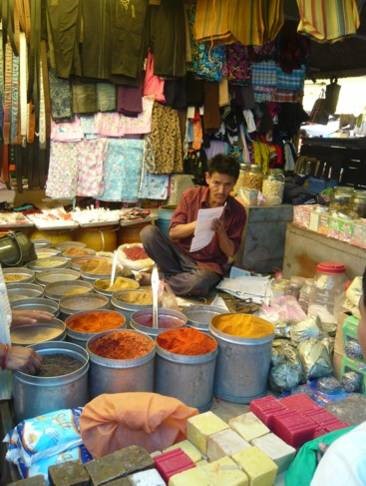
Kalimpong market:
nineteen

I watched this gentleman for some time before I approached and asked for a photo. he was rapidly serving a succession of customers at great speed, making up little paper screws of spices and powders at a tremendous rate…

twenty

…whereas this gentleman served his customers at a more leisurely pace, as if he had all the time in the world.

twenty one

This gentleman was delighted to be photographed with his fine collection of Kukris. As I prepared to take the photo, he picked up a kukri and brandished it with a none too convincing snarl, to the obvious amusement of most of the people around him.

twenty two

This stall-holder seemed to find it hilarious that I should want to photograph her.

twenty three

This lady, on the other hand, was delighted to be photographed; volunteering eagerly when a lady on a nearby stall refused.
twenty four

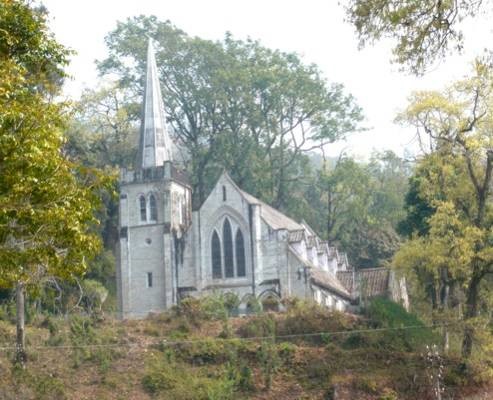
The Katherine Graham Memorial Chapel, in the grounds of the Dr Graham School and home, Kalimpong. Built in 1925, it looks to have materialised straight out of the Scottish Highlands. Dr Graham was a Scottish missionary, and built the home and school originally to educate the children of local tea estate workers. It now has a far broader intake.

twenty five

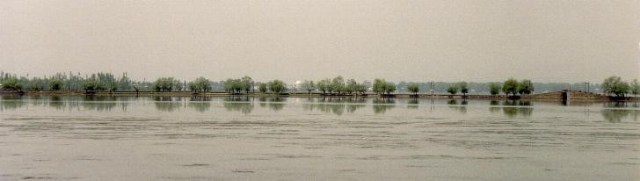
Lake Dal, Srinagar, Kashmir. Unfortunately, it is still probably unwise to visit most of Kashmir, and things will probably remain this way for some considerable time to come. A pity, because this really is a most beautiful part of India and Pakistan. I took these photos in 1989, a very short while before the area became off-limits to tourists.
twenty six

Panorama – Lake Dal, Srinagar, Kashmir). In the distance is the Hazratbal Mosque, a comparatively modern mosque, enshrining a hair of the prophet.

twenty seven

Hindu shrine. Near the shore of Lake Dal in Kashmir.

twenty eight

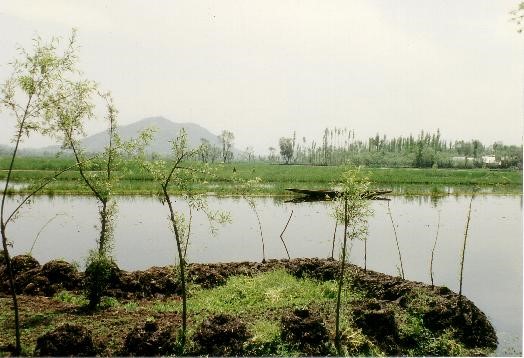
Houseboats around the shore of Lake Dal, Shrinagar, Kashmir. In the nineteenth century, the British, who first developed Srinagar as a hill station to get away from the stifling heat of the Indian Plains in the summer, found that the then Maharajah refused to sell them land to build houses. The solution? They built boats to live on…great, elaborate, ornate carved and decorated houseboats. These same boats, with many more recent editions, now function as floating hotels to tourists. The majority are moored not on the actual shore, but a little way off, often on the edge of small islands. This gives the local shakira (a type of small boat unique to Lake Dal) owners a chance to clean up, as a taxi service.
twenty nine

Shakira moored on Lake Dal.

Review: “Making friends with the Crocodile” by Mick Canning

A great review of my book by Christoph Fischer.

Christoph Fischer's avatarwriterchristophfischer

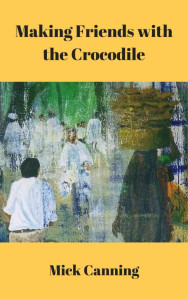
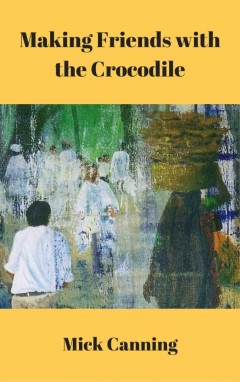
Making Friends with the Crocodile coverI am delighted to present you my review of Mick Canning’s novel “Making Friends with the Crocodile”. Having followed Mick’s blog posts about India for some time, I was eagerly awaiting it.
The book focuses on women in rural India. “If you live near the river, you better make friends with the Crocodile” is an Indian proverb.
In the novel we get to see simple lives, where people struggle to make a living, earn a reputation and survive in a world full of crocodiles. Those crocodiles come in all shapes and forms: friends, family, strangers, laws, conventions…
Surviving isn’t easy, especially if you are a woman.

The story of Siddiqui and her family revolves largely around an unfortunate evening incident that involves her daughter in law and the friend of her husband. How people and the community respond to said incident shows the difficulties women face.
At first I didn’t…

View original post 255 more words

Kathmandu, Nepal

How on earth have I managed to blog for almost a year, now, and still not put up a single post on Nepal? I think I’d better put that right immediately.
I’m going to start with a selection of pictures from Kathmandu, capital of Nepal.
All of these pictures were taken before the dreadful earthquakes of last year, and I do know that some of the buildings in these pictures (especially in Durbar Square) were sadly destroyed.

015a.jpg

The entrance to Swayambunath. Swayambunath is the main Tibetan Buddhist site of Kathmandu. Sitting on top of a hill overlooking Kathmandu, it comprises temples, stupas and various other buildings, including a couple of Hindu shrines. Here, a Hindu holy man lurks in ambush, ready to dab a tikka mark on the forehead of (especially) western tourists and demand rupees for the privilege.


038.JPG

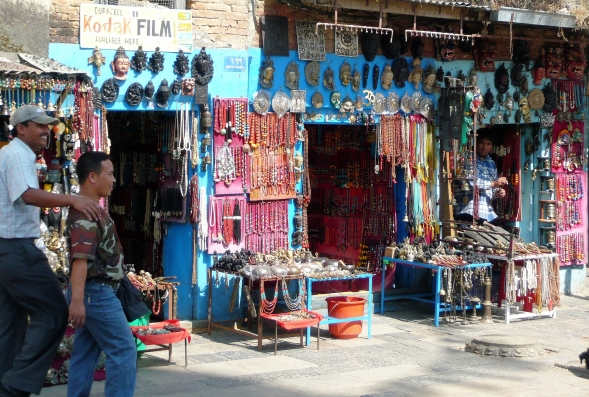
The sacred and the secular at Swayambunath. In Nepal, as in India, it is almost impossible to visit a religious site without Mammon getting a good look in. Here, in the main Buddhist site of Kathmandu, everything from yak bells to masks.


034a
‘One day, my boy, all this will be yours’ – just as long as you have enough money and all the time in the world to bargain hard. More shops – seriously colourful, seriously prepared to sell you anything. And having said that, the hard sell is a world removed from India. It almost feels as though there is no pressure at all. In Nepal, you feel you can relax again, especially if you have just travelled there from India.
056.JPG

Nuns lighting butter lamps beneath a row of prayer wheels at Swayambunath.

030a

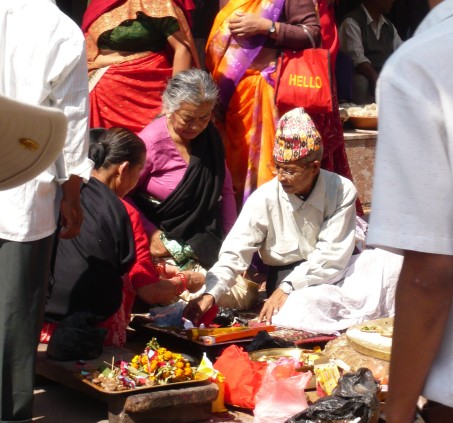
Hindu puja at Swayambunath. Probably a private ceremony at the request of the beneficiary, either for good luck in general or with a particular goal in mind (e.g. birth of a son, successful business venture.)


031b
Portrait of a Hindu lady.
057

Tourist shop in the Swayambunath complex.
100

Buildings in Durbar Square. Durbar (or ‘Palace’) Square is the heart of the old town and the area where the Kings used to live in the 18th and 19th centuries. In contrast to Swayambunath, this area is entirely Hindu, reflecting the vast majority of the lowland Nepali population.

102a

Side street in Thamel, Kathmandu. The lovely old buildings…beautiful wood carvings…collapsing brickwork…wiring all over the place…speed…calm…old and new…………the only things I can’t bring you are the sounds and smells…you must imagine them for yourselves. Coming soon, scratch and sniff websites!!!


098

Bicycle rickshaws awaiting customers in Durbar Square.


067b

Balloon seller and hopeful customer, Durbar Square.


070

Kala Bhairab – an image of Shiva in his most fearsome aspect. Wearing a garland of skulls, the six armed Kala Bhairab tramples a corpse, symbolic of ignorance. Carved originally from a single stone, it was set up by Pratap Malla, king in the 17th century. He was a pious Hindu, but interested in the arts and tolerant of other religions. He even restored much of Buddhist Swayambunath. It is said that telling a lie while standing before Kala Bhariab will bring instant death. It was once used as a form of trial by ordeal.


img
Pashupatinath, on the Eastern side of Kathmandu, is the holiest of the Hindu sites in the city. It is the temple of Shiva, on the Bagmati river and hence it includes the ghats, the most widely used place of cremation for Hindus in Kathmandu, indeed, in Nepal.

The Book is Released – Hurrah!


Making Friends with the Crocodile‘ is now released!

Making Friends with the Crocodile cover                             POD cover

Kindle edition                                                     Paperback edition

Anyone who has already pre-ordered it on Kindle / Amazon should have received it by now, and in countries where there is no pre-order facility, such as India, the Kindle edition is also now available to buy.

The paperback is available from the Amazon.com, Amazon.ca, Amazon.co.uk and Amazon.eu sites only – this is a quirk of Amazon – but can also be ordered from the estore at CreateSpace, at the following link:

https://www.createspace.com/6301808

And now, I wait to see what people think of the book, with a considerable amount of nervousness.

If you do buy a copy, please consider leaving a review either at Amazon, or on Goodreads, if you are a member (better still, at both!). Reviews are genuinely the lifeblood of a writer, and do help to sell books.

Finally, the blurb again…

‘Siddiqa was only just into her teens when she was forced to leave her home to live with her new husband and his family in another village. The years have passed, and now Siddiqa has three children of her own. Her grown up son has brought his new wife, Naira, to live with them, so Siddiqa is no longer the lowliest in the household, for she has a daughter-in-law.

Life in rural India is particularly harsh for women. This novel explores themes of female oppression and tradition and asks whether the next generation will find life any easier.’


Interview with Mick Canning

My first author interview, with Cathleen Townsend. My thanks to her for generously hosting this.

cathleentownsend's avatarCathleen Townsend

Mick CanningI met Mick through his wonderful blog, located at https://mickcanning.co/, and I was delighted when he agreed to be a guest here today.

Let’s start with you, Mick. Tell us about yourself.

I’ve always been writing, and completed 2 novels a long time ago. Both were so awful, though, that I junked them. It was a good learning curve, however, and now I’m hopefully a more mature writer. Until I become rich and famous (!), though, I make ends meet by teaching rock climbing, and occasionally some other outdoor activities.

I love travelling, especially to India and other nearby countries, which probably comes out in my blog posts!

I’ve learned a lot about India from those posts. How did you start your blog? Has it changed over time?

I have been following the blog at Writer’s Village (http://www.writers-village.org/writing-award-blog.php) for some time, and advice that I received in…

View original post 1,039 more words

Sri Lanka – The Hill Country

I thought I’d bring you a third helping of Sri Lanka today, so to speak. These are a few of the photographs that we took when we went up into the hill country for a few days.

179

First up, a view of Ella Rock taken across the tea gardens.

177

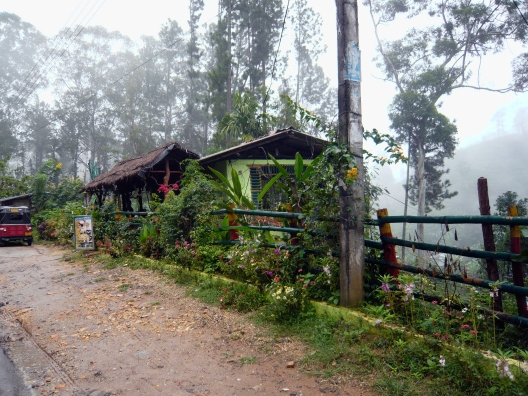
Next, a view of the charming Lizzie Villa, our home for a few days. It is set in beautiful gardens, and run by our equally charming hostess, Mrs Lizzie. For the first day or so, we had good weather – rather humid and a little cloudy, but pleasant enough. But then the heavy rain arrived, and our walk from the road to the villa became an adventure in trying to avoid the leeches that magically appeared from every leaf and twig.

181

During one of the breaks in the weather, we walked to Little Adam’s Peak which is approximately an hour and a half’s walk from Ella to the top. On the way back, we stopped in this lovely flower-covered cafe for some late refreshments.

167

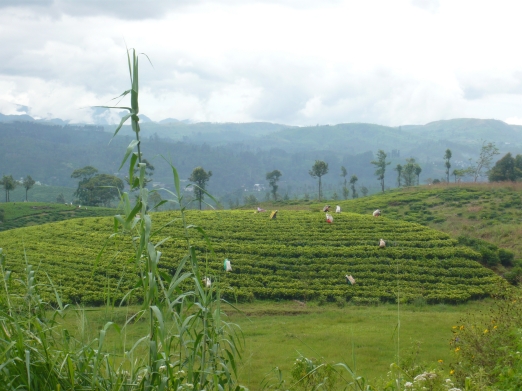
Tamil tea pickers in a tea garden near Nuwara Eliya. Most tea pickers in Sri lanka are still Tamils, descendants of those brought from India by the British over a hundred years ago to work in the tea gardens.

170

A farmstead in the jungle near Haputale.

172

Hillside jungle near Ella.

184

Finally, the rather quaint railway station at Ella, which was unfortunately closed due to landslips on the line when we wanted to get the train back down to Kandy. We had left the cottage early, and a taxi had dropped us off here. But when it was apparent that the line was closed, the taxi driver very kindly loaded us back into his taxi, drove us to a bus stop and explained which bus we should get, where we should go, and what bus to take from there to Kandy. And would he let us pay him? No, he wouldn’t. Small, unexpected, kindnesses again.

The Morning After…

Wow, what a weekend!

After the book launch, the parties!

Celebrations!

Oh, and when I looked out of the window to see the streams of bunting all the way along the road, and the swarms of well-wishers gathering outside the house, I was so excited!

Then once I had gone out and signed loads and loads of autographs, I was being chased all over town for interviews by all the big newspapers!

And then I…

Well, okay. That’s not strictly true.

It’s not very true at all.

In fact, it’s not true in even the teeniest tiniest littlest way.

My life does not seem to have altered in the slightest and, actually, I’m glad about that.

070 (2)

Right, now it’s time to get on with the next stage.

I’ve put a link on the image of the book on my sidebar, which goes directly to my book page on Amazon (thanks, Stuart!).

And I’m looking at the best way to create Print on Demand paperback copies of the book, probably by using CreateSpace (lots of recommendations), and hope to have that sorted out in a couple of days. I don’t think it’s too difficult, but my way of dealing with new technology tends to be by shouting at it and slamming doors, so I may take longer than other writers.

But since the release date of the Kindle copy is June 4th, I should have time to arrange for the paperback to be released on the same date.

So, what next?

Actually, it will be great to feel that I can focus on just writing again, and not just constant editing and revision, so it’s back to the long Work in Progress, ‘The Assassin’s Garden’. This has a timeline that stretches from Medieval Persia through Medieval India and the British Raj, through to Edwardian England. It’s already a long novel and nowhere near finished, so I suspect that I might eventually have a trilogy on my hands.

I might even write a short story or two.

Ooh, it’s exciting. I do love this writing lark!

Published!

Well, blimey, Making Friends with the Crocodile is now published on Kindle and is up on Amazon as we speak!

Making Friends with the -Crocodile

About a week ago, I reached the point where I felt that the editing was finally complete, or, at least, if it wasn’t, then I might just pick at it for ages without really making any further difference, and so it was time to get the process finished.

What a relief.

It feels as though I have been under pressure for weeks. I’ve felt tired, I’ve felt tense.

Ooh, I’ve been irritable!

All this pressure, of course, is of my own making. A lot of it, I suspect, being due to this being my first foray into publishing.

I knew that I needed to format my text for Kindle, and heard that Scrivener was a useful tool for that. And so I downloaded Scrivener, and spent a couple of hours working through the tutorial until I decided that it just wasn’t going to happen for me.

I’m sure it is very useful, but I was getting to the point where I felt like chucking the laptop at the wall.

So I went and looked in detail at the instructions for publishing on Kindle, and found that you could just save your file in the correct format and then upload that.

Bye, bye Scrivener.

I looked at a few Kindle books and then wrote the stuff at the front and back of the book – about copyrights and stuff like that.

I inserted my table of contents.

I already had my book cover ready.

I wrote the blurb:

‘Siddiqa was only just into her teens when she was forced to leave her home to live with her new husband and his family in another village. The years have passed, and now Siddiqa has three children of her own. Her grown up son has brought his new wife, Naira, to live with them, so Siddiqa is no longer the lowliest in the household, for she has a daughter-in-law.

Life in rural India is particularly harsh for women. This novel explores themes of female oppression and tradition and asks whether the next generation will find life any easier.’

Working out how to upload to Kindle, and to complete all of the forms and tick boxes proved a little long winded, but reasonably straightforward.

So then, suddenly, there it was. Sitting on Amazon, available for pre-order, with a launch date of 4th June. Although for some reason, unfortunately, pre-order is not available in India.

And now it feels much like stepping off of a crowded and noisy street into summer sunshine; the sounds of the shouting and the traffic disappearing and being replaced by birdsong.

IMGP2282

Woo-hoo!

And what a buzz to go and look at my own author page on Amazon, with my own book there!

Woo-hoo again!

For the moment, as I say, it is only available for pre-order, and will be released on 4th June. But if anyone does feel inclined to buy it, pre-orders will help boost the ratings when it actually launches.

I am going to look again at Print on Demand, in a day or so. Initially, I had ruled it out, mainly because the one site that I looked at required the customer (i.e. me) to order and pay for a set number in advance, and I assumed that would always be the case, but now I think that is possibly not so. Certainly, the Amazon tool, CreateSpace, looks as though it might work more the way that Kindle does.

It will be great if it does, since I really prefer to have a physical copy of a book, and I know there are still a few other people out there who still feel that way.

So…now to get my head around promotion…

Sri Lanka (2)

Sra Lanka – Ancient Cities

Today, a return to Sri Lanka, and a few of the photographs that I took at some of the ancient sites.

Dambula – Rock Temple – reclining Buddha. There are 5 caves in all, each one more splendid than the last (assuming, of course, that you visit them in the correct order!), containing some 150 Buddha images.

SRPanorama 1thumb

SR250athumb

Dambula – Rock Temple -feet of reclining Buddha statue.

BELOW: A further selection of images from the caves at Dambulla.

SR247thumb

SR241thumb

SR238athumb

SR227thumb

SR243thumb

SR283thumb

Anuradhapura – Red brick Jetavanarama Dagoba.

SR261thumb

Anuradhapura – moonstone. Moonstones were not merely designed to be decorative, the patterns and figures are all relevant to Buddhist cosmic symbology.

SR288thumb

Anuradhapura. The Ruvanvelisaya Dagoba.

SR289athumb
Anuradhapura. Elephant carvings at the Ruvanvelisaya Dagoba.

SR265athumb
Buffaloes at Anuradhapura doing what they do best!