Winter – 1

The long-range weather forecast is predicting generally mild, wet weather in the run-up to Christmas. So still no sign of ‘winter’ yet.

Although there is a lot to be said for mild weather, we need the cold of winter to help to break up the soil for the following year and kill off many pests. But our climate is changing.

There are some swallows still around, apparently. Presumably because there are still plenty of insects for them to eat. They should have left ages ago. What does this mean for them in the coming months? If the weather remains mild and the insects persist, will they be able to survive the winter here? And will they still be able to successfully migrate if the expected colder weather kills off these insects, or will they have left it too late? I suspect it will not end well for them.

There have always been a few of these days at the turn of the seasons, although probably nowhere near as many as now, and I wonder how our ancestors would deal with these days; the days I am sometimes tempted to call the Nothing Days. Those days which are grey and cold, but not severely so. The leaves are continuing to fall but seem in no hurry to complete the job. Nothing seems to be contributing to the change of the seasons. If any plants or animals are responding to anything, it can only be to the shortening of the daylight hours. There are still plenty of nuts and berries for the wildlife to forage – the birds are largely ignoring our bird feeders at the moment – although little for the human forager; the blackberries have finished, the chestnuts and hazelnuts all gone.

I suspect our ancestors would have moved into their own winter routines anyway, and got on with the jobs in hand, largely mending and making. With the onset of rains and wind and snow, rooves and walls would be repaired and strengthened, leaks caulked, trenches dug out to drain water away from dwellings. Tools and weapons would be fashioned and repaired. Measures taken for comfort and warmth – perhaps grasses and rushes and bracken collected and heaped up inside, likewise firewood, and fodder for animals.

Although I’m only guessing, but a fire in the middle of a hut filled with heaps of dried grasses might have required a Neolithic risk assessment following a visit by a fire and safety officer.

R. I. P. Winter

It’s beginning to feel both as though autumn has been with us forever, and that it is especially reluctant to leave us, this year.

This year has been a mast year; the trees and bushes have been laden with prodigious quantities of nuts and berries. The hawthorns, especially, seem to be weighed down with berries, and we have gathered large quantities of nuts from the hazel in our garden. There are so many acorns beneath the oaks nearby that there is a thick, continuous, crunchy, carpet of them underfoot. Traditionally, this has been said to indicate a harsh winter ahead, although how the trees and bushes are meant to work this out when we have no idea what the weather will be then, heaven only knows.

What it really indicates, of course, is that the climatic conditions have been such throughout the year that these trees and bushes have successfully produced their large crops. Nothing to do with what will come along later.

On the other hand, the leaves have held onto their greens for longer than usual and only turned late, and still seem most reluctant to fall. It has taken the determined efforts of a few strong winds just to remove about half of them. Certainly, around my part of Britain, anyway.

It is not cold. There are no signs of a proper winter chill approaching, with the long-range weather forecast contenting itself with predictions of the occasional cold spell in the next month, which takes us through to mid-December. In the garden the grass and many of our other plants are still engaged in that crazy autumn growth spurt.

Of course, it was never unusual for November to be wet and mild, and we may yet have a biting cold winter, although I wouldn’t bet on it. It is a long, long time since we have had a winter like that in these parts. In my lifetime, only the winters of 1963 and 1978/79 really stand out as being extremely harsh, although a few others have had shorter periods of cold and snow. The expectation for winter around here now is that it will just be chilly and wet. I think only once in the last six or seven years have we had more than just the odd flurry of snow; that was from the so-called ‘Beast from the East’ a couple of years ago, and even that only lasted a few days.

We seem to have lost winter somewhere along the way, which sounds very careless of us.

In fact, that is quite a good way of describing it.

You don’t need me to tell you we have been careless in the way we have interacted with nature, the result being our world is heating up dangerously. And in our part of the world, this has led to hotter, drier, summers and milder, wetter, winters. There has been a notable increase in destructive flooding events. Downpours are frequently very heavy and long-lasting. Rather than being spread out through the month, we may get an entire month’s worth of rain in less than a day. Summers, conversely, have become very dry.

This is absolutely nothing to the extreme climate conditions suffered by millions of others in other parts of the world, but it helps to bring it home to us that the Climate Emergency is real, and it is happening. With everything else happening in the world at the moment, this seems to have been conveniently ignored by the mainstream media for the last six months.

R. I. P. Winter.

An Andalusian Adventure (2)

Part 1 can be found here: Part 1

It was a long way to Colmenar. I was walking up into the Malaga Mountains, with no map and no directions other than a road sign at the edge of Malaga suggesting that by following this road I would eventually reach my destination.

I suspect I have undertaken other journeys where I have been better prepared.

But the day was perfect for walking, with high drifting clouds and a light breeze to keep me cool, and having done little for several days other than eat, drink and wander around Malaga, I was feeling fit, fresh, and eager to get going.

As the hours went by and I slowly gained height, the clouds began to build up, and the temperature gradually dropped. About an hour from my destination, it finally began to rain. Immediately the temperature plummeted, and I rapidly went from merely chilled to decidedly cold.

Usually, we approach rain all wrong. Buddhists would say unskilfully. If it begins to rain, we hunch ourselves up, both physically and mentally. We fear becoming cold and wet. We need to let go of this fear. It’s a good lesson to learn. Stop. Take several long, slow, deep, breaths, and let go of this feeling. Let go of this need. We act as though hunching ourselves up will keep us dry and make us warmer. It doesn’t. Unless one can find shelter, it is better to accept the rain and finish the journey.

It is a cliché to speak of heightened awareness, yet that is also a by-product of this letting go. We remove our focus from the rain and instead allow it to go elsewhere, where it is really needed. We should throw back our heads and embrace the rain, enjoy the freshness of the rain on our faces. Listen to the sound of the rain on the ground and the leaves around us.

Back then, I hadn’t learned that lesson. I hurried towards the town as fast as I could.

One of the first buildings I came to was an inn. I went into the bar and asked for a room. The room I was given was reached by leaving the bar again and walking around the side of the building. The door to my room had a gap at the bottom of an inch or two, but otherwise fitted the door frame well enough. It was locked and unlocked by the type of huge key frequently described as a jailor’s key. The room was furnished only with a bed, a chair, and a small chest of drawers. There was a mirror above the chest of drawers and a crucifix above the head of the bed, but other than those the whitewashed walls were bare. There was a small window which was shuttered. The floor was of flagstones, with no carpet or mat. To use toilet or bathroom it was necessary to leave the room again and continue still further around the building to reach a very basic room. But again, it was clean. And there was a toilet that worked, and a sink with a cold tap. There was also a shower set into the ceiling I could have braved, but it felt much too cold for that.

Later, I would occupy rooms like this in many other places, in many other countries. Simple, perfectly clean, and usually very cheap. I am not sure whether it is because they appeal to the minimalist in me, but in many ways I prefer them to more comfortable accommodation.

Whenever I have stayed in one, I have always felt I was carrying too much baggage with me. I have been beset with the feeling I should be throwing out some of the items I have in my bag – do I need all those clothes? All those other items? It has been a recurring regret of mine that I have never managed to live a simpler lifestyle than I have. I have never enjoyed the frenetic hurry and clamour of modern urban life, and I hate how easily my life can become complex and filled with what feels like unnecessary fuss.

Here, even the spartan contents of my rucksack seemed too much. Perhaps I had too many books with me…

But now I was here, I changed out of my wet clothes and opened the shutters so I could look out at the low cloud and misty horizon. The rain drummed comfortingly on the roof and I settled down to read a book for an hour or so. I was content, and that’s a good place to be.

I cannot remember what I had for supper that night, but I do remember I drank a bottle of cheap red wine with it. Perhaps that is the reason.

I rather think I slept well, too.

And as in all good stories, the morning dawned bright and clear, the sun shining low in a clear blue sky. Before I left the town, I passed a couple of shops and bought a few items for my lunch: bread, a huge tomato, a hunk of cheese, a couple of apples, a bottle of cheap wine.

img20190318_12103098

With the improved weather, and the fact I had more downhill stretches that day than uphill ones, I allowed myself the luxury of returning to Malaga slowly, including a stop for lunch of about an hour. Compared to the UK, Spain is a large country and the rural population is comparatively small. Although I was not far from the city, I saw almost no one else on my walk and I meandered along slowly through a mixture of low trees and bushes, many of them in flower – the distinctive Mediterranean maquis vegetation – rocky outcrops and clumps of flowers, and the occasional lone farmhouse. The ground was dry and dusty, as though the rain of the previous day had never happened, and the sun was hot. With my lunch consisting of about half a bottle of wine as well as the food, I was feeling extremely weary and footsore when I reached Malaga again. I found the hotel I’d stayed in before and got a room on the same floor. After showering, I finished the bread and cheese and decided all I wanted to do was read my book for a while and then have an early night.

There was a knock at the door and when I opened it Matthias was standing there grinning.

‘I saw you arrive earlier. We go for beer, now!’
I Am The Wind

Untitled-Grayscale-01

I clatter dry leaves along dusty footpaths

And bear burdens far greater

Than mere birds and clouds.


On high, cold, moors I blow

In the hollow eyes of sheep, inert and prone,

And ruffle the hissing grass over barrows

Of long-dead chieftains.


From the fading fires of the sick and the dying

I blow prayers in the smarting eyes

Of disinterested and uncaring gods.


I steal your thoughts.

A Walk And Other Things

It was bitterly cold but sunny first thing yesterday morning, but after a couple of hours the air had warmed up enough to tempt me out. I was due a walk anyway, having not even left the house the previous day.

Every year there is a point somewhere around the middle of February when I feel the warmth of the sun for the first time that year, but yesterday morning there was already a hint of that.

It wasn’t cold enough to freeze the ground, except in a few particularly exposed places, and so it was very muddy underfoot. Therefore it was a delight to occasionally walk through drifts of last years leaves.

And there was so much birdsong. So much so that it became a background noise that was easy to filter out after a while, except when a particularly loud or unusual song caught my attention. Not that I do that deliberately, since birdsong is one of the delights of the countryside. At some point or another when I’m out, I can usually hear the rooks, but maybe because of the sun and the noise from the other birds they seemed to be silent. I’ve always associated them with cloudy skies for some reason, perhaps because I’m so used to hearing them on moorland and in the hills and mountains.

But I’m sure they like a sunny day every bit as much as the next bird.

This morning is cloudy again and the rooks are back. Outside I hear crark crark crark, and the occasional cronk. There is rain and sleet forecast for later, so I go into town in the morning. By the time I get home, the sky is already full of dark clouds and threatening to drop some weather soon.

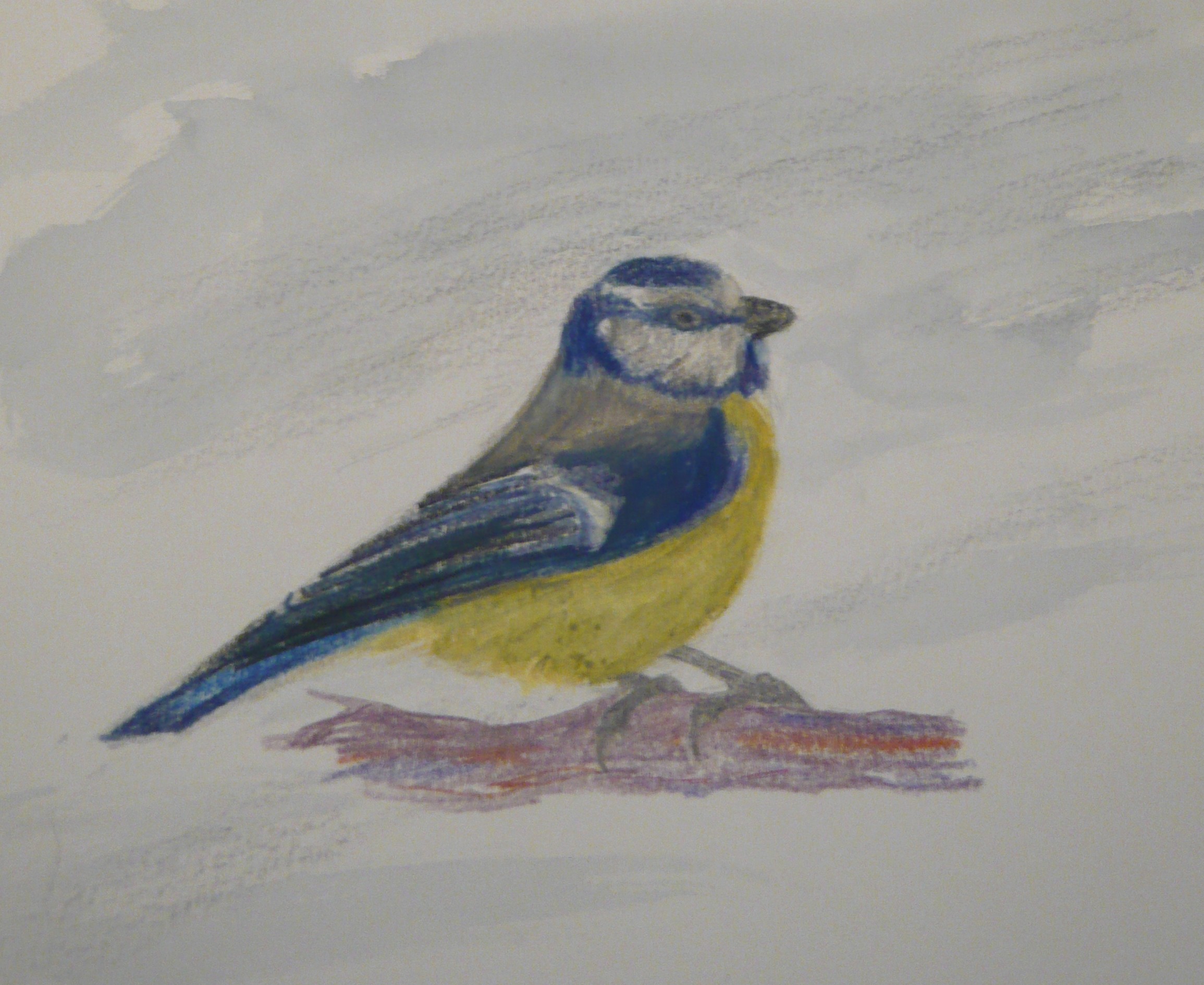
The afternoon, then. I partly spent painting this little fellow:

035

The blue tit is one of the few British birds whose population seems to be increasing slightly at the moment, in contrast to most whose populations have fallen – sometimes dramatically – over the last few years. We seem to be losing lots of the birds I took for granted as a child, which is such a sad thing. As a race, we seem to be so damned good at exterminating other creatures.

Do It Tomorrow

IMGP2317

We have all been encouraged to think

That our time is so important.

Yet it is only when we become old,

And we have so much less of it left,

That we realise this is not the case.


We’ve been told we must save time,

Instead of using it and moving on.

How precious time is,

As if it were a commodity we might hoard

And use when we need it most.


Instead of squandering it on what makes us happy,

And filling it with unimportant things.


But I say, let what you’re doing fill your time.

If you’re washing up,

Then let your plates be the cleanest.

And if you’re looking at the winter sun on frosty leaves,

Well, let that be the best experience you have ever had.


Sometimes I have these flashes,

When I think I’ve understood something deep and profound.

And usually it means an evening drinking wine,

Or half an hour sitting on a sunlit hillside.

But I do wonder what we’re all so busy chasing.


And if you think this lesson worth remembering,

There’s no better time than now.


Winter – a Tanka

I was writing a haiku yesterday, and decided to go the extra mile with it. Traditionally in Japan these poems were sometimes written in the form of tanka, which are essentially poems of five lines rather than three, with a syllable count of 5/7/5/7/7.

They could also be written as linked verse, with one or two poets writing haiku, and others supplying the two remaining lines between each haiku.

I’ve gone down the linked verse route, and also given myself the remit that each verse (of two or three lines) must contain a word or sentiment linking it to those either side – something that was also commonly done.

Yesterday was cold and miserable, hence the results.

It’s my first attempt – please don’t be too harsh!

029

The flowers have gone.

Crumbling stems standing askew,

In waterlogged soil.


Outlined against the grey sky,

Old willows by the stream.


Ten thousand leaves are

All that remain of autumn.

Wistful nostalgia.


Memories of warmer days,

Are all but forgotten now.


Wrapped up warm and snug,

Watching the grey willows weep.

Hands in my pockets.


Leaves fall slowly through the air,

Onto silent black waters.


Now a gust of wind

Swirls leaves around and around.

Racing each other.


Shifting clouds race overhead,

Sudden drizzle on the breeze.


Spiteful winter day,

Grasses shiver in the wind.

Low sunlight dazzles.


Walking in meditation,

Clouds unexpectedly clear.


Sudden bright sunshine

Reminds me the cold Winter,

Will change into Spring.

010a

Just Playing…

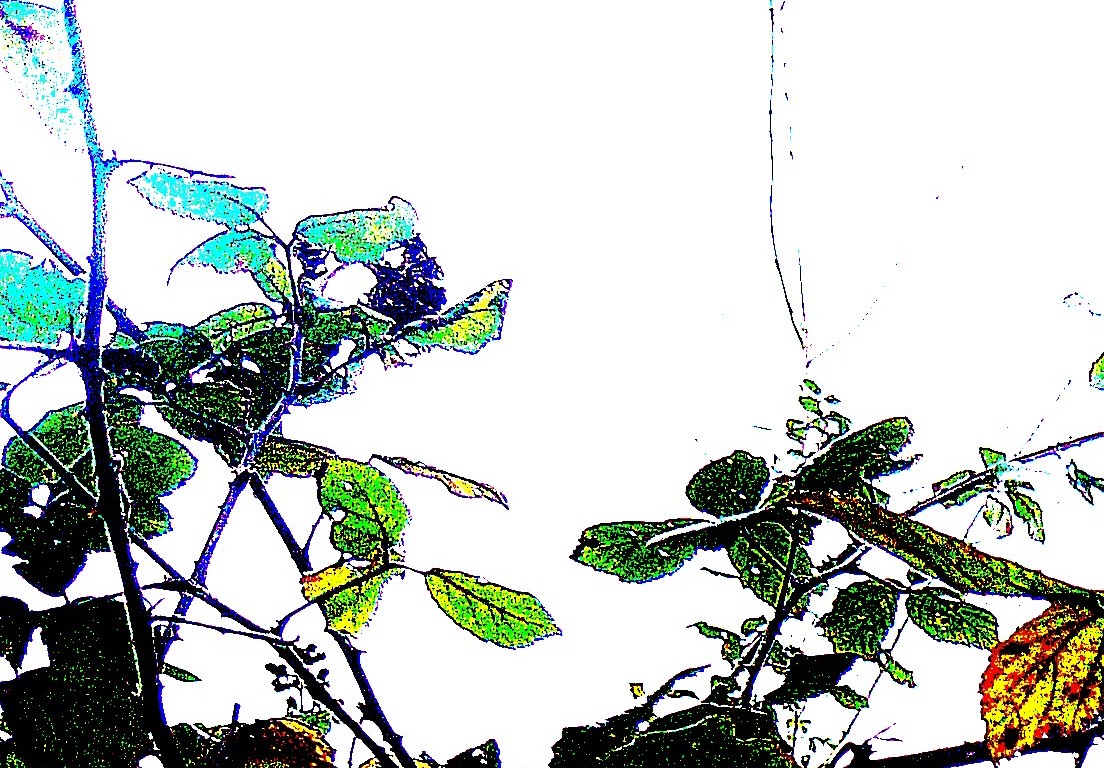
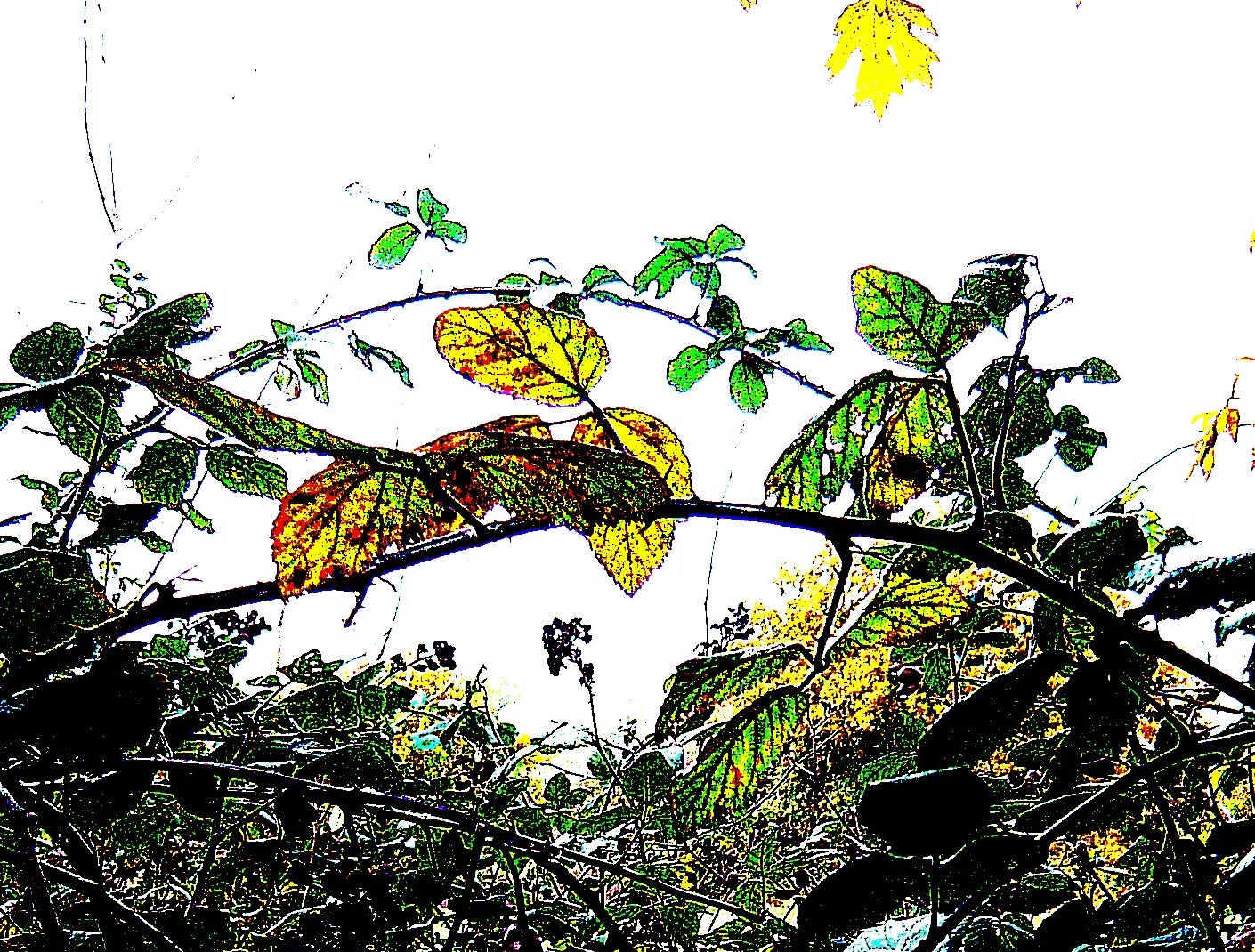
Take one photograph, play around with it a little, create 3 new ones, all different.

Add some autumn haiku, since it’s almost spring.

That was fun.

001b

Yellow maple leaves

Rattling wildly in the wind –

Autumn’s prayer flags


001c

Obsession with time

Is climbing trees in autumn

To get down the leaves.


001d

The last yellow leaf

Hovers above the brambles

Waiting for the wind.

Leaves

This is another standalone poem from my linked series, a work in progress, ‘Breeze’.

So much work in progress! One day, I’ll finish one of these projects, but for now I hope you’ll be satisfied with a few extracts. Unfortunately, I just don’t seem to have a great deal of time at the moment…

Untitled-Grayscale-01

It is like a small dog,

The wind is.

Nosing into corners, and

Snuffling around piles of leaves.

Making them leap up in surprise,

And slowly come back down again.

All a-flutter.


Suspicious of the wind,

They cannot keep still,

But are continually on the move.

Looking this way and that,

And glancing over their shoulders,

Whispering…

Whispering ‘Did you see that?

‘Did you see it?’

Whispering…

Another Creative Art Post

I’ve had a go at woodcarving, too. Would you like to see a few? You would? That’s marvellous.

As if I ever needed an excuse to blow my own trumpet!

003.JPG


The first one is my version of a Sri Lankan carving. This piece consists of two panels; the first one depicting a garuda (a mythical bird who carried the god Vishnu) and the second depicting a lion. It is 10 in x 20 in, and carved in sycamore wood.

004

The second one is also a copy of a Sri Lankan carving, this time an elephant attacked by an eagle. My version is in Ash, and measures roughly 6 in x 3 in.

002

The third piece is a totally different subject; my interpretation of a painting by the American artist Georgia O’Keeffe of oak leaves. I have carved it in -appropriately enough – oak wood, and it measures 7 in by 3 in.

001

Finally, this is my interpretation of a medieval piece from a church in England – I forget which one – depicting the crucifixion of Christ, with Christ flanked by Saint John the Baptist and the Virgin Mary. Again, it is carved in oak wood and measures approximately 8 ins x 13 ins.

Every now and again I think that I would like to work on another carving (possibly one of those two or three unfinished ones I still have hanging around the house!), but we are rather short on space. If I ever manage to get hold of a studio again, I promise myself that I will.