The Night Bus

After a day of faffing and kerfuffle (and a little bad language, but not too much) yesterday, I have posted my new book up on Amazon.

312EjL1fieL._SY346_

The Kindle e-book will be released on 30th November and is available to pre-order now. It will take a few days yet for the paperback edition to be ready, as I need to check through a printed proof first. I’ll post when that is done.

The book is in two parts. A collection of seven short – and not so short – stories, which make up the bulk of the book, followed by a selection of recent poems.

I have always enjoyed travel and, one way or another, nearly every piece in here is to do with travel. The only exceptions are a couple of the poems that seemed to fit in among the others for aesthetic reasons.

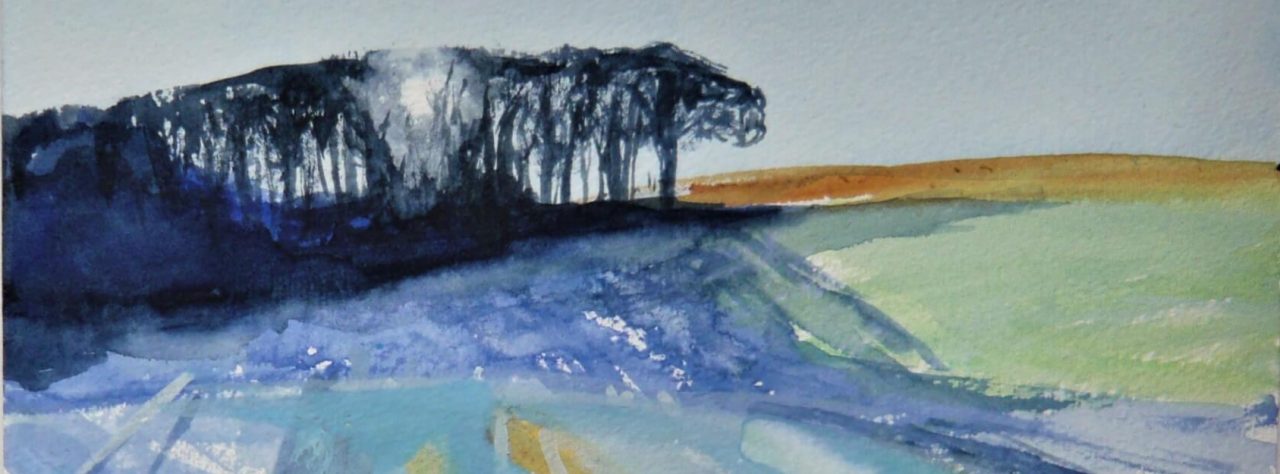
Some of the stories are quite dark, but the majority of the poems have a lighter touch. In these, especially, I hope that my love of the natural world comes through.

Two of the longer stories are set in India; in one, a young man goes in search of a mysterious destiny, while in the other a travelling Englishman becomes embroiled in a chilling disappearance. One story speaks of the support and comradeship of a close-knit island community while another tells of jealous intelligences far older than mankind.

Of the poems, there is one long piece, which gives the title to this collection and tells of a long journey across India and into the mountains and, among others, one short series of poems about the ancient paths and tracks of Britain.

An early piece of writing advice I was given, and for which I am eternally grateful, was ‘Write the stories and poems you want to read’. This I have done, and I hope you will want to read them too.

Review of You beneath Your Skin by Damyanti Biswas

YBYS high res front

First, a disclaimer: I received an Advance Reading Copy of this book with no obligation to post a review.

A psychological crime procedural novel set in Delhi, You Beneath Your Skin quickly paints a vivid picture of the streets, drawing the reader into a dark and desperate world. Although Indian society is divided into the haves and the have-nots more starkly than many, here the two worlds soon collide.

The central character, Anjali, is the divorced mother of a teenaged boy with a form of high-functioning autism that makes him extremely challenging and demanding. She is having a long-term affair with Jatin, who is both the Special Commissioner of Crime in the Delhi Police Force, and the married brother of her best friend, Maya.

Jatin has been charged with investigating a crime supposedly committed by an opposition member of Parliament, but while the government want a conviction, the politician has friends who will pull strings to ensure it is hushed up. The crime under investigation never made clear, but this conflict has resulted in pressure being brought on Jatin to have the case dropped. On top of this, a series of brutal murders are being carried out in the slum areas of Delhi, and although there are elements of the police and the wider establishment who don’t consider them worth investigating, Jatin and his team are determined to track down the perpetrators.

As the tension increases, and the investigations unexpectedly threaten to draw in more of the central characters, one of them is suddenly the victim of an acid attack. And from now on, there are two main storylines, one being the on-going police investigations into the murders, and the other following the victim of the acid attack and the search for reasons and answers to that.

The unfolding storyline, the large cast of different characters and the continuing atmosphere of menace is handled skilfully throughout. Both the brutality both of the criminal underworld and of the police themselves is an ever-present threat, as is both the desperation felt by the poor and the sense of privilege and entitlement by the rich and powerful. And throughout it all, the misogyny intrenched in Indian society overlays everything that happens.

Damyanti Biswas is a Delhiite, writing with the knowledge and authority of someone who knows their area intimately. This a remarkable achievement for a debut novel, powerful and fluent. I was hooked from the beginning, sympathising with the characters and intrigued by the twists and turns of this powerful plot.

Acid attacks are a horrendous phenomenon, scarring and disfiguring, and even killing the victim. I think that many people view them as almost ‘minor’ crimes, and assume that the victim merely suffers a bit of pain and discomfort, and a bit of damage to their skin, but these attacks can inflict injuries as terrible as the burns from fires, and cause almost unbearable pain. Yet partly because of the easy availability of corrosive liquids, they have become almost commonplace in some ways, being used as revenge for perceived slights and ‘dishonours’ as well as for gangland feuds.

This novel, as well as relating an excellent detective story, is also Damyanti’s vehicle to help bring understanding of this horror to the attention of the wider world.

I would certainly give this book five stars.

The Joy of Unknowing (2)

As soon as I had written my last blog post, I thought of this piece I wrote quite a long time ago which offers a similar take on travel and navigation. I am tempted to tidy it up a bit and perhaps update it to mention GPS, but instead I’ll leave it as it is.

Untitled-Grayscale-01

When I was a teenager, I began to use maps, although in rather an ad hoc, hit and miss manner. They were there for me when I was really stuck, or just wanted to know which general direction something lay. It would be a very long time before I began to use them in a careful, detailed way, able to predict the exact lie of the land, navigate in the fog or the dark, find my way through complicated landscapes with the map and compass. And, do you know, since I’ve learned to do that, I feel as though I’ve lost something rather magical, although I don’t suppose that I can blame it all on that. The maps that I was using as a teenager would tend to be the Bartholomew’s touring maps, small scale with little detail. I would feel, as I headed along a Cornish footpath, that I only knew roughly where I was going. It felt like an adventure, an exploration.

Untitled-Grayscale-02

Now, I need to be more and more remote to get that feeling, and even then it does not always work. Having just spent some time in Ladakh, in the Himalaya in the far north of India, I was surprised at just how easy all of my walking was. Setting off with map and compass, I always knew exactly where I was, only confused at times by the multiplicity of tracks criss-crossing the landscape. Even then, reference to mountains and villages with map and compass would invariably allow me to set my position. It doesn’t mean that I wanted to get lost, just that there was a small part of me that said ‘even this is all tame!’ Equally, I can be put off, by using the map, by the knowledge that over the interesting looking ridge that I was heading for, lies a motorway or building estate, and so I spend ages trying to plot a route that I try to get perfect, rather than simply heading off in the direction that I want to go and exploring as I go, correcting my course as I travel.

Nothing can tempt me more than a track leading tantalisingly into the distance, perhaps meandering through Mediterranean scrub towards a notch in the skyline, perhaps leading through a glowing archway of trees. Even now, when using map and compass to navigate, I often have to resist the temptation to ignore the map and head off to follow an interesting looking track. I think that this must be a part of my ‘I wonder what’s over the other side of the hill?’ nature. It is another reason why I’ve never been able to lie on a beach – apart from the fact that it seems a particularly pointless pastime in any case. Any time that I’ve tried it, it never seems to be more than a couple of minutes before I begin to think ‘What’s round the cliff?’ or ‘If I head back up the river, I think I might find a way through those hills.’ And then I just have to go to find out.

Wordy Wednesday 3

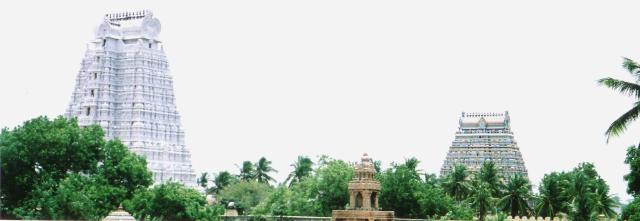
trichy temple 2

Arv’s comments on last week’s Wordy Wednesday post reminded me of some of what stirred my interest in the history of language. Reading about the unexpected discovery in the nineteenth century of the great similarities between words in Sanskrit, the ancient written language of much of the Indian Subcontinent, and words in Ancient Greek and Latin which were a starting point for the study of Linguistics, was something that fascinated me.

The word for ‘father‘, for example, is ‘pita‘ in Sanskrit, and ‘pater‘ in Latin and Greek.

The word for ‘mother‘ is ‘mata‘ in Sanskrit, ‘mater‘ in Latin and ‘meter‘ in Greek.

The word ‘Aryan‘, actually has the meaning of noble or honourable in Sanskrit (arya), which in Latin becomes ‘ariana‘ (holy) and in Ancient Greek ‘areia‘.

And there are other, seemingly more unlikely, connections.

The word for ‘horse‘ is ‘aswa‘ in Sanskrit, and ‘asva‘ in Lithuanian!

Whether the implications behind this are that there was a great mixing of peoples in those days and that different civilisations adopted words from the others, or that all these languages descended from one single, now lost, language in the distant past, can never be known for certain, but the evidence for the latter is extremely strong, especially as the world population was so much smaller then.

Modern research suggests that Sanskrit, spoken by the ancient tribes of India who called themselves ‘Aryans’, entered the Indian subcontinent from the north west, an area both closer to modern day Europe (and its languages) and to the source of the original migration of peoples out of Africa.

Of course, the theory of a single original language puts me in mind of the myth of the Tower of Babel…

My interest was also stirred by a number of similarities I came across when I was travelling or working overseas. One example will suffice:

Cat‘ is ‘chat‘ in French, ‘gato‘ in Spanish and Portuguese ‘katz‘ in German, ‘kot‘ in Polish, ‘kot‘ in Russian and ‘kitta‘ in Arabic.

I think the real significance of these similarities is that when you consider it logically, I don’t suppose that the speakers of all these languages were just waiting for someone to come along and give them a useful word for the furry mouse-catchers they had hanging around their villages and towns. It seems entirely probable that they all contain similar words because all those languages descended from one common source.

And this all leads me to one final thought (deep breath!)…in this ancient, lost, original language of our distant ancestors, we can be fairly certain, for example, that the word for ‘father‘ was something similar to most of its derivatives in use today. As well as the Latin, Greek and Sanskrit examples above, it is ‘padre‘ in Spanish, ‘pere‘ in French, and ‘vater‘ in German.

We may not be able to reconstruct this language (although in the future, who knows?), but we can certainly make a good guess at what a number of its words were, and they were words that most of us are familiar with today.

Leh Old Town

Fourteen years ago I went up to Ladakh, in the Northern Indian Himalaya. Crikey, fourteen years! Where did that go?

025a

This is a painting I made in ink and watercolours of an area of the Old Town of Leh, the Main Town of Ladakh. It shows part of a Buddhist shrine, next to another old building. Most of the buildings are a mixture of stone and wood, the wood frequently carved and / or painted.

Although there were quite a few new buildings in the town, the majority of them were old and the whole town had the feel of belonging to another century. I travelled in early April, before most visitors arrive and when Ladakh is still bitterly cold and wintry – certainly overnight. During the day the temperature just sneaked a little above freezing. This meant that I seemed to be the only Westerner there – I certainly don’t remember seeing any others – and I was never hassled by touts of any description, possibly because it was still too early.

But, above all, the people were among the friendliest I have ever met.

Regretfully, I doubt I’ll get another chance to go there, but it is certainly a very special place!

Picture available on my Etsy shop site here

Wordy Wednesday 2

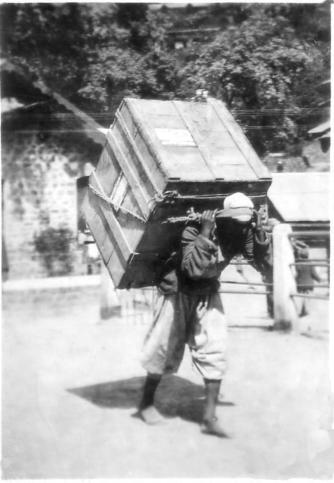
Coolie – now there is a word that is remarkably offensive; offensive not so much because of what it is, but the implications behind it.

coolie 1

The Oxford Dictionary defines the word thus: unskilled native labourer in eastern countries and gives the word’s origin as perhaps from Kuli, an aboriginal tribe of Gujarat, India.

Hobson-Jobson, the 1886 Anglo-Indian Dictionary, has rather more to say upon the matter.

It gives the spelling as ‘cooly’ and the definition as follows: a hired labourer, or burden-carrier; and, in modern days especially, a labourer induced to emigrate from India, or from China, to labour in the plantations of Mauritius, Reunion, or the West Indies, sometimes under circumstances, especially in French colonies, which have brought the cooly’s condition very near to slavery.

It goes on to give further definitions and details of the word, and then makes several suggestions for its origin. One possibility, agreeing with the Oxford Dictionary, is that it derives from Koli, the name of a caste or race in Western India who frequently carried out these tasks and who, the dictionary reports, had long held a reputation for ‘savagery, filth and general degredation.’ This would make its origin analogous to that of slave, which is presumed to come from the racial term Slav.

But it suggests the waters are rather muddied by a couple of similar words in the Sub-continent: In Southern India a Tamil word Kuli signifying ‘hire’, and Khol is a Tibetan word for slave.

And then there is also a Turkish word kol meaning a slave while, more specifically, kuleh  means ‘a male slave, a bondsman’.

But back to the implication. It is impossible to get away from the colonial undercurrents with this word, as brought out in the Hobson-Jobson definition above. So to use the word to describe a person or persons today, is to call them a servant or slave of a foreign overlord.

Bihari Door

I paint quite a few doors – they are a favourite subject of mine. Although if you mention that to my wife, she will sniff ‘You’re joking! I can’t even get him to paint a shelf!’

bihari door

Bihari Door – Acrylic on canvas, 18ins x 24ins.


Pictures available on my Etsy shop site here

Wordy Wednesday 1

Many bloggers post photographs on Wednesday under the heading ‘Wordless Wednesday’. Me? I’m going to write a few posts about words – specifically words in English borrowed from languages of the Indian Subcontinent.

I’m just plain awkward, but you knew that, didn’t you?

I am currently editing the first draft of my novel A Good Place, which is set in a hill station in Northern India. And in that hill station live a number of English who remained behind after Partition.

‘I’m sitting on the veranda of the bungalow in my pyjamas.’ Well, no, no one says that in my book. But if they had, what is the significance of that sentence?

The significance is the number of words borrowed from Indian languages.

Untitled-Grayscale-03

Veranda is an Indian word, but coming originally, perhaps, from Persian. The Oxford Dictionary suggests two derivatives, either from the Hindi (varanda) or from the Portuguese (varanda). Digging a little deeper, if I refer to Hobson-Jobson, the Anglo-Indian Dictionary that was published in 1886 and traces pretty well every word or phrase borrowed from the Sub-Continent, I discover a very long entry on this word. It begins by dismissing the possibility of it being derived from the Persian beramada, and goes on to state that it appears to exist independently in both Hindi, and in Portuguese (and Spanish). It then traces the possible routes the word might have taken to reach the English language, before then saying, surprisingly, that it could have its roots in the Persian after all. This seems quite likely to me, since many Persian words made their way to India especially with the Mughals, and it suggests a possible route to the Spanish peninsular when the Islamic armies arrived in the early eighth century.

I tried typing it into Ngram Viewer. This is an online tool that searches through the entire database of books that Google can access online (including ones still under copyright) published since 1800. Looking at the results for all books in English, it tells me it was barely used in 1800, although it does exist, rises steadily to a peak about 1910, and then falls away slowly, although it is still in common usage. Unfortunately Ngram has not been set up to search books in Indian languages, or even Portuguese. I tried Spanish and the pattern was similar, except that after peaking just before 1910 , it dropped sharply, but since then the trend has been upwards. I then noticed something. I had actually looked at the trend in American English. So I then tried British English, and this gave me a rather different pattern; The curve rose gradually until it peaked in the 1950’s and then fell away sharply. Why? I think it must be due to a surge of historical / biographical / nostalgic writing, both fiction and non-fiction, after the British left India.

Don’t worry, I’m not going to try to go into that sort of detail with other words.

Next, bungalow actually refers to a ‘Bengal style’ house (often with a veranda!) that the British frequently chose to live in.

And pyjamas are loose cotton trousers worn in India which were ‘adapted’ for night wear by Europeans.

Okay, class, lesson over. Be sure to wash your hands before eating your snacks (samosas and pakoras today, of course).

Review of An Atlas of Impossible Longing

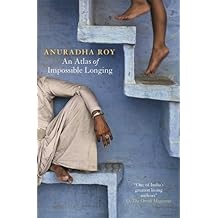
An Atlas of Impossible Longing

A year ago I read The Folded Earth, Anuradha Roy’s second novel, and decided it was so good I would have to read all of the others. And so recently I finished her first book, An Atlas of Impossible Longing. In this, Anuradha Roy tells the story of three generations of a family who have moved from Calcutta to live in a huge, rambling mansion in Songarh, a small town in the hills of Bengal.

Amulya’s wife, Kananbala, hates the isolation of the town, with its lack of fashionable shops and social life, and longs to return to Calcutta. Their oldest son, Kamal, longs for children, and his youngest, Nirmal, is widowed and longs for his unmarried cousin.

Everyone appears to long for something that proves unattainable, and at the centre of the story are two children, thrown together by chance circumstance and then separated by the cultural fears of adults, but who have formed an unbreakable bond that endures through years of separation.

Mukunda is an orphan of unknown caste adopted by the family, and his only companion is Bakul, daughter of Nirmal. They pass their time playing in the grounds of their home or in the woods and fields around the town.

As Bakul and Mukunda grow towards adulthood, their friendship slowly begins to become something more, and Mukunda is sent away to Calcutta by the family, suddenly fearful of the consequences of this.

As the years pass, Mukunda graduates from college and becomes prosperous, even through the years of Partition, without ever returning to see the family who raised him, although he thinks frequently of Bakul. But then chance sends him to Songarh, and he realises he must find out what has happened to her.

The pace of this book is deceptively languid, but this enables Roy to paint the characters and settings in exquisite detail, and for the plot to unfold at an easily assimilable rate.

I feel you always gain more from re-reading a book, and I am longing to do this, to immerse myself again in the rich landscape and characters Roy has created.

Most definitely a five star read.

Seven Cities of Delhi by Rajiv Chopra


001

On my first visit to Delhi, almost thirty years ago, I was overwhelmed by the huge numbers of monuments there, such as the Red Fort and Purana Qila. I found the area around Paharganj to be chaotic and exciting and everything an inquisitive Westerner could wish for – a mixture of smells of food and incense and, yes, sewage. A mixture of ugly concrete buildings and beautiful dilapidated buildings left over from the British Raj and often much earlier. Milling crowds of people and cows and rickshaws and bicycles and autos, and history, history, history.

Chadni Chowk was incredibly crowded, the Lodi Gardens completely deserted. The Jama Masjid crowded by tourists and worshippers alike, the Janta Manta often almost empty.

There is so much history everywhere you turn in Delhi.

Other Westerners I met tended to be highly disparaging of Delhi, which was something I couldn’t completely understand since many of these same Westerners seemed to praise Mumbai and Kolkata for the very reasons they hated Delhi.

Yet Delhi is, I think, one of the most exciting and interesting cities I have ever visited. From a historical viewpoint alone, it has over ten thousand listed monuments.

Ten thousand!

Rajiv Chopra is a Delhi based photographer with a passion for recording both the historical Delhi and the street life he comes across from day to day. In this book, he has combined his photographs with a little of the history of the seven historical cities that constitute Delhi, and also a perspective of the differing processes that photography has passed through from its invention up to the present day.

To illustrate all these factors, his book is split into seven sections – one for each of the historical periods – and in each section he has outlined one of these photographic processes so that, for example, in the section covering the first city, Mehrauli, he speaks of daguerrotypes. And then his own photographs he processes through Photoshop to simulate the effects of these processes.

This is not a long book, but it does not pretend to do more than act as an introduction to the history of Delhi. And in this it certainly whets the appetite for more, and then for anyone with even a passing interest in photography it gives a concise and potted description of these photographic processes. Finally the photographs themselves complement the text perfectly.

I unhesitatingly recommend this book for anyone who wants to know a little of the history of Delhi, and who enjoys photographs that give a real flavour of the history of that magnificent city.

Five stars out of five.

You can find Rajiv’s website and blog here